Wedding Music Part I: Can we dance the Foxtrot to our song?

When did you first learn to dance?

How can music4dance.net help?

Let’s assume for a moment that your special song is “Fever” by Ray Charles.  Here’s what you do:
song-menu-annotated

  1. Go to the music4dance web site (https://www.music4dance.net).
  2. Choose Music->Songs from the menu at the top of the site by first clicking on Music (A) then on Songs (B).
  3. Type “Fever” (without the quotes) into the search box (C).
  4. Click on the search button (D).
  5. The Ray Charles and Natalie Cole version of “Fever” should show up near the top of the list (E), if not try sorting by Artist by clicking on the Artist column header (F).
  6. The row already shows you some suggested dance styles in the dance column (G) including Foxtrot and Swing.  And you can see that others have tagged (H) this as a good Wedding and First Dance song.
  7. The play button (I)  will give you a list of music streaming and purchase options, which at minimum will let you listen to 30 seconds for free to make sure this is the song you were thinking of at if you’re subscribed to one of the services like Spotify or Groove, you can listen to the entire song.
  8. You can click on the title link (J) to get even more details including albums that contain this song.

fever-annotated
Hope that helps.  If you can’t find your song in our catalog, let me know what it is by commenting on this thread and I’ll see if I can add it.

Next time I’ll walk you through the other direction – starting with a dance that you know and finding music that others have identified as good First Dance songs for that style of dance.

Documentation for the song list

I have resisted writing any real documentation for the music4dance website as it is evolving quickly enough that keeping up with the changes will be difficult.  But I did some user testing on several of the key features of the site and they just aren’t self documenting yet.   So while I will continue to work on the features to make them as intuitive as I can and reduce the need for documentation, for now documentation seems to be an essential feature.

The first thing that I’ve documented is the use of the songs list.  Please take a look and let me know what you think.

The “Dancing with the Stars” solution

I learned to dance in part because Dirty Dancing made me want to be Johnny Castle.  Or at least dance like him. And my first dance partner was similarly moved by Strictly Ballroom.  These days So You Think You Can Dance and Dancing With the Stars are both inspirations for aspiring dancers.

Since one of my goals with the music4dance project is to build a catalog of music that inspires you to dance, it seems appropriate to make sure I’m folding in the songs that the choreographers from these shows have found inspiring.  I’ve started by adding in the songs from (season 20) of Dancing with the Stars since that is currently airing.

All of the Dancing with the Stars songs that I’ve cataloged can be found at this link.  You can refine your search to a particular episode by clicking on the episode number and choosing to include that episode.

One fun side effect of this is that you can click play on the Spotify Player at the bottom of the page and play all of the songs from an episode (or you can follow the individual links to iTunes or Amazon to purchase the songs). Here’s an example of the spotify player for DWTS Season 20, Episode 1:

What other movies and shows have inspired you to dance?  Did they include specific songs that really make you want to get up and move?

Before you go, I’m continuing to gather data on how people group dance styles and would appreciate your input.  More information about that is available in this post.  Or just go directly to the survey.

Help: How would you group this dance style?

One of the fun things about learning more about different dance styles is that you start to see patterns in how one style evolves into another and how a dance style will move from one tradition to another, be transformed and possibly take on another name (or not). I have all kinds of crazy ideas about how to represent that information as you browse through songs searching for something that inspires you to dance or choreograph or to just throw into a practice play-list.

But not all of those ideas are feasible and even the feasible ideas will take some time to implement. So in the meantime I’d like to take a small slice of one of those ideas and get your input on how you categorize dances. I’ve set up a small survey that allows you to sort names of dance styles into groups. I’ve named some groups to start you off, but you’re welcome to change things up in any way that makes sense to you.

There is no right way to do this. It’s essential to get input from people with all different kinds of dance knowledge, all the way from those with professional training to those whose main exposure to dance is through television and movies. The tool I’m using only allows you to put any given dance into one group, so just choose the group that you most associate with the dance. I’ve intentionally started with group titles that include both names that some dancers may be familiar with and pop culture references. Use and extend whichever system makes sense to you by creating new groups or use a combination of both if that is what works for you. Remember, I’m just looking for patterns in how people think about grouping dances, so don’t spend too much time on this, just throw things where they make the most sense to you.

Thanks in advance for taking a few minutes to try this exercise. Here is the link: https://conceptcodify.com/studies/II5fJIxuQOzjSEB3fMLCCA7b/via/98u3CehK9xmYMwaWE2K7OYCp/
This is an open survey, so please pass this link along to your friends.

The Pink Martini Solution

Not all artists are created equal when it comes to creating dance-able music.  For instance, one of my favorite artists of all time is John Coltrane.  Do you see him well represented in the music4dance catalog?  Absolutely not.   Because a consistent tempo just isn’t a core part of his music.  Which is part of the appeal when listening, but doesn’t work particularly well when trying to Lindy Hop.

Towards the opposite end of the spectrum, sits Pink Martini.  They are a band that plays a combination of original works and updated covers of classic melodies.  Many of both types of song are in a musical style that co-evolved with a partner dance.  Take “Let’s Never Stop Falling In Love“, which is a classic Tango if I ever did hear one, but still has the unique Pink Martini flare.  Or “Amado Mio“, which has a extremely dance-able Rumba beat.  And don’t forget “Hang On Little Tomato“, a wonderful Foxtrot as long as you can dance through the lyrics without cracking up, or possibly tearing up.  That little tomato has quite a challenge ahead of him!  And if you are up for a challenge yourself, try to West Coast Swing to “Hey Eugene” while keeping a straight face.

Pink Martini’s catalog is both broad and deep and most of their songs are well suited to partner dances.  Check them out on music4dance.net and if you like what you hear, let me know and I’ll catalog some more of their songs.

Question 2: What dance styles can I dance to my favorite song(s)?

Again, I rephrased the question from my original post.

One of the things that amazes me about the best dance teachers I know is that they seem to do this matching instinctively.  They hear the first bar or two of a song and immediately know which dance(s) to dance.  I imagine “instinct” in this case is some combination of natural talent, many hours of practice and the amount of time that they spend listening to music and thinking about how it fits with dance.

After dancing for 20 years, I have something of this sense myself, but being a techie first and a dancer second I feel compelled to break it down a bit more.

There are two sub-questions here; let’s call them 2a and 2b.

Question 2a: “Does the style of music match the style of dance?” This is very much about the general feel of the music – so salsa music sounds like music that you would want to salsa to and swing music sounds like music that you would want to swing to.  But it’s also about the rhythm.  The most straightforward example of this is Waltz, where the three-count rhythm is very distinctive.  Conveniently, every partner dance that you can dance to three-count rhythm has waltz in its name.  There are more subtle variations on this concept: Cha Cha music has a distinct “4 and 1 (or cha cha cha)” emphasis that makes it feel like a cha cha, mambo music sounds a lot like salsa, but with emphasis on the second beat, and there is something called “Swing Rhythm” that distinguishes swing music from other kinds of music. And the list goes on.  I don’t have a great idea for a tool to help with this, but I’m considering writing a more in-depth series on how this relationship works.  So if you’re interested please let me know and I’ll move that up my to-do list.

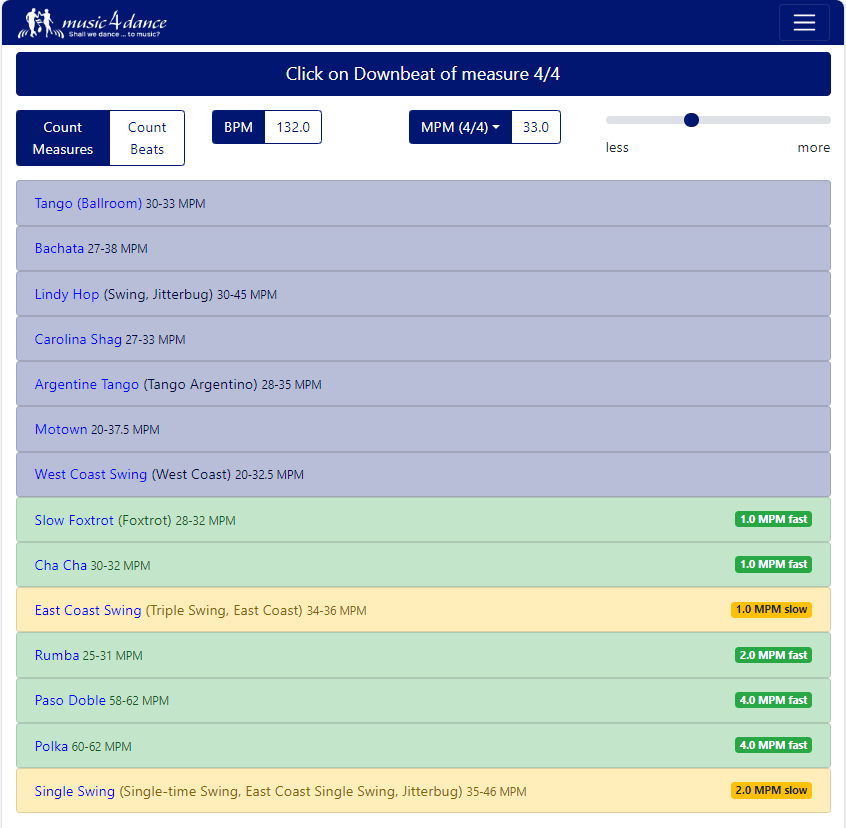
Question 2b: “Does the tempo (speed) of the music work for the dance?”   Swing is a great example since there are a whole bunch of different dances that can be danced to music that is in the swing style, but they are each danced at  a different tempo.  For example, West Coast Swing is best danced between 28 and 32 measures per minute (MPM), East Coast Swing between 34 and 36 MPM and Jive between 38 and 44 MPM.  I’m building a web application  that at least partially solves this problem.

With this app. you can count out a few measures by clicking the count button on the first beat of each measure and it will not only show you what the tempo is, but also suggest a number of dances that will “work” for this tempo.  Pretty slick, no?  What would you add to this to make it more useful?

Question 1: I’m learning to Cha Cha, where is some great music for practicing?

Okay, so that’s a slight rephrasing of the question from my previous post.  But it sticks to the spirit of the idea.  As a dancer learning a specific new dance, be it Cha Cha, Paso Doble or Waltz, where can I find music?

So how do I do that?  Dance generally co-evolves with music, so to get a very traditional song for any dance, it’s usually easy to find a source.  If you like swing dancing, Benny Goodman is a great source or if you like to waltz Strauss is always available.  However, if you’re trying to learn a number of dances at about the same time or if you’ve got taste in music that is more modern than the traditional music that the dance evolved with, this starts to get confusing.

It’s also often the case that some of the most interesting choreography to traditional ballroom dances is performed to music that is entirely different than the style that it evolved with.  A recent example of this is Jean Marc Genereux’s Paso Doble1 on  So You Think You Can Dance Season 11, choreographed to Rob Zombie’s Dragula.

In any case, there are of course as many ways to answer the question at hand as there are dancers.  From my perspective, one way to go about finding dances to Cha Cha to is to it to go ask the internets.

Well, I’ve done internet searches on various dance styles a number of times over the years. I’ve combined the results along with some songs from my personal catalog.  I’ve done a bunch of merging, cleaning up and matching to four of the major music service (Goove®, Amazon® , iTunes® and Spotify®) and the result is the dances page on the site.

What do you think?  Would you use the music4dance dances page now?  What features would you need to make this something you would use? What would make this into a site that you couldn’t live without?

  1. When I originally wrote this post I was able to link to the episode on fox.com. That has since disappeared, so I removed the link. I would like to take this opportunity to express my disappointment that there is no way I can find (even via paid subscriptions) to access back episodes of this show. I’m assuming it has to do with rights (probably especially rights to the music), but it’s still quite frustrating. ↩︎

The Two Questions that Inspired Music4Dance

As a beginning ballroom dancer there were two questions that kept coming up:

  1. What are some songs that I could play to practice the dance that I’m currently learning?
  2. Which dance style(s) can I dance to this song that I’m currently listening to? For instance, would this work for a Cha Cha or an East Coast Swing?

The dances page on the site is the beginning of an answer to question #1.

Dances
A partial snapshot of the Dance Style page from music4dance as of January 22nd, 2024

And, the counter page is the beginning of an answer to question #2.

music4dance beat counter
Snapshot of the beat counter/dance finder as of January 22nd, 2024

Which of these questions is most important to you? Or what other questions are more important to you?

If you’re a dancer or teacher, what are the questions you ask?

Where to Start?

I’ve been spinning my wheels a bit with respect to this blog. It is much easier for me to write code than to write prose, but I realize that for anyone to see what I’ve been doing coding-wise, I need to start publicizing it. And one of the ways to do that is to start blogging about it. I had some grand ambitions to try to set up categories and start writing tutorials about the relationship between music and dance and have a bunch of thoughts around both those things, but nothing has quite gelled. Meanwhile, I’m continuing to spend time coding and cataloging.

So I’m going to go back to my original intention of writing small posts about what I’m currently thinking about, as well as doing a bit of catch up about what I’ve been doing with the main site and I’ll let you vote with your comments about what you want to see both on the blog/documentation and with the site and its features.

Do you think this post is small enough?

Introducing the music4dance Blog

I’m an amateur dancer with some training in music who also happens to be a professional software engineer. I love dancing, and I particularly love dancing when I enjoy the music that I’m dancing to. This blog will be about my journey in trying to build a technical solution to this problem. I’m hoping to build some community around this idea since music and dance are both so personal that multiple viewpoints early will be essential to any kind of success in this area.

I’m hoping to keep this blog in the short and frequent post format and may start building more article-like content alongside it. So please hop on over to my about page for a bit more detail, visit my alpha music catalog site, poke around, and let me know what you think.