Tag Archives: Voting

Enhanced Feature: Editing Tempos and Deleting Tags

Based on some of the comments on my last post, I’ve been thinking more about my early decisions concerning who can edit various aspects of a song in the music4dance catalog. I was worried that malicious actors would mess with the data, and spent considerable time designing and implementing a system that lets me roll back all edits for a specific user if I find they’re up to no good.

Oddly, I have had to spend significant energy dealing with bad actors who have been attempting to hack the site. But they’re all about things that have absolutely nothing to do with the music and dance data. I haven’t once had to back out dance votes by someone trying to break the system. I think I was overly influenced by stories about moderating issues on Wikipedia (which was relatively new at the time), and by my personal history with programmers fighting over whether three or four spaces is the “right” number to represent a tab in C.

And in my defense, dancers are often very opinionated about the definitions of dances and what is “appropriate” music to dance them to (e.g. Why is the tempo range you list for West Coast Swing wrong? and Why are the tempos that music4dance lists for Salsa wrong?). But most of what I see in those cases are angry emails about how I’ve gotten it wrong.

In the spirit of assuming that the members of the community are well-intentioned and knowledgeable (or at least self-assess well as to the limits of their knowledge), I’ve changed a couple of things about the Dance Details pages.

Tempo Editing

Some time ago, I started preferring human tempo edits over algorithmic ones. But I was only allowing a few vetted moderators to edit tempos. I’ve now opened tempo editing up to all registered users. So if you see a tempo that doesn’t make sense for a song, please go to the Song Details page (generally by clicking on the song title in search results or lists) and click the pencil icon next to the tempo. That will put the song into edit mode, and you should be able to edit the tempo. Don’t forget to save when you’re done!

If you are signed in and don’t see the pencil icon next to the tempo, it is probably because I, or another user, has already manually edited the tempo. You can generally tell this is the case by looking at the changes section in song details. If this happens frequently, I’ll consider building a moderation system of some kind, but in the meantime, please just contact me with your thoughts on the tempo and why, and we can work it out.

One special case the system can’t handle yet is when two very different dances can be danced to the same song at different tempos. I’m getting close to pulling the trigger on a solution for that, so if you come across any of these, please let me know – the more examples I have, the more general I’ll be able to make the solution.

Tag Deletion

Another attribute of song editing that’s only been accessible to select moderators in the past is the ability to delete tags created by other users. But, like tempo, the algorithms sometimes get the meter wrong (labeling something as 4/4 that should be 3/4, or vice versa). I’m also not thrilled about how broadly musical genres are applied, so I’d be happy if anyone would be willing to go in and trim some of those down. Again, generally, I’m going to assume that a discerning human user will do a better job than the algorithm. I’m also limiting this feature to deleting algorithmically created tags, not tags created by another user, for reasons similar to the Tempo Editing feature.

In order to remove tags, just click on the pencil icon at the end of the tag list on the Song Details page. The single list of tags will split into two lists, one labeled “Remove Tags.” This list contains the tags that you’ve added + the algorithmically generated tags. Clicking on the (x) icon in the tag will remove it. Again, don’t forget to save. And again, if you don’t see a tag in the Remove list that you expect, it’s probably because another user, not an algorithm, added the tag. You should be able to confirm this by looking at the changes section. Please contact me in such cases, and I’ll resolve them manually.

Step of the Month:

As I noted previously, I’ve traditionally closed out these posts with a generic ask to check out the contributions page and to please send feedback on anything in the post or your general thoughts. That’s been less effective than I like, so I’m pivoting. Each month, I’ll choose one specific ask that may or may not be on the contributions page lists, but would really help keep music4dance and the community strong. I’ve decided to call this section “Step of the Month” – a play on dance steps and steps to help – and see if that gets a response. If the response is to hold your nose and run away from plays on words, please let me know that, too.

The “Step of the Month” for April is to vote on songs that you like to dance to. This will make the catalog more useful for everyone.

Thanks, everyone, for your continued support.

What Happens When a Song is Danced at Different Tempos?

Sometimes, a song can be a perfectly good Bolero when heard one way but a Salsa when counting the music differently. Another example is Slow Dance (Castle Foxtrot) vs. Lindy Hop. Generally, this phenomenon is because, with some music, it’s easy to count what the musicians see as either a half note or a quarter…

Is music4dance becoming too popular?

I first published music4dance in 2013 and, within a year or so, started seeing traffic measurable in the thousands of active users per month. Usage plateaued there for over a decade, but last year, the numbers started climbing rapidly – into ranges better measured in tens of thousands. Now these are very rough measures from…

Song Details

The music4dance song details page contains all of the information that we have gathered about a song, including tags and dances that you have may have added. Below is a snapshot of a song details page for “(I’ve Had) The Time of My Life” as seen by a user “Charlie” while he is editing it.…

Please help us catalog new music

A Swing Band leader (Glenn Crytzer) reached out to me recently, asking if it would be possible to add his entire catalog to the music4dance.net database. He found a few of his songs already listed, but has a published catalog of well over a hundred songs, most of which should be danceable to partner dances (mostly Swing variations).

Glenn graciously provided me with a spreadsheet of his music, and I was able to upload it to music4dance. This was particularly nice because I could include his data on tempo and genre tags, as well as some other miscellaneous metadata from his comments that I turned into tags. But that led me to the next issue – his data didn’t include anything about which dance or dances would be particularly suitable for each of the songs. Which is entirely reasonable, he’s not actually dancing to them, and most of them would work for a generic swing night – the dancers can choose to dance Lindy, Balboa, East Coast, or something else to any particular song. Although that’s a vast over-simplification, if you’re interested in how a musician thinks about these things, Glenn’s article On Programming an Original Swing Music Album is an illuminating read.

That leaves me in a bit of a bind. I can certainly go through the 100+ songs myself and vote on which dances work for those songs, and I probably will. But I dance East and West Coast Swing and a bit of Lindy and Charleston – oh, and a bit of Slow Foxtrot, as Foxtrot and Swing music overlap – so I’m not familiar enough with some of the other dances to say whether a song would be suitable for Balboa, Jump Swing, Quickstep, etc. And more importantly, even with the dances I do know well, I’m only one opinion. Music4dance works much better when others in the community contribute by voting on dances that they are familiar with for songs in the catalog.

That line of reasoning led me down the path that I’ve considered several times before, of unlocking premium membership for free for members who vote on dances. I’ve thought and rejected several complex mechanisms to enable this. While some of them seem plausible, I don’t want to spend time writing code until I prove that there are enough members of the music4dance community willing to participate to make it worth my while.

Something about the interaction with Glenn and the thought that I’d love to get his songs showing up with associated dances sooner rather than later made me look at the problem a little differently. What if I went the low-tech/high-trust method of giving out premium memberships to anyone who committed to voting on a certain number of songs per month? I wouldn’t have to write any code at all for that, and if enough people take me up on it to make manual management of the “feature” cumbersome, I can always write the code later. That will also let me play with the parameters without building a whole dashboard of knobs and dials.

The Offer:

If you are familiar enough with at least one dance to confidently listen to an arbitrary song and say, “I would dance that dance to the song,” and are willing to spend some time each month doing that on the music4dance website, I’ll extend you a premium membership for each month that you do. Furthermore, I’ll take your word for it and give you the premium membership ahead of time. That will let you look at songs that no one has voted on yet (which is essential for things like the Glenn Crytzer catalog – at least until someone has voted on a song). To make this somewhat measurable on my end, let’s set the number of votes at 50 per month to keep your premium membership going. I’ll reserve the right to change the parameters at any time, including cancelling the program, since this is an experiment. But at minimum, if you contact me to try this out, you’ll get the first month of premium free, and I won’t turn that off before the end of the first month unless I detect you doing something malicious.

Why should you care about a premium account? In this case, it allows you access to more songs, including songs that no one has voted on yet and songs that I’ve pulled in from someone’s list of danceable songs but haven’t matched to a music catalog. With a premium account, ad content is turned off, and you can export results of your searches to Spotify – see details here.

Musicians (a quick aside):

Before I get into the nitty-gritty details of how to take me up on this offer, let me take a moment to reach out to other musicians who would perform music suitable for partner dancers. If you are interested in having me bulk upload your catalog to music4dance, please contact me, and I’d be happy to do that.

Here’s how to go about taking me up on my offer:

  • Create an account on music4dance.net here if you don’t have one already. (Account management help)
  • Email me at info@music4dance.net from the email you used to create your music4dance account and include “I’d like to Help Cataloging Music” in the title. Feel free to include any other details you’d like to share or questions about the offer in the email. I read everything that I get.
  • I expect to be able to upgrade your account and respond to your email within forty-eight hours (but this is an intention, not a commitment – read the notes above about this being an experiment) – if you haven’t heard from me in that timeframe, please try again.
  • Read the information about Dance Tags to understand how to vote.
  • Start voting!

This offer is for voting on dances, not for clicking the like button on songs. The latter is a feature that helps you organize your use of the music4dance catalog, but doesn’t do much for other users, so I’d like to focus on the core music-to-dance relationship of the voting mechanism for this offer.

Useful links:

What if you want to support music4dance but don’t have either the time or the experience to catalog songs by dance? There are plenty of other ways to contribute, as described on our “Contribute” page.

New Feature: Searching on songs with a minimum number of dance votes

Several folks have been frustrated with the number of songs in the music4dance catalog that only have one or two votes for a particular dance style. This limitation doesn’t matter for many searches because you can sort by dance votes, and the most popular songs end up at the top.

But if you want to sort by something else, such as tempo or date modified, you’re out of luck. That is until now.

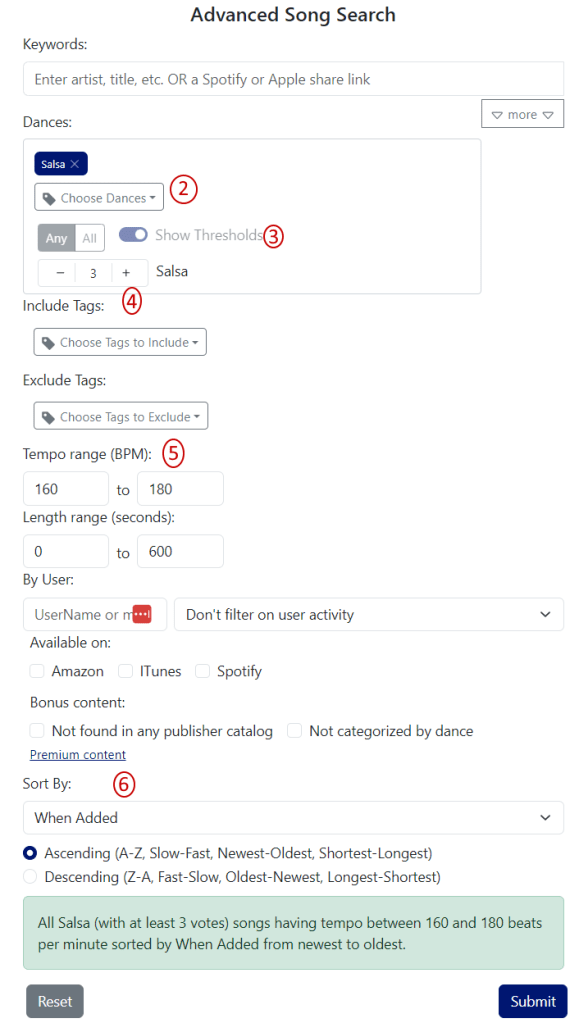
I’ve added a feature in advanced search that enhances the ability to filter by dance. Previously, you could filter only on whether a song had a net of at least one vote for a dance style. Now, you can filter on any threshold. So, if I want to create a list of all songs with at least three votes (net) between 160 and 180 beats per measure sorted by date added, I can do that now.

Here’s how:

  1. Go to Advanced Search
  2. Choose Salsa in the Dance filter
  3. Click on Show Thresholds
  4. Click on the “+” next to Salsa twice to increase the threshold to 3
  5. Change the tempo range to 160-180
  6. Choose “When Added” for the “Sort By” field
Advanced Search with Dance Thresholds
Advanced Search with Dance Thresholds example

Let me know what you think. Are there other ways you would use this kind of filter? Is there any reason to filter out the most voted for songs? That’s certainly possible, but I didn’t see a use case for that.

In addition to the specific ask above, I’m always happy to hear ideas about this post or the site by commenting below or using other feedback mechanisms listed here. And if you enjoy the site or the blog (or both), please consider contributing in whatever way makes sense for you.

We’d like to dance a “real” partner dance as the first dance at our wedding (Part I: We already chose our song)

Wedding season is upon us, and one of the things that come with weddings is receptions with first dancesfather/daughter dancesmother/son dancesmother/daughter dances, and any other variation you can think of. I think it’s extra special when those dances are recognizably partner dances like FoxtrotRumba, or Swing. Of course, I have a bit of a bias.

If you want to find a dance that fits the song you love, here are some things that can help. In my next post, I’ll cover the other direction – finding a song to fit your dance.

First, consider visiting your local dance studio and asking a professional. The other professional that could help is your wedding DJ; sometimes, they are also dance teachers or at least know a dance teacher to connect you with.

In tandem with going to a professional, some features of music4dance.net can help. The first is to try searching for your song – you can type the title into the search box in the menu bar or on the Song Library page. If it’s a particularly popular song, you might also include the artist to see if you can get to the specific version of the song. But oftentimes, variations on a song by different artists still maintain enough of the same characteristics to be danced to the same dance. So be creative in your search and see what you come up with.

For example, try typing “Fly me to the moon” into the search bar – including the quotes to get songs with that full title rather than all the songs with those keywords. And we’re probably most interested in the Frank Sinatra version, so scroll down to that or add Sinatra (outside of the quotes) to the search.

You can already see which dances folks in the music4dance community have voted on to dance to this song. There is quite a spectrum. If you click on the song title, you will get more details. Among other things that will show you that Slow Foxtrot is the most-voted dance for this song, some folks have voted for East Coast Swing and Jive but have noted that it’s slow for those dances. That’s not necessarily bad; you could speed up the song a bit (modern technology is fantastic) and get it to something still slow for ECS but not crazy slow – which might be just the right tempo for a first dance.

But what if you can’t find the song in the music4dance catalog? There is another tool that can provide some help. Try looking at the tempo counter tool (and its help page). Counting out the song’s tempo in this tool will show you which dances can technically be danced to the song. The tempo counter result doesn’t tell you anything about if the style of the song fits the dance. But this is also pretty interesting because if you’re going to go all the way and choreograph a first dance, sometimes doing something that’s a little out of a stylistic mismatch can be pretty effective. Choreographing a dance to a song that doesn’t quite fit is frequently done with showcase dances like those you see on Dancing with the Stars and can be very effective in creating a memorable wedding dance.

I hope this helped and that you really enjoy your first dance, not to mention the rest of your wedding and reception.

If you used the second method I mentioned or the help of a professional to find a song/dance combination for any of your wedding dances, please consider becoming part of the music4dance community and adding your wedding songs to the catalog.

As always, I’m very interested in your feedback, so please share any thoughts and ideas about this post or the site by commenting below or using other feedback mechanisms listed here. In addition, if you enjoy the site or the blog (or both), please consider contributing in whatever way makes sense for you.

P.S. This is a reboot of a very early blog post I wrote in 2015. Since the site has been through a couple of significant over-hauls since I wrote the first pair of wedding music posts, I think it’s worthwhile revisiting them. I may end up doing a more systematic rewrite. In that case, I’ll try to figure out a better way to index the posts to remove duplicates and/or make the fresher content pop up ahead of the old content.

Ask music4dance: Why am I listed as Anonymous?

A few months ago I started working on a set of features with the goal of making music4dance more personalized.  This includes the ability to add new songs to the catalog, to see who else likes to dance specific styles to a song, and more. As I was working on this I realized that almost all members of the music4dance community have chosen the privacy setting to not share their profile. This was the default setting, so it shouldn’t have come as a surprise.  While the features that I’ve written so far don’t even give one the ability to write a profile, I want to be as respectful as possible with everyone’s privacy and not show user names anywhere for members who had opted for privacy.  This is especially true because many members have chosen to use what appears to be their full name as their user name.

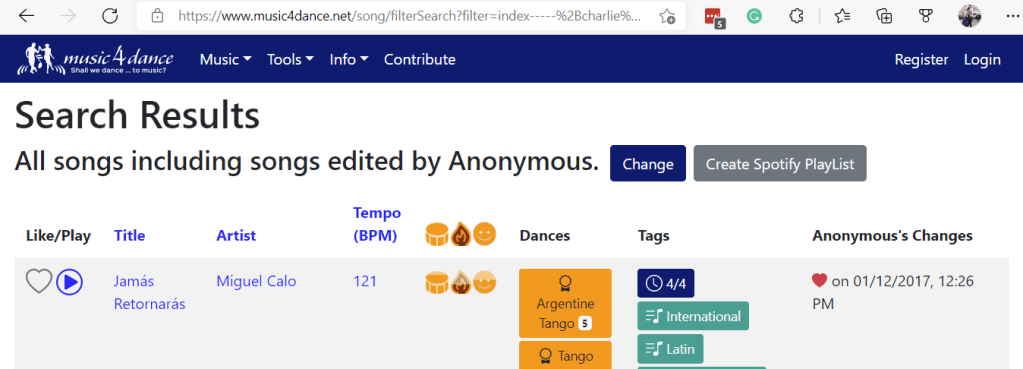
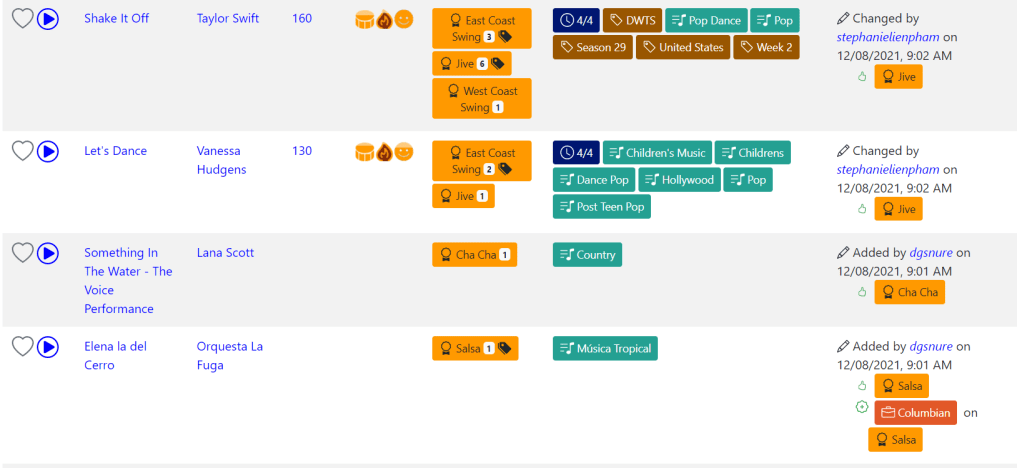
So I did some work to make sure that anyone who had chosen that setting is protected by not showing their name, and instead I use the single “Anonymous” moniker.  I’m still tracking who those users are by means of a randomly generated number, but other visitors to the site will only see the user as “Anonymous”.  That is even the case if you send a link to your songs to a friend.  For instance, I’ve marked my test user “Charlie” as not wanting to share his profile, so if I’m logged on as Charlie and look at a list of Charlie’s songs then the list and changes to the songs are attributed to Charlie.  But if I send that link to you, you’ll just see his changes attributed to Anonymous.

A search of all the songs “Charlie” has edited as Charlie sees it
The same list that is shown above as seen by anyone but Charlie

This isn’t the best user experience in my opinion.  I had some thought of having permanent anonymous names so that Charlie might be anonymous1 and you might be anonymous2, but that was a considerable amount of extra work for a pretty marginal improvement. 

What does that mean to you? If you’ve spent time voting on songs in the music4dance catalog, please consider turning the privacy feature off to allow sharing.  You can do that from the My Profile page. All changing that setting will currently do is show your user name in searches and attribute changes that you’ve made to a song to your user name.  If you happened to use your real name as your user name and would like to change it to something else, just contact me and I can make that change (if enough people want to do that, I’ll add a self-service feature).

I’m very interested in making this site a useful place to share ideas for songs to dance to and I believe part of that experience is being able to attribute changes to specific users. But it doesn’t matter too much right now if those users are connected to the real person that’s making those changes (more on that later). So please take the time to make it easier for other dancers to follow your work by changing that setting.

As always, I’m very interested in your feedback so please share any thoughts and ideas you have about this post or the site by commenting below or using other feedback mechanisms listed here.  In addition, if you enjoy the site or the blog (or both), please consider contributing in whatever way that makes sense for you.

New Feature: More ways to see what’s going on at music4dance

One of my goals for music4dance is to build a system that people can use to share their knowledge of partner dance music with others.  I probably spent too much time early on in this project building bots and scrapers to seed the catalog with content and neglected the community aspect of the site.  So I am now trying to focus on more community-building features.  This includes everything from simplifying the system so that it’s easier to add new styles of dance to making it easier for members to add new songs to making it possible for members to see who else likes to dance to a song.

Following on to the feature where I added the ability to see the voting history on a song on the details page, I’ve added a couple of small feature-lets.

Now,  when you filter music on a user you will see a column  with that user’s changes:

If you know a user’s username, you can filter by a user in the advanced search page by typing the username and choosing what you want to filter on (likes, tags, etc.).  Or you can go down the path described in a previous post and click on a username anywhere that one shows up.  That will take you to a page that will let you filter on all the songs that the user has tagged or all the songs that that user has added to favorites among other things. Eventually, I’d like to have that page contain additional user profile information.

The other fun thing you can do is on the new music page.  The song list on that page has a similar column to the one above that shows latest change to each song and who made it.  That’s a way to find users that are actively adding songs and seeing what they’re up to.

And finally, when you’re exploring these features if you find a search that you want to share with others, you can just copy the URL and send it to a friend. That’s what I do with links back to the music4dance site with these blogs – so it’s not a new feature, but it is becoming more useful with the other community features that I’m building.

As always, I welcome feedback on not just the feature, but the site in general.  And if you find the site useful, please consider contributing in any way that you can.

New Feature: Adding Songs to the music4dance Catalog

I’m excited to announce that I’ve nearly completed a feature that will let you add songs to the music4dance catalog.  I’ve been fortunate enough to have a couple of kind folks test it so far and they’re pretty happy with it.  I’ve documented the feature here and am keeping it under beta for a little while longer – I’d love to have a few more people give it a try before I open this feature up to all music4dance members.  So please reach out to me soon if you’d like to give it a try.

Who else likes to dance to this song (and what do they dance to it)?

As I browse the music4dance catalog and find a song I like, it’s nice to be able to see who added it and use that as a way to find other songs that I might like.  To this end, I’ve added a new section to the song details page called Changes that lists the changes people (and the bots/scrapers that I’ve written) have made to the song.

For instance, I like dancing East Coast Swing to Demi Lovato‘s Confident.  If I look that up in the music4dance catalog (I can just search for that on the catalog page) – I can go to the song details by clicking on the title of the song and then look for the new Changes section in the lower right.

This shows me that ZacharyPachol, BatesBallooom and JonathanWolfgram have all voted for this song to be danced as an East Coast Swing.  So I can, for instance, click on ZacharyPachol and get to a list of all songs that he has voted on.  I can then click on “Change Search” to filter the list down to East Coast Swing songs that ZacharyPachol has voted on.  Or I can just click on any East Coast Swing tag in the original search and choose to filter the list that way.

Even as I write this, I see that there are several ways I might want to improve this feature.  But I have a limited amount of time and so many ideas, so please let me know if you find the feature useful and if you would like improvements. Also, I’m very interested in getting more direct participation in rating songs (the site is currently built much more on automation than direct user participation) – so let me know what would make rating songs interesting to you.

P.S. There are about ten other things I’d like to say about this, but I’m trying to keep this short so I can get out more posts.  But I can’t resist noting that you can also see that this song was used on Dancing with the Stars to dance Paso Doble and Ballroom Tango – a good example of how one can use a song for a performance piece that you might not want to dance (that dance style to) socially.

Dance Pride

Each year Spotify does a number of fun playlists in support of Pride weekend.  With this being the 50th anniversary of the Stonewall riots, they pulled out all the stops. 

Not surprisingly, there is a lot of overlap between these playlists and songs that are great for partner dancing.  And I’m not just talking about disco music.  I’ve been listening to several of these playlists including Pride Classics and Disco Fever.  The surprise is that it wasn’t until the end of Pride month that it occurred to me that it would be fun and possibly useful to cross reference some of the Pride playlists with the music4dance catalog.

But better late than never.  Click here to see the full list.  You can get to the pride catalog anytime by going to the “Music” menu, choosing the “Tags” option and then finding the “Pride” button.  Clicking on that will pop up a menu that will let you list all the songs tagged as “Pride.”  I’ve also added tags for the specific playlists that Spotify built, so you can use the same method to get to the Disco Fever, Pride Classics or Fierce playlists.

Remember, there is a lot of subjectivity to what someone finds to be a danceable song.  So please sign in and express your opinion by voting on that for your favorite songs and dances. 

If you’re a premium member you can see the full Spotify lists, even the ones that we didn’t already have cross-referenced, by clicking the “Change Search” button on the results and then choosing “Not categorized by dance” and then “Search.”  Then you could go and add what you would dance to any of the songs that are uncategorized.

As always, I’d love to hear your feedback.

crowdnote.org

Another programmer and amateur ballroom dancer created a site called crowdnote.org that solves some of the same problems that I’ve attacked in the music4dance project.  He has done an extremely good job of streamlining the process of browsing through music and finding songs to dance a particular style to.  He has also done a great job of making the voting process very easy.

Check it out here:  crowdnote.org.

We would both be very interested to hear your thoughts on what you like/dislike about each of the sites and we’re both open to suggestions for improvements.  Feel free to comment on this post or provide feedback via the music4dance feedback form.