
Tag Archives: Jive

Fun Rhythms: Half-time/Double-time – Dancing a Jive and a Slow Foxtrot to the same song

In the first post in this series, I talked about the 12/8 meter. And how, at certain tempos, that allows dancers to legitimately hear a very slow Foxtrot rhythm while someone else (or the same person tuning their ear a little bit differently) can hear and dance to a fast Viennese Waltz. This is one of my favorites, but it is pretty rare.

This time I’d like to touch on the much more common cases of half- and double-time rhythms. Musically, this can be when one person is counting quarter notes, and someone else is counting eighth notes; the second is double-time (or double the tempo) of the first. Or one person hears quarter notes, and the other hears half notes, that being half-time (or half the tempo) of the first.

Bam Bam:

One example of this is Bam Bam by Camila Cabello – One can dance a fast Salsa to that song at 190 beats per minute, or a slow Cha Cha at 95 beats per minute. If you take a look at the sheet music, the official meter is 4/4 with a tempo of a quarter note = 96 beats per minute. But you can also see that most of the melody line is sixteenth notes, and the bass line is dominated by eighth notes, so you can see a potential double-time rhythm.

But more importantly, if you listen to the recording (Spotify or Apple Music), there is a snare drum that’s consistently hitting eighth notes (exposing a 190 bpm tempo), and the actual bass guitar is predominantly playing quarter notes (exposing a 95 bpm tempo).

You Can’t Hurry Love:

In Phil Collins’s You Can’t Hurry Love, the sheet music is listed at 96 bpm. But the bass guitar is playing fairly strong and consistent eighth notes, so the majority of the music4dance community has heard this at double the listed tempo (196 bpm) and voted to dance Quickstep, Single Swing, or Jive to it.

But there is a very strong tambourine on beats two and four that brings out the quarter-note tempo and allows one to hear the 98 bpm natural tempo and dance a Slow Dance or Slow Foxtrot to the same song.

An aside – small discrepancies in tempos:

If you were following along closely, you’ll notice that the listed sheet music tempos are slightly different than the “listening” tempos that are on Music4Dance, even allowing for double-time/half-time considerations. e.g., Bam Bam is listed at 96 bpm in the sheet music, but I (and the algorithm) are actually hearing 95 bpm (or 180 bpm). I’m assuming this is because musicians don’t always follow the exact tempo on the sheet music. Or that whoever transposed to the piano sheet music I’m looking at was listening to a slightly different recording. But it may be because I’m counting slightly off. In any case, it wouldn’t materially change what one would dance to it, so I’m going to leave this little nitpick at that.

And the list goes on:

When You’re Smiling by Michael Buble – A very Slow Foxtrot at 76 BPM or a Quickstep at 151 BPM.

Old Black Magic (the Oscar Peterson version) – A Slow Foxtrot at 104 BPM or a fast Quickstep at 209 BPM.

Why should you care?

As a DJ, these songs are great because dancers who may be comfortable with different dances can dance to the same song, and you’ve got a better chance of filling the dance floor. As a dancer, I’ve always found it fun to dance a fast swing in the middle of the floor while most of the room is dancing a Slow Foxtrot around the perimeter – but that may just be because I’m more comfortable with Swing than Foxtrot.

In addition, spending some time listening to these kinds of nuances is one way (certainly not the only way) to improve your musicality as a dancer.

Finally, I like picking at the edges of these kinds of things, and it is helping me focus a bit on cleaning up the catalog, since there is a strong overlap between these fun rhythms and the places where the algorithmic tempos don’t line up with the dance. So if that is the only real reason for this series, please bear with me, and feel free to skip them – hopefully the end result is a more accurate set of tempo/dance alignments than we had before.

Step of the Month

The “Step of the Month” for August:  This is a small variation on the July Step. Please share an unusual rhythm song (or songs) that you enjoy dancing to. I’m specifically looking for interesting variations that I haven’t mentioned yet in this series. I’ve got one more up my sleeve, but I’d like to continue on this path for more than three posts. But I need some help to do that. Post it in the comment thread here or send feedback.

Fun Rhythms: 12/8 meter- Slow Foxtrot + Viennese Waltz?

Since I’ve added the ability to set the tempo of a dance for a song independently of the tempo of the song itself, I’ve found some renewed energy to go through and clean up some of the inconsistencies that have crept into the music4dance catalog. As I promised (or threatened) when I blogged about the…
Nine Sinatra Songs – Ballroom inspired Ballet

Pacific Northwest Ballet included Twila Tharp’s Nine Sinatra Songs as part of their Director’s Choice performance this year. I’m not in any way qualified to review a Ballet performance, but I can say that I thoroughly enjoyed it and had a great time playing with the Ballroom-inspired aspects of the dancing as I watched the show unfold. For me, the idea that the dancing was inspired by ballroom rather than in any way attempting to choreograph actual ballroom dance steps on ballet dancers is what made it work (this is the issue I sometimes have with partner dance in Broadway musicals). It was obvious in several of the nine pieces that  Ballroom dance inspired the piece, and the upper body shaping and movements felt quite ballroomesque throughout the performance.

On returning home, I hoped to find a resource that listed the dances that Tharp drew from for each of the first eight pieces (the ninth is a reprise group number), but I failed. The notes from some of the performances mention the roots of one or two dances, but it seems like, for the most part, they name the same couple of songs. So, my guess is that even a thorough search of those through the years wouldn’t yield a complete list. As an aside, it was fun to jump down the rabbit hole of the French Apache Dance that Tharp drew from for the choreography for That’s Life. If someone has such a reference, please let me know.

In the meantime, I will take this as inspiration to play a little with the possibilities of music and dance. Sinatra is already well represented in the music4dance catalog, with 166 songs listed before I started filling out the few missing entries from the ballet. But I’ve always thought of dancing Foxtrot to Sinatra or maybe Swing. In the ballet, Tango, Rumba, and Samba were definitely represented. So, I took a few minutes to see what the music4dance community has to say about dancing to this music.

If you go to the Frank Sinatra artist page, you’ll see Slow FoxtrotLindy HopRumbaCastle FoxtrotEast Coast SwingJive, Quickstep, Peabody, West Coast Swing, Single Swing, Slow WaltzBalboaBoleroBossa NovaViennese Waltz, and Blues all represented.

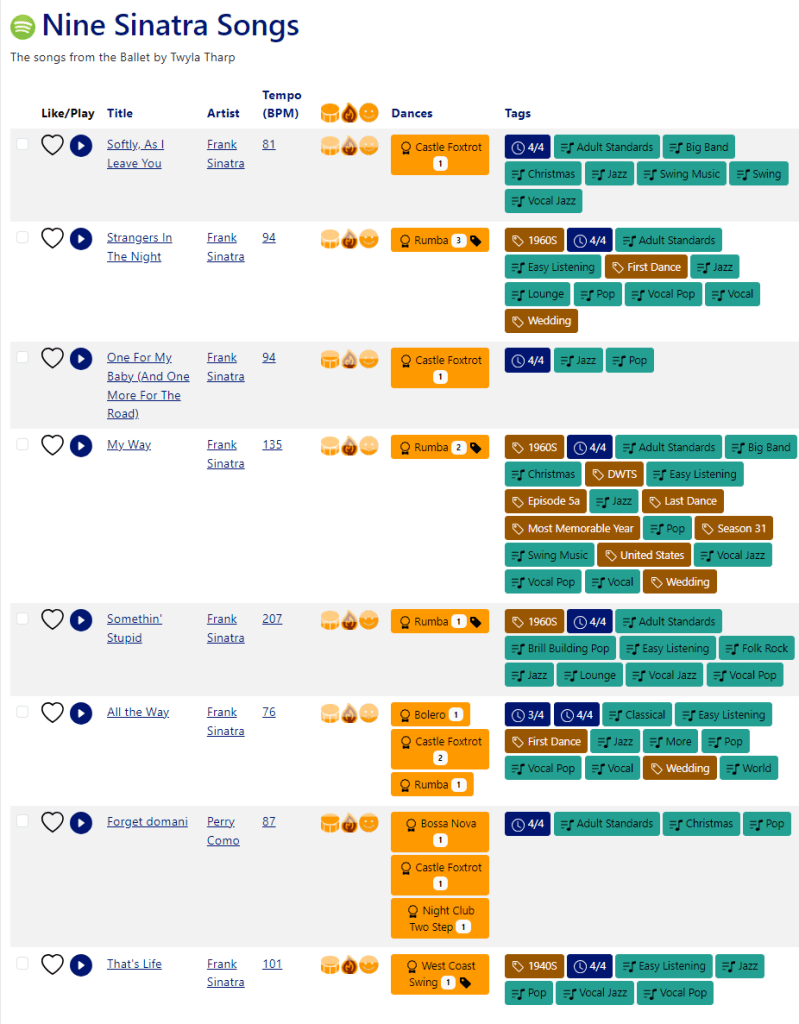
And here’s a custom music4dance playlist that includes all eight songs (although one song is the Perry Como version since the Sinatra version isn’t available on Spotify or iTunes).

A snapshot of the eight songs used in "Nine Sinatra Songs"
The eight songs used in “Nine Sinatra Songs” as shown on music4dance.

Are there other partner dances that Tharp drew from in this work that we should represent in music4dance? Are there other Ballroom-inspired ballets out there worth viewing? Do they use different music that you’d like to add to the catalog? Are there other playlists that you’d like to overlay the music4dance information on, like I did with this one? If you have ideas about this post or the site, please comment below or use other feedback mechanisms listed here. And if you enjoy the site or the blog (or both), please consider contributing in whatever way makes sense for you.

Where did all the Collegiate Shag music go?

When I first started publishing lists of swing music on the music4dance site, I grouped all of the swing style dances together and then used tempo ranges to guess at specific dance styles.  This method works reasonably well for some of the core swing dances such as Lindy Hop, East Coast Swing, and Jive.

But a helpful Carolina Shag DJ contacted me to let me know that this method did not work at all for Carolina Shag since the dance ancestor might be swing, but the music that one typically dances to doesn’t even have a swing rhythm.  And of course, both Hustle and West Coast Swing are very much part of the swing family of dances but don’t require a swing rhythm to dance to.  So I went back and made the default searches only return songs that someone had explicitly tagged as a type of swing rather than inferring anything from general category and tempo.

Since the only exposure I had to Collegiate Shag was a reference that it was a swing style dance to music between 180-200 beats per minute when I turned off the “infer by tempo” feature,  I stopped listing any Collegiate Shag songs.  Well, that seemed wrong, so I did some digging around the web and found a few lists of Collegiate Shag songs and incorporated them into the music4dance catalog.

Do you dance or DJ Collegiate Shag?  Please, let me know if there are other songs that I should add to this list.

Question 2: What dance styles can I dance to my favorite song(s)?

Again, I rephrased the question from my original post.

One of the things that amazes me about the best dance teachers I know is that they seem to do this matching instinctively.  They hear the first bar or two of a song and immediately know which dance(s) to dance.  I imagine “instinct” in this case is some combination of natural talent, many hours of practice and the amount of time that they spend listening to music and thinking about how it fits with dance.

After dancing for 20 years, I have something of this sense myself, but being a techie first and a dancer second I feel compelled to break it down a bit more.

There are two sub-questions here; let’s call them 2a and 2b.

Question 2a: “Does the style of music match the style of dance?” This is very much about the general feel of the music – so salsa music sounds like music that you would want to salsa to and swing music sounds like music that you would want to swing to.  But it’s also about the rhythm.  The most straightforward example of this is Waltz, where the three-count rhythm is very distinctive.  Conveniently, every partner dance that you can dance to three-count rhythm has waltz in its name.  There are more subtle variations on this concept: Cha Cha music has a distinct “4 and 1 (or cha cha cha)” emphasis that makes it feel like a cha cha, mambo music sounds a lot like salsa, but with emphasis on the second beat, and there is something called “Swing Rhythm” that distinguishes swing music from other kinds of music. And the list goes on.  I don’t have a great idea for a tool to help with this, but I’m considering writing a more in-depth series on how this relationship works.  So if you’re interested please let me know and I’ll move that up my to-do list.

Question 2b: “Does the tempo (speed) of the music work for the dance?”   Swing is a great example since there are a whole bunch of different dances that can be danced to music that is in the swing style, but they are each danced at  a different tempo.  For example, West Coast Swing is best danced between 28 and 32 measures per minute (MPM), East Coast Swing between 34 and 36 MPM and Jive between 38 and 44 MPM.  I’m building a web application  that at least partially solves this problem.

With this app. you can count out a few measures by clicking the count button on the first beat of each measure and it will not only show you what the tempo is, but also suggest a number of dances that will “work” for this tempo.  Pretty slick, no?  What would you add to this to make it more useful?