
Ask Music4Dance: Why is a song tagged with the wrong dance style?

Variations on that question make up a significant amount of the feedback I get here at music4dance.  The first answer to these questions is that music4dance is crowd-sourced.  So someone at some point said that they could dance that style to that song.  They may or may not be right, but I think it’s worth stopping to think for a moment – is there a way they could they be right?

That’ s because of the second answer – which is that the dance world is diverse, so what people mean by naming a dance style can mean different things to different dancers.  Now, I could lock down the site and say that only songs that meet a very specific criteria of being strict tempo for American Style East Cost Swing can be marked as Swing.  There are advantages to being that strict – the biggest one is that it would make auto-generating playlists or rounds much more accurate.  But the disadvantage is that it narrows the world of dance.  Especially in these times I feel that it’s important to foster diversity even in the small ways, like what kind of music I would dance a swing to.

In any case, I bring this up now is in part because of a discussion I had with Brent T. Mills who found a song that he had produced listed on the site as a Swing rather than as a Foxtrot. He clearly intended this song to be a Foxtrot.  And aside from the (very important) fact that he has every right as the producer of that song to assert what he intended it to be danced to, he and I both come from a ballroom background and so share the same definitions of dance styles, at least at some level. Mr. Mills also wanted to make it clear that his main interest in contacting me was to help avoid confusion for dancers that aren’t experienced enough to know that many songs have a lot of crossover rather than anything negative. I very much appreciate the sentiment – and he speaks from experience – check out what he’s up to at www.MusicMills.net.

The thing that I realized as part of this discussion is that it wasn’t obvious from the page that he landed on that the dance information was crowd-sourced.  I hadn’t thought about that in exactly those term before, but as I’ve been reworking the site I’ve been trying to do a better job of re-using more common user interface elements than I did the first time around.  In the particular case of the voting mechanism for dances I think this I’m making some progress in making things like the crowd-sourced aspect of the site more clear.

In the original version (which is the current version running on the site as of mid-march 2021) I have a musical note next to a dance style that is filled up (like a thermometer) based on how many votes it’s gotten.  The only way to tell that this is a voting mechanism is to hover over the icon and read the text that says that this song has one vote. In my defense this is a little clearer when you’re on a page that lists a bunch of songs with their respective votes, but it’s still not great.
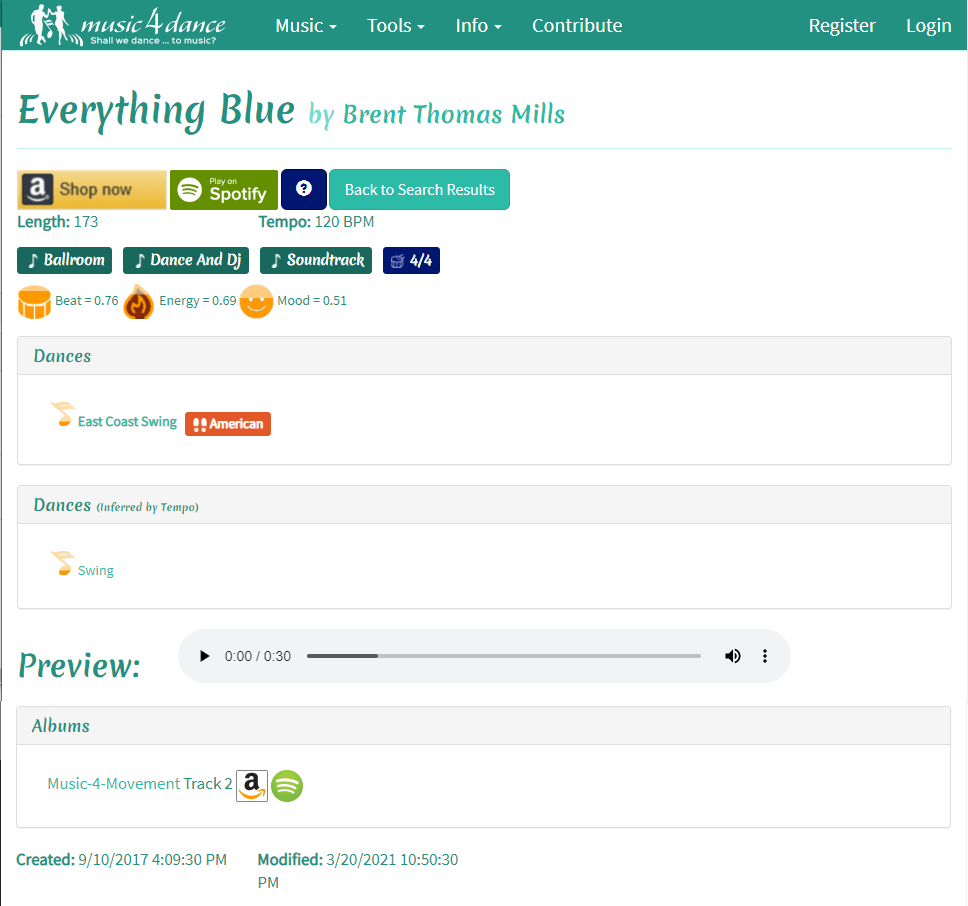
Original version of a song page on music4dance.net
An example song page from music4dance.net (current version)

In the new version (which I hope to release shortly), I use what I believe is a pretty standard mechanism to indicate voting. At least this is how the Stack Exchange family of sites that I spend an inordinate amount of time handles voting.   It’s the number of votes vertically framed by up and down arrows. Clicking on the arrows will allow you to vote (or ask you to sign in to vote).

An example song page from music4dance.net (upcoming version)

What do you think, is the new version easier to understand?  Or should I go back to the drawing board again? As always, I welcome feedback.

Quick Tip:

If you would like to vote on what dance you would dance to a song, create an account and start voting.

Ask music4dance: Why is the tempo that you’re listing for Ricky Martin’s “Casi Un Bolero” wrong?

I’ve seen a number of questions recently about why information on the site is wrong.  So I’ll start with one of the easier ones, which I’ve seen a number of variations on but is basically, “why is the tempo wrong”.  Here’s the specific question that prompted me to write this post:

There are a lot of Ricky Martin songs where the beats/minute are twice what they should be (186 for “Casi un Bolero” ?!?!).

The quick answer is that this is wrong for a dancer – listening to this music, I would dance to it at 93 beats per minute rather than 186.  And the fact that people have voted for this song to be danced as Bolero (96-104bpm) or International Rumba (100-108bpm)  indicates that others would agree.

So why was this listed incorrectly?  Unlike other things on the music4dance site like which dance you would dance to a song, tempo at least of a particular recording of a song is not subjective.  And even amongst recordings of a song, there is generally not that much variation.  Sheet music generally has some kind of tempo marking which will tell musicians the tempo at which they should perform the music.  This can range from a general marking like Presto that indicates a range of about 168-200bpm to actual metronome markings of a precise bpm tempo.  Music Theory Academy has a great explanation of reading tempo markings if you would like to dig deeper.  But my main point is that there is generally a “right answer” to what the tempo is of a piece of music.

This is a piece of music that is intended to be played ate 120 beats per minute as indicated by the quarter note = 120 marking circled in red

But if you notice the tempo that was listed for “Casi un Bolero” (186bpm) is exactly twice the tempo that we would dance to the music (93bpm).  Take a moment to listen to it (you can listen to a snippet on the “Casi Un Bolero” page on music4dance or the whole song on Spotify.com).  There are two instruments that are defining the beat – bass guitar and drum.  If we interpret this song as 4/4 at 93bpm, the bass guitar is emphasizing the first and third beats and playing occasional more complex phrases.  But you definitely hear a consistent one/three from that instrument.  on the other hand if you listen closely to the drum, it’s playing every eighth note (or 8 times each measure).  If you take the drum as the primary beat and definite that as a quarter note rather than an eighth note, you get a tempo of 186bmp.  Which is probably not what the musicians are thinking, and certainly not what a dancer is listening for.

Why is this important?  Because while many of the tempos listed on music4dance came from dancers who would hear the tempo that they can dance to a song, many other listings are generated via machine learning algorithms.  And the machine hasn’t quite figured out how to decide between listening to the bass or listening to the drums. In fact, both algorithms that I’ve used seem to prefer the drums.  So I occasionally go though and fix things up.  But with a catalog of nearly 40,000 songs and growing I’m not always keeping on top of that task.

As I rework the site, I’m hoping to get a moderation/curation function in to make it easy for others to help out with this.  So if you’re interested in helping out in that way, please let me know.  And as always I’m happy to hear from you with any kind of question, comment or feedback.

Quick Tip:

In this post I talk about the beats per minute of Bolero and International Rumba.  You can find listings of tempos for these and other dances in different forms on the tempi tool and competition ballroom page.