Tag Archives: Viennese Waltz

Fun Rhythms: 12/8 meter- Slow Foxtrot + Viennese Waltz?

Since I’ve added the ability to set the tempo of a dance for a song independently of the tempo of the song itself, I’ve found some renewed energy to go through and clean up some of the inconsistencies that have crept into the music4dance catalog. As I promised (or threatened) when I blogged about the update, I am going to share some of the fun rhythms I find in this process.

12/8 Meter

The first “fun rhythm” I’d like to talk about is the different rhythms a dancer may hear in music written in 12/8. This is effectively 4/4 time where each beat of 4/4 is a triplet, although technically it’s twelve eighth notes per measure (4 *3 = 12).

12/8 musical notation example
My quick demo of what 12/8 looks like on the page.

This post on Jade Bultitude’s site does a much better job of explaining and illustrating the musical part of this than I do.

Dancing to 12/8

The fun thing about this meter is that as a dancer you can count it in two ways – either as a 3/4 measure for each of the triplets or as 4/4 where you hear each triplet as a beat.  Then the triplet rhythm will sometimes work for a Viennese Waltz, and the 4/4 rhythm will work for a slow dance like a Slow Foxtrot, Nightclub Two Step, or Blues. Also note that if you’re looking at the sheet music for a song, you’ll generally see a dotted quarter-note as the measure of tempo, which means a musician is counting the tempo at four beats to a measure, effectively the same as 4/4,

Examples

Like I’m Gonna Lose You” by Megan Trainor featuring John Legend is listed as West Coast Swing, Castle Foxtrot (e.g. Slow Dance), and Blues at 72 BPM, and Viennese Waltz and Tango Vals at 216 BPM on music4dance. The sheet music shows the tempo as 72 BPM, so I’ve set the main song tempo to that.

The sheet music for “Me and Mrs. Jones” by Michael Buble shows that it is technically in 6/8, but the same principle applies. The music4dance page shows votes for Viennese Waltz at 198.2 BPM and Castle Foxtrot (e.g. Slow Dance) and Slow Foxtrot at 66 BPM (this would be very slow for Slow Foxtrot).

Cataloging

I am still playing with how to tag these kinds of songs. Should I add a 12/8 tempo tag to the songs (*even if they might be technically 6/8 or 4/4 with strong triplets)? Should I put a 3/4 tag on the Waltzes and 4/4 on the Foxtrots, or is that redundant? Would it make sense to put a Compound Time tempo tag on all of these?

Next Steps

I’m going to continue to muddle through manually cleaning up these songs, but it will take some time, since there are a lot of these (and I haven’t even gotten into some of the other fun variations).

If you’re interested in seeing more examples and/or jumping in and cleaning them up, here are a few interesting music4dance searches:

If you are interested in helping, but find the documentation (or the discussion above) too confusing, or if you have thoughts on how to better tag these kinds of songs, please feel free to reach out with questions or comments.

Step of the Month

The “Step of the Month” for July:  Please share an unusual rhythm song (or songs) that you enjoy dancing to. It doesn’t have to be a variation on 12/8 or in any way related to the discussion above, just something that’s a little different that you enjoy. Post it in the comment thread here or send feedback.

Update – July 15th, 2026

An astute reader pointed out that I was conflating the terms meter and rhythm. I believe I’ve cleaned this up in the post; the general idea is that dancers hear and dance to a rhythm, while the time signature or meter is a technical term that is used in written music. I am still going to keep the title of this series as “Fun Rhythms”, since I am using this as a forum to talk about the way some dancers may hear the rhythms in a piece of music differently than others.

What Happens When a Song is Danced at Different Tempos?

Sometimes, a song can be a perfectly good Bolero when heard one way but a Salsa when counting the music differently. Another example is Slow Dance (Castle Foxtrot) vs. Lindy Hop. Generally, this phenomenon is because, with some music, it’s easy to count what the musicians see as either a half note or a quarter…

Playing with Dance Tempos

I just rewrote the Tempo tool for the music4dance site as part of the current effort to update the site.  In the process I went back and revisited the reasons for writing the tool in the first place.  The main reason for this tool is to have a single place to do a bit of…

Song Details

The music4dance song details page contains all of the information that we have gathered about a song, including tags and dances that you may have added. Below is a snapshot of a song details page for “How Sweet it Is” as seen by a user, “Charles”, while he is viewing it. Some of the features…

Nine Sinatra Songs – Ballroom inspired Ballet

Pacific Northwest Ballet included Twila Tharp’s Nine Sinatra Songs as part of their Director’s Choice performance this year. I’m not in any way qualified to review a Ballet performance, but I can say that I thoroughly enjoyed it and had a great time playing with the Ballroom-inspired aspects of the dancing as I watched the show unfold. For me, the idea that the dancing was inspired by ballroom rather than in any way attempting to choreograph actual ballroom dance steps on ballet dancers is what made it work (this is the issue I sometimes have with partner dance in Broadway musicals). It was obvious in several of the nine pieces that  Ballroom dance inspired the piece, and the upper body shaping and movements felt quite ballroomesque throughout the performance.

On returning home, I hoped to find a resource that listed the dances that Tharp drew from for each of the first eight pieces (the ninth is a reprise group number), but I failed. The notes from some of the performances mention the roots of one or two dances, but it seems like, for the most part, they name the same couple of songs. So, my guess is that even a thorough search of those through the years wouldn’t yield a complete list. As an aside, it was fun to jump down the rabbit hole of the French Apache Dance that Tharp drew from for the choreography for That’s Life. If someone has such a reference, please let me know.

In the meantime, I will take this as inspiration to play a little with the possibilities of music and dance. Sinatra is already well represented in the music4dance catalog, with 166 songs listed before I started filling out the few missing entries from the ballet. But I’ve always thought of dancing Foxtrot to Sinatra or maybe Swing. In the ballet, Tango, Rumba, and Samba were definitely represented. So, I took a few minutes to see what the music4dance community has to say about dancing to this music.

If you go to the Frank Sinatra artist page, you’ll see Slow FoxtrotLindy HopRumbaCastle FoxtrotEast Coast SwingJive, Quickstep, Peabody, West Coast Swing, Single Swing, Slow WaltzBalboaBoleroBossa NovaViennese Waltz, and Blues all represented.

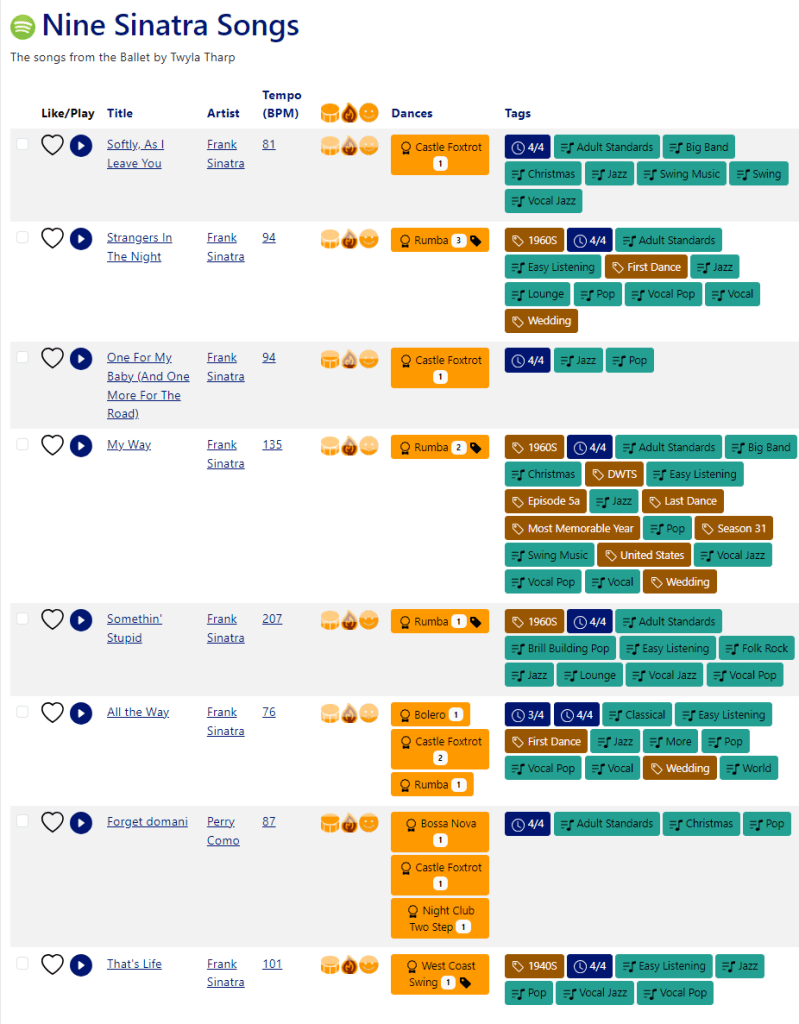
And here’s a custom music4dance playlist that includes all eight songs (although one song is the Perry Como version since the Sinatra version isn’t available on Spotify or iTunes).

A snapshot of the eight songs used in "Nine Sinatra Songs"
The eight songs used in “Nine Sinatra Songs” as shown on music4dance.

Are there other partner dances that Tharp drew from in this work that we should represent in music4dance? Are there other Ballroom-inspired ballets out there worth viewing? Do they use different music that you’d like to add to the catalog? Are there other playlists that you’d like to overlay the music4dance information on, like I did with this one? If you have ideas about this post or the site, please comment below or use other feedback mechanisms listed here. And if you enjoy the site or the blog (or both), please consider contributing in whatever way makes sense for you.

What is that dance called? Swing, East Coast Swing, Triple Swing, East Coast, or…

When I got into the business of categorizing music by dance style, I knew there would be a lot of ambiguity involved. However, some of the passion behind people’s opinions about what a dance should be called or what tempos are acceptable for the dance called X still takes me by surprise. Several times a year, I get an email from someone who is absolutely livid that I “got the tempo of West Coast Swing completely wrong” or called a dance “Lindy Hop” rather than “Swing” or some other variation on the theme.

I learn a lot from the people who send these emails, and often learn something that helps me improve the site or my general knowledge of dance. One feature I added a while back, based on some of these interactions but haven’t discussed in the blog, was the idea of having “synonyms” for dances.

The way music4dance works, I have to have an unambiguous and unique name for a dance. This leads to somewhat clunky names at times – for instance, the dance that most dances consider “Waltz,” I call “Slow Waltz” to distinguish it from “Viennese Waltz” and to allow for a catch-all category of Waltz. But I want to be able to show other names for dances so people can find the dances even if they know them by another name. This applies both to cases where the dance really is the exact same dance; it’s just named differently to disambiguate it, and in cases where the parameters for what music works are close enough that it makes sense to use the same list of music for both dances.

Cases of actual synonyms:

Cases where the dances are different, but the music is the same:

  • Castle Foxtrot = Slow Dance – I started categorizing music that was basically Slow Dance music as Castle Foxtrot, which is a legacy dance that some studios occasionally teach because Castle Foxtrot showed up in my searches as I was designing the site, and fit nicely into the tempo spectrum of Foxtrot-like dances. The practical use of this ended up being more for people looking for “Slow Dance” music in wedding contexts, so I added the Slow Dance synonym. Perhaps I should change the primary name?
  • Hustle = DiscoFox – As far as I can tell, these have evolved into different dances but are still danced to similar music. But that is based on web searching rather than personal experience, so please correct me if I’m wrong. I’m also now second-guessing myself as to whether I should add “Swing Fox,” “Disco Swing,” and “Rock Fox” as synonyms, or if one or more of these rates is its own category.

In any case, if you go to the main “Dance Style” page, you’ll see all the styles we’ve set up, along with their synonyms. As this list grows, being able to filter it is more important, so the filter control acts on both the primary name and the synonym. I also handle the synonyms when you search in the search control in the menu bar. So if you type “Slow Dance” in that search box, you’ll find a list of slow dance songs (that are actually tagged as “Castle Foxtrot”). I don’t convert the name of the tag in the results, but I could if that seems important…

I’m posting this now in part because, during my recent round of updates, I broke the showing of synonyms in the Dance Styles page and then realized I hadn’t ever asked for feedback on the feature. The only mention in this blog was the post when I added it as an afterthought to adding Single Swing to the catalog.

Are there other synonyms that I should add? Are there dances that I’ve listed as synonyms that I should break out into separate dances? If you have ideas about this post or the site, comment below or use other feedback mechanisms listed here. And if you enjoy the site or the blog (or both), please consider contributing in whatever way makes sense for you.