
One of the cool things about maintaining a database of songs cataloged by dance is that I can use that information to correct the most common mistake made by algorithmic tempo matching: the double-time/halftime issue. I’ve done this on an ad hoc basis for years, but now I have everything lined up so the system can make these adjustments automatically.
One of the major blockers was that I was only maintaining one tempo per song. To do this right, I’d need to keep different tempos for every dance a song can be danced to, which was a major feature I implemented earlier this summer. So I decided it was time to take another look at automatically adjusting the tempo based on the dance.
The Feature
The general idea is to have two thresholds. One is the tempo under which it is clear that the listed tempo is half-time of what one would dance that specific dance to. The other is the tempo where it is clear that the listed tempo is double time. These are related to the subject of my last post. Although, in this case, there may not be a dance one would dance to the listed tempo. But there might be, which is where things get interesting.
When a song is added to the catalog or a new dance style is added to an existing song, the system checks if I’ve defined threshold tempos for the dance. If I have, and the song’s tempo is below or above the threshold, I double or halve the tempo, respectively. There are some additional nuances depending on whether other dances are already defined. But with the tempo-per-dance system, I can ensure that changing the tempo of one dance doesn’t affect the others. I do change the song’s default tempo if all dances define the same tempo. Sometimes this ends up listing the song’s tempo as half or double what the sheet music says, but since music4dance is a dance-oriented site, I’m all right with that.
Note that, in line with my current policy of trusting community members over algorithms, all of these changes are made using the “tempo-bot” account and can be changed by any signed-in community member.
Please Help
Why am I telling you all this? Because I am not an expert in all of the dances I have listed on music4dance. And even for those I have some experience with (or can at least stumble through on the dance floor), it’s through my personal lens, which may not be the same as yours.
If you’ve got a minute, please go to the tempos page (Tools → Tempi) and scroll down to the columns control. There is a new column called Range; go ahead and select that. When I’m looking at this info, I generally deselect all other columns except Meter and BPM to get a cleaner picture. Or click here to get directly to the page with the columns correctly configured. (More about that little trick in a future post).
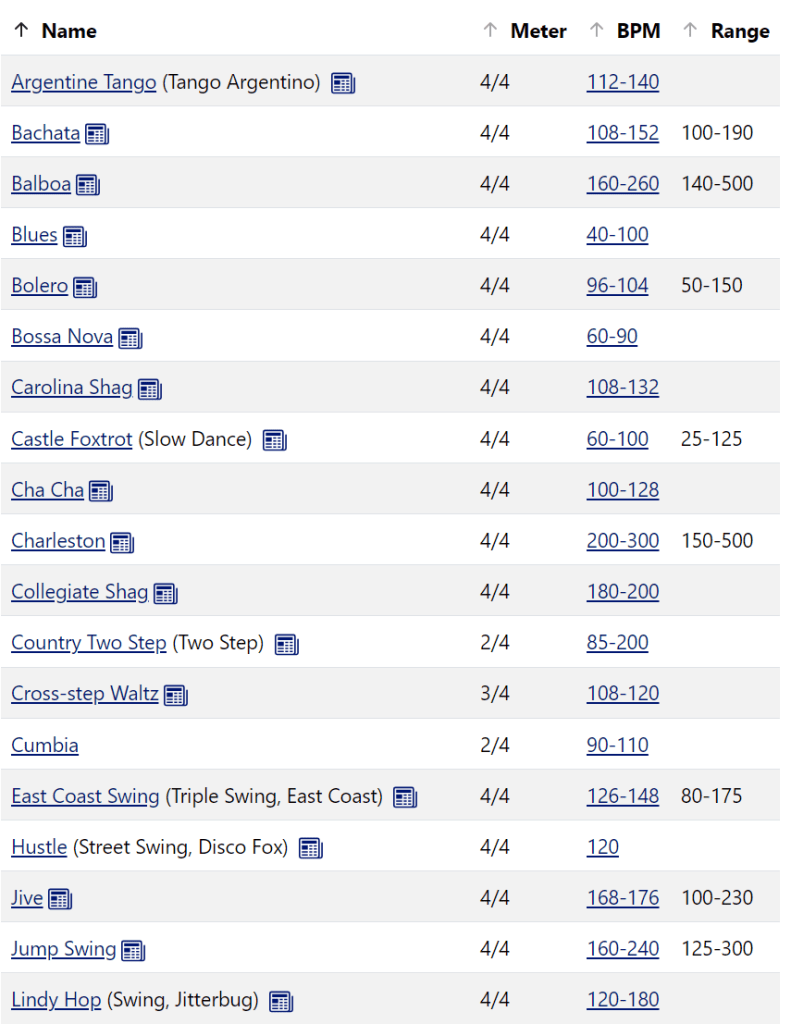
I’d like to know your take on what these thresholds should be for both the dances I’ve felt confident enough to set (sometimes based on data rather than personal knowledge) and those I haven’t pulled the trigger on.
Waltzes
I started to call out why waltzes are in a class of their own, but decided that’s worth a post of its own; look for that soon.
Dances that are primarily Social
Some dances, like West Coast Swing and Salsa, are primarily social dances. I know there are competitions for them as well, but they’re so broadly and actively danced socially that I think they’re evolving faster than the dances that I’m familiar with that have more of a center around competition with strict tempo rules.
In the case of West Coast Swing, I made the mistake of centering around the tempos that I’ve danced in competition. Based on feedback and additional research, I ended up listing it with such a broad range that I don’t think I can use the range-limiting technique on it at all.
In the case of Salsa, there were enough half-time songs to find a reasonable breakpoint. I’d love to hear from Salsa dancers and DJs if I’m wrong.
And I’m completely out of my depth with Argentine Tango and related dances, so if there is anyone out there willing to help with those, I would really appreciate any guidance you can give.
In short, I could really use some help on this one. Please comment on this post or send feedback if you can help.
Step of the Month
The “Step of the Month” for August: This is a small variation on the July Step. Please share an unusual rhythm song (or songs) that you enjoy dancing to. I’m specifically looking for interesting variations that I haven’t mentioned yet in the Fun Rhythms series. I’ve got one more up my sleeve, but I’d like to continue on this path for more than three posts. But I need some help to do that. Post it in the comment thread here or send feedback.
New Feature: Tempo-per-dance, or what if I want to Salsa to this song twice as fast as someone else wants to Cha Cha to it?
One of the things I’ve been struggling with since very early on in the music4dance story is the fact that not everyone hears the same rhythm when they dance to the same song. Struggling isn’t the right word – it’s a difficult technical problem to solve in the context of the music4dance song index, but…

Fun Rhythms: Half-time/Double-time – Dancing a Jive and a Slow Foxtrot to the same song
In the first post in this series, I talked about the 12/8 meter. And how, at certain tempos, that allows dancers to legitimately hear a very slow Foxtrot rhythm while someone else (or the same person tuning their ear a little bit differently) can hear and dance to a fast Viennese Waltz. This is one…
Fun Rhythms: 12/8 meter- Slow Foxtrot + Viennese Waltz?
Since I’ve added the ability to set the tempo of a dance for a song independently of the tempo of the song itself, I’ve found some renewed energy to go through and clean up some of the inconsistencies that have crept into the music4dance catalog. As I promised (or threatened) when I blogged about the…
What Happens When a Song is Danced at Different Tempos?
Sometimes, a song can be a perfectly good Bolero when heard one way but a Salsa when counting the music differently. Another example is Slow Dance (Castle Foxtrot) vs. Lindy Hop. Generally, this phenomenon is because, with some music, it’s easy to count what the musicians see as either a half note or a quarter…
Ask music4dance: Why are the tempos that music4dance lists for Salsa wrong?
I’ve addressed questions about tempo in several different ways over the years, and I appreciate the continued feedback, as there is absolutely room for improvement in how the music4dance system handles tempo. Algorithms are far from perfect: The issue at hand is that many of the tempos listed for Salsa were exactly half the speed…
Ask music4dance: Why is the tempo range you list for West Coast Swing wrong?
A West Coast Swing DJ contacted me and kindly let me know that the tempo range I had listed for West Coast Swing was “entirely wrong.” The average tempos that she plays are between 90 and 110 bpm, while I listed a tempo range of 112-128 bpm. Before I dig further into the details, I’d…
 music4dance