Tag Archives: Cha Cha

Ask music4dance: When was this song added to the catalog?

Someone recently asked me to add a feature that shows when a song was added to the music4dance catalog. It turns out this feature already exists, but the fact that this person didn’t realize it means it isn’t as obvious as it should be. This is especially true, given that the questioner demonstrated she was a fairly sophisticated user of the site through other questions and comments in the same thread.

I have some ideas for how to expose this functionality, but I’d like your feedback before I dive in. I’d also like to get a sense of how interested you are in this information and how you’d like to use it.

What I have:

I’ll start by mapping out what I’m keeping in the database. In my internal format, I keep a record of every time a song is changed, including who made the change and (of course) what the changes are. It is too expensive to index all this information, so it is available on the song’s detail page, but only a few things can be quickly looked up for filtering and sorting the song list. These are as follows:

  1. The date that a song is originally added to the database
  2. The most recent date on which the song was modified (including by the system)
  3. The most recent date on which a song was edited by a user
  4. The most recent date that someone took the time to enter a written comment on the song

What you can do with it:

The easiest way to use this information (other than looking at the change log on the song’s details page), is to go to the New Music page. This will let you see the most recent songs based on when they were added, changed, or commented on. I find this useful as a quick check to see whether people (and bots) are successfully adding and making changes to songs. If the things at the top of the changed list are more than about a day old, it’s a good indication that I broke something. I also think this is good for users who are looking for new music to see what’s up – but now that I’m looking at that page with fresh eyes, I feel like it could benefit from filtering by dance style, like the Holiday Music and other similar pages.
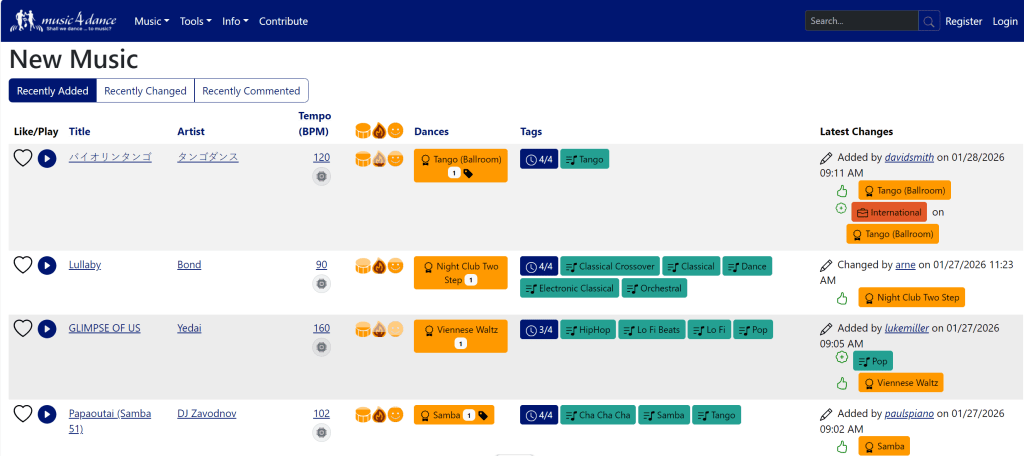
Image of the new music page

To go to the next level, you can open the Advanced Search page and search/filter a song list any way you like, including by dance style, and then sort it by “When Added”, “When Modified”, “When Edited”, or “Comments.” Modified and Edited are subtle variations on Changed, which I’m not going to dive into here, but feel free to play with those and let me know if you think I’m just adding complexity for no reason.

In general, the last column in the desktop version shows information about the date you’re sorting on. The only indication I’m giving on smaller screens is the order in which the list is presented.

Where to go from here:

Between the original question and writing this post, I have had a number of thoughts about what I would improve. But please pause for a moment before you read on, as I’d like your ideas unpolluted by my ramblings.

  • Add some indication of the sort-ordered date on mobile.
  • Make the information that is shown about songs in the search results list configurable – possibly separately for mobile and desktop (this one would be part of a larger project).
  • Add dance filtering to the New Music page. And/Or add an “advanced search” button to those pages that pre-populates the advanced search form.
  • Distinguish between Modified and Edited on the New Music page.
  • Provide the option to view the full edit history on the song details page.
  • Add the ability to filter between two dates for any of the indexed date types (e.g., I want to see all cha-chas that were added before 2015)

Publication date of a song:

When I first read the message that prompted this post, I thought I was being asked to show the date the song was published. That’s a question that I’ve been asked quite a bit, and the answer is that it’s harder than it seems. In general, people are asking for the date the song was first released as a single or on the first album it appeared on. But since the data I have access to is often a “Best Of” or “Ballroom Mix” album, and the date I can see is the album’s, not the song’s, I haven’t figured out a way to reliably get the information we want. This may be a matter of hooking up to another music database like MusicBrainz, but that’s a pretty big lift, so it’s not part of my immediate plans.

However, I have used various sources to tag songs with the decades they’re associated with; this is more of a fuzzy style idea than anything to do with the song’s release date, but that’s often what I want: 70’s Cha Cha or 50’s Slow Foxtrot.


As always, please let me know if you have any thoughts about the subject of this post or the site by commenting below or using other feedback mechanisms listed here. And if you enjoy the site or the blog (or both), please consider contributing in whatever way makes sense for you.

Song Details

The music4dance song details page contains all of the information that we have gathered about a song, including tags and dances that you have may have added. Below is a snapshot of a song details page for “(I’ve Had) The Time of My Life” as seen by a user “Charlie” while he is editing it.…

Advanced Search

The advanced search form can be found by clicking on the “Advanced Search” item in the “Music” menu or by clicking on the “Advanced Search” link on the song list page. Text Searching If you want to search specifically in certain fields, you can click the “more” button in the keywords section and get some…
Ask music4dance: How do I find a song that people can dance West Coast Swing and Foxtrot to, or Cha Cha and Rumba, or…

Some of the most vocal members of the music4dance community are folks who either DJ for their studio’s dances or help build the playlists for their community dances, or some variation of the two. The common thread is that they’re using music4dance at various points in their processes and have been kind enough to share the details with me. This has resulted in a number of features that I am sure help more members of the community than my original interlocutor. Thanks again to everyone who has taken the time to share their experiences with music4dance.

The topic at hand is a recent email expressing appreciation for the ability to use the advanced search feature to find songs that can be danced to two or more different dance styles. I realize that I last blogged about this feature in 2015, before I moved the advanced search features to their own page. I missed this post in the review I went through last year to try to update some of the most out-of-date posts and archive the old ones. So I appreciate the reminder.

A little bit of personal history:

When I was first learning to dance, my teacher tried to get me up and able to social dance quickly, including several smooth dances and several rhythm dances. That was totally and completely beyond my capacity, and I spent the better part of a year taking lessons, occasionally showing up to Friday night dances and stumbling through a song or two, but not feeling very good about it. And stepping on too many toes. I clicked in with dancing when a different teacher took me on and convinced me to enter the in-studio competition with an East Coast Swing “solo” piece (what I would now call an exhibition piece – she choreographed the dance to a specific song. We put on costumes and acted out a little scene as part of the dance – pretty close to what most of the performances on Dancing With the Stars are.

With that experience, I graduated to a comfort level with East Coast Swing that I could show up to a dance and dance that one style for the one in 10ish songs that the DJ played. But wait – there is some overlap between East Coast Swing tempo and Slow Foxtrot, at least for social dancing. And the music is of a similar style, since these dances “grew up together” in the Swing Era. And even better – the people dancing Foxtrot were following line of dance around the edge of the dance floor, so we could tear up the middle of the floor with a swing and not disturb the “official” dance. Now I could be up on the floor for one in 5ish songs, and things were starting to feel better. And the rest is history.

How can music4dance help?

But back to the topic at hand. There is a strong motivation when picking songs for a social dance where many styles are represented (which is often true in a traditional ballroom setting) to cater to music that lets newbies dance what they know.  Music4dance makes this easy. If you want to find songs that fall in the overlap between East Coast Swing and Slow Foxtrot, just go to the Advanced Search page and choose each of those dances in the Dances section and click on All (you want the intersection, not the union). Or click here. Then you might want to whittle down that list to the fast end of the Slow Foxtrot and the slow end of the East Coast range – say 128 to 132 BPM, and you get a manageable list of songs to browse through. You can listen to snippets of most songs directly in music4dance. Or, if you’re a premium subscriber, you can export the list to a Spotify playlist and listen to the full songs.

There are a lot of combinations of dances this technique works for, including the dances from the title of this post – West Coast Swing and Slow Foxtrot or Cha Cha and American Rumba are just a couple. Take it for a spin and let me know what you think. And let me know if you use this alongside other features. Or just drop me a line with how you use music4dance. I always read and respond to feedback.

As always, please let me know if you have any thoughts about the subject of this post or the site by commenting below or using other feedback mechanisms listed here. And if you enjoy the site or the blog (or both), please consider contributing in whatever way makes sense for you.

Create a Spotify Playlist

One of my initial goals with music4dance was to be able to create playlists to dance to.  I can finally say that I’ve got this working in a way that is close to my original vision at least for Spotify. The idea is, for instance, that I’d like to build a playlist of Foxtrot songs…

New Feature: Filter by Song Length

If you’re trying to get a playlist together for a social dance, it would be nice for the songs to be a reasonable length for your audience.  I realize that DJ tools will let you manage this in multiple ways, but sometimes it’s just easier to start with songs in the length range you’d like. There are…

Add to a Spotify Playlist Directly from music4dance

A number of people have told me over the years that they create custom Spotify playlists by browsing the music4dance catalog and selecting individual songs. I’ve had ambitions to do all kinds of things to create and manipulate playlists. But it occurred to me, based on a recent conversation, that just the ability to easily…

Ask music4dance: Why are the tempos that music4dance lists for Salsa wrong?

I’ve addressed questions about tempo in several different ways over the years, and I appreciate the continued feedback, as there is absolutely room for improvement in how the music4dance system handles tempo.

Algorithms are far from perfect:

The issue at hand is that many of the tempos listed for Salsa were exactly half the speed at which one would dance. There is a straightforward explanation for this. Many of the tempos listed on the site are algorithmically generated. The algorithms are decent at this point for many types of music. But with some music (and Salsa definitely falls into this category), the algorithm “hears” a double-time or half-time beat and chooses that over the “correct” tempo for the dance.

I have several mitigations for what I think of as “shadow” tempos that I’ve implemented over the years, including a new one that was prompted by the email that also convinced me to write another post on this subject.

First, the system prefers a user-entered tempo over any algorithmically generated tempo, even if the latter is more recent (the general default for conflicting information is to believe the most recent edit). I currently don’t open up editing tempos to every user, but contact me with an example of something you’d like to change for a quick check that we’re on the same page, and I’d be happy to add that permission to your account. The more people we have catching and correcting these issues, the more reliable the site will be overall.

Second, I occasionally do a pass through the database and adjust the tempo values that are obviously outside a dance’s tempo range if halving or doubling them would put them within the dance’s range. I recently ran this process for Salsa, which significantly reduced the number of songs with the issue that prompted the original complaint. I have considered generalizing this algorithm so that if a song is added without specifying a tempo and the system generates a tempo algorithmically, it would make a simple adjustment to double or halve the tempo if that puts it within the dance’s range. But I haven’t pulled the trigger on that yet. In any case, this process still left a few songs tagged as Salsa with very unsalsa-like slow tempos. I’ll dig into that shortly.

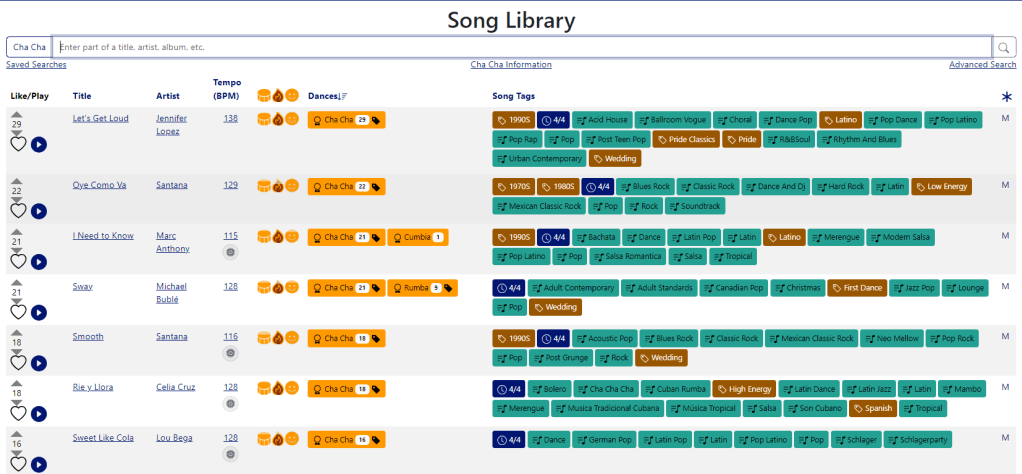
The last feature that I hope mitigates this algorithmically generated tempo issue is brand new. People need to understand that a tempo is algorithmically generated and should therefore be taken with a grain of salt1. But there was no easy way in the music4dance user experience to indicate that the system had generated a tempo algorithmically. Now, near each algorithmically generated tempo listing is a small icon of a computer chip; clicking that icon takes you to our help page with information on how tempos are generated.

Image of the song library with algorithmic tempo icons

Different dancers can hear different beats:

But there is another, related issue. It’s not just algorithms that can “hear” a double or half-time beat. Dancers can do the same thing2. The algorithm hearing a half-time beat mentioned above is precisely the opposite problem from the one I discussed in this post, where the tempo was twice what one would dance Bolero/International Rumba to. But it was for a similar reason. Some songs have a strong enough double-time or half-time beat that it’s hard to tell which is the primary beat to count or dance to. When you are actually on the dance floor, this generally doesn’t matter, since if you’re at a salsa club and the choice is between dancing to 190BPM and 95PM, you’ll dance at 190BPM. Or conversely, if you’re in a dance studio where you’ve been studying American Rhythm, and have the same choice, you might choose to dance Bolero at 95BPM (or maybe  Mambo at 190BPM, depending on the feel of the song).

So the remaining songs in the music4dance Salsa catalog that are listed as much slower than one would dance a salsa remain because someone set that tempo based on a different dance where the slower tempo is appropriate (or because they were added with an algorithmic tempo since the last time I did a pass to clean them up). There is no easy way to solve this problem when each song has only one tempo. But I’ve been refactoring the code and the indexing service to make it easier to carry more information about the intersection between dance and song, which would allow us to list a different Salsa tempo than a Cha Cha tempo for the same song. The problem is that we would have to save a tempo field for every song/dance combination, even in the most common case where all dances to a given song are at the same tempo. I need to do some more testing to make sure that doesn’t degrade the overall search experience. The more I hear from you that this limitation is frustrating, the higher it will rise on my to-do list.

As always, please let me know if you have any thoughts about the subject of this post or the site by commenting below or using other feedback mechanisms listed here. And if you enjoy the site or the blog (or both), please consider contributing in whatever way makes sense for you.

Footnotes

  1. This strikes me as ironic, since I vibe-coded this feature using GitHub Copilot and Claude. And even though the underlying algorithmically generated tempo issue existed long before the current generative AI situation, it has a similar feel to me. ↩︎
  2. It’s also really fun to be able to dance a different dance than the rest of the room if you can make it work, but that may just be my rebel nature. ↩︎

What Happens When a Song is Danced at Different Tempos?

Sometimes, a song can be a perfectly good Bolero when heard one way but a Salsa when counting the music differently. Another example is Slow Dance (Castle Foxtrot) vs. Lindy Hop. Generally, this phenomenon is because, with some music, it’s easy to count what the musicians see as either a half note or a quarter…

Ask music4dance: Why is the tempo range you list for West Coast Swing wrong?

A West Coast Swing DJ contacted me and kindly let me know that the tempo range I had listed for West Coast Swing was “entirely wrong.” The average tempos that she plays are between 90 and 110 bpm, while I listed a tempo range of 112-128 bpm.  Before I dig further into the details, I’d…

music4dance Goes Country (part I)

One of the most common requests I’ve received is to support Country Western dances. That request has come in many forms, but I don’t have personal experience with Country Western dancing (well, that’s not 100% true, I learned to West Coast Swing at a Country bar in downtown Seattle that my ballroom dancer friends would hang out at after rehearsing). I’m nearly certain that in adapting music4dance to support more country music, I’ll stick my foot in something stinky and get some negative feedback. I’m all right with that – all feedback will make the site better in the long run, just please try to be gentle 🙂 I’ve also stepped on plenty of toes with Ballroom dance which I know quite a bit about, Argentine Tango, which I know a little about and some of the social dances that fall in between on my personal knowledge spectrum.

And music4dance is pretty complicated to begin with, so adding another dimension may make it harder to use. But I’m hoping that, with your help and some iteration on the idea, we can get things to work even better in the long run.

My initial approach to adding Country Western Dance support is to review the organizations that publish competition rules, including tempo information, and see if I can work those dances into the music4dance system in a way similar to how I’ve set up the competition ballroom dances. This turned out to be easier than I expected. All three organizations that I found online (United Country Western Dance Council, World Country Dance Federation, and American Country Dance Association) list eight competition dances. Triple Two, Polka, Night Club Two Step, Cha Cha, Waltz, Two Step, Swing, and West Coast Swing. Only one of those dances wasn’t already in the database (Triple Two). Polka and Country Two Step were random additions early in the site’s evolution because a couple of DJ friends and lists published by ballroom dance studios included enough songs of those styles to make it worth my while to include them.

My biggest question was, should I create new dances for all of the dances that overlapped? After all, the Cha Cha danced in Country Western competitions is certainly not the Cha Cha I learned competing in American Rhythm (heck, the cha cha that the International Latin dancers were learning in the next room wasn’t the same dance either). I decided to follow the pattern that I’ve already established for Ballroom dances with the same name, even if they are pretty different. Rumba is probably the strongest example in the ballroom catalog of two dances with the same name that are not the same dance. But the characteristics of the music that a dancer cares most about are similar – this is true even of Rumba, where the tempo is significantly different.

Not coincidentally, I recently finished a significant project that allowed me to use the core database to easily and accurately search specifically for American Rumba vs. International Rumba. While there are a few drawbacks to grouping America, International, and Country Cha Cha together, there are a lot of advantages both in terms of how the system works internally and in making it easier to find new music for everyone (I’ve always been a proponent of genre-bending in fiction and cross-over choreography in dance).

So, there is now an active “Country Western Competition Dancing” page, and all of the individual dance pages for dances that include Country styles include the competition info for those dances. I’ll continue to tweak some of this information as I get feedback and do more research.

I realized as I was writing this post that I hadn’t addressed the fact that this change also complicated the voting mechanism. I want to encourage folks to vote on a song being a good Cha Cha, but also make it easy for them to specify Country, International, or American. I made some quick tweaks, but this is definitely a feature still under development.

Please let me know what you think (even – possibly especially – if you think I got it completely wrong). I’m interested in whether there are other Country Western dances that I should include, even if they’re not part of the core competition dances. There was a reference to Country Smooth and Country Rhythm rounds in one of the organizations rules, should I be supporting that? I’ve also used the composite tempos from the rules, combining the different levels to give the broadest range. Should I just be using the most advanced category?  What else have I missed?

And as always, if you enjoy the site or the blog (or both), please consider contributing in whatever way makes sense for you.

What if I want to find just Cha Chas tagged as American Style?

Or one of the many variations, such as Slow Foxtrots labeled as “Traditional,” or Boleros labeled as “fast”?

Queries like the above have always been possible, but with a very major caveat. Up until now, you could search on Cha Cha dance and “American” style. But what that did was find all songs that had a net Cha Cha vote of at least one and a tag on any dance of “American” style. So if someone voted on a song as Rumba and tagged the Rumba as American, then someone else voted for the song as Cha Cha, searching on Cha Cha and American would include that song.

This behavior was particularly troublesome if you wanted to do something like search for fast Salsas, because you’d end up with songs that are fast Rumbas or Cha Chas, but slow Salsas, which is precisely what you don’t want. Side note: the workaround for that particular issue is to search on specific tempos, but that isn’t really the same as searching for songs that someone explicitly tagged as slow or fast for a particular dance, since there is more thought put into tagging (and not every song has a tempo associated with it).

I’ve done a bunch of restructuring and added more than a bit of UI to enable the kinds of searches that I’m describing here. I’m currently busy updating the documentation to catch up, but I hope that the fundamental change is relatively intuitive.

There have always been two kinds of tags: tags on songs and tags on top of a dance style for a song. I’m gravitating to calling the latter dance-specific tags, although I haven’t been 100% consistent yet. If you go to any of the dance details pages (try Slow Waltz), you’ll see two tag clouds now, labeled Dance Tags and Song Tags. Clicking on any of the tags in the Dance (specific) Tags section will give you the option to list the songs with that tag on Rumba.

Alternatively, you can navigate to the Advanced Search page, add Rumba to the list of dances, toggle the “Show Dance Details” switch, and select the option to include the American tag. In either case, you’ll end up with this result. Or we can answer the original question of All Cha Cha songs tagged as “American” style.

In any case, this is a very large new feature that includes a breaking schema change in the search index, so there are bound to be bugs. Please poke at it and let me know what you think. I’m doing my best to enable the deep scenarios that you ask for without overly complicating the core scenarios. Part of what I’m trying to do is what I alluded to in my last post, where I made a reference to making it easier to add refinements to dance searches, so that you can more accurately find all American Style Slow Foxtrots – once could theoretically do something similar with Country Cha Chas (which aren’t currently supported at all).

Please let me know if you have any thoughts about the subject of this post or the site by commenting below or using other feedback mechanisms listed here. And if you enjoy the site or the blog (or both), please consider contributing in whatever way makes sense for you.

New Feature: Searching on songs with a minimum number of dance votes

Several folks have been frustrated with the number of songs in the music4dance catalog that only have one or two votes for a particular dance style. This limitation doesn’t matter for many searches because you can sort by dance votes, and the most popular songs end up at the top. But if you want to…

New Dance: Single Swing

I’ve added Single Swing as a dance style that can be searched on and voted for in the music4dance catalog. While I think of this dance as a short-cut to use when I want to dance East Coast Swing to faster Jive or Lindy-Hop music, I’ve received enough feedback from the community that it’s considered a unique dance in its own right that…

“Search like Google” is now the default

Update (July 2024): This underlying search mechanism described in this series of posts is still in place and functions as described here, but the user interface has changed. Please see the Simple Search and Advanced Search documentation for how the current user interface works. I’ve just updated the music4dance site to make the new search engine the…

How to find the most popular songs to dance to

The core mission of music4dance.net is to help you find music to dance to, whether you’re a ballroom dancer, social dancer, or really any kind of dancer. Sometimes I look at the site and say, “This could be better.” Or “Here’s a place that I’ve wanted to improve for a while but couldn’t figure out how; maybe I should try something different.” I had an “aha” moment when I was going through the site for my annual Holiday Music post. I’ve been frustrated that many of the lists of songs on music4dance.net default to some nearly random order that tended to put songs on top that only one or two people had voted for. In the Holiday Music catalog, if you choose a specific dance (like Foxtrot), the list is sorted by the number of votes for that dance. But that wasn’t true of the main list, and there wasn’t an obvious way to sort that list by dance votes.

So I took a step back to think about the general problem of getting the songs with the most dance votes to the top of lists and search results and started digging into the corner cases, which is generally where I get stuck on this kind of problem. For song sorting, I was particularly worried about an issue that a customer brought up when I first implemented the general search like google feature that enabled full-text search. In that case, I was sorting by most recent by default, and when the customer tried to do a full-text search, the song he was looking for ended up on the second page of results because there were a bunch of songs that matched his search less well but had been added more recently.

After thinking about this for a while and looking through search history, I concluded that there are two main ways people search for songs to dance to on music4dance.net. The most common search is for a specific song or artist, in which case you want the song you’re searching for to end up as close to the top of the list as possible, whether or not it is highly rated. The other way is to build lists to browse or create playlists from. In these cases, having the most popular songs at the top makes sense (unless you’ve specified something else like tempo).

Given the above, I’m more explicitly handling the case where you don’t specify a sort order as a special “default” case. If you search for specific text, I assume that’s the most important part of your search, and I sort by most relevant to the text part of the search. This part should take care of the customer I  mentioned above and folks doing that kind of search. In all other cases, I’ll sort by dance votes. You can, of course, always use the Advanced Search page to specify a sort order to override the default.

One of the reasons that I didn’t do this a long time ago is that there are some other corner cases. The biggest one is that there is no way in the underlying search engine to sort on the sum of the votes for different dances. So I can sort on votes for Rumba or even votes on Rumba, then votes for Cha Cha, but I can’t sort by the sum of the votes for Rumba and Cha Cha or even on the most total votes. I still haven’t fully solved this problem, but I have reduced it to a corner case that I believe is a better compromise than the random sort I started with.

I added a new sortable field in the database representing the sum of all dance votes on each song. With the new field, when looking at the default song list you see when you go to the Song Library, you’ll see the most popular songs on the first page. That also helps pages like the main Holiday Dance Music page, where you’ll also see the most popular songs first. The dance-specific pages were already sorted by dance votes for the Holiday, Broadway, and Halloween pages but not for the main dance lists (e.g., East Coast Swing Songs). That’s now fixed.

Unfortunately, in cases where you search for multiple dance styles, I can’t sort by the sum of the votes of those styles. Instead, I sort by each dance style vote in the order you specified them. So, if you search for all songs with Rumba, Bolero, and Cha Cha votes, you’ll get a list starting with the songs with the most votes for Rumba, then Bolero, and finally by Cha Cha votes. It’s not a perfect solution, but I think it’s still an improvement over the previous random ordering in these cases. What do you think?

Following the line of reasoning that started this post, I’m sure there are things that aren’t quite working for many of you when searching on music4dance. Please let me know. Sometimes, I just need to see the problem to come up with a fix. That’s especially true if you’re using the site in a way I didn’t expect, so even if everything is working smoothly, I’d love to hear how it’s helping you.

In addition to the specific ask above, I’m always happy to hear ideas about this post or the site by commenting below or using other feedback mechanisms listed here. And if you enjoy the site or the blog (or both), please consider contributing in whatever way makes sense for you.

Are you ready for your Halloween Dance?

Whether you’re a DJ getting your playlist together or a performer looking for that perfect song to craft a routine to, our Halloween collection is a great place to start. I’ve recently spent some time expanding the catalog. As of this writing, there are 222 songs tagged as Halloween with at least one vote for some kind of partner dance like Foxtrot, Cha-Cha, or Salsa.

Several years ago, I made an initial pass at taking generic Halloween playlists and cross-referencing them with the music4dance catalog of songs tagged by dance style. At the time, I did the simplest possible thing: I imported the songs from some Halloween catalogs and then put a link in the songs menu that went to that query. At the time, 80 songs were tagged as Halloween and associated with a dance.

This seemed fine at the time, but recently, I noticed folks searching on the keyword “Halloween.” What does that get someone beyond the songs I had explicitly imported a while ago? One of the side-effects of the system is that I link as many albums that a song has been released on as I can. This means that if a song lands on “Halloween Hits” or something like it, searching by the Halloween keyword will find it even though no one in the music4dance universe tagged it as such.

So, over the last few days, I spent some time reviewing that list and adding an explicit “Halloween” tag where I felt it was appropriate. For the most part, if the song was included on a Halloween Party album, I included it. But I didn’t include songs that were merely on an album because they were used in a horror movie. Some songs will still appear in a search for Halloween that aren’t in the explicit Halloween catalog. If you find one that would make sense to include in a Halloween dance, please tag it.

As I mentioned earlier, between the general evolution of the music4dance catalog and my current efforts, there are, as of this writing, 222 songs that are tagged as Halloween and also have at least one dance vote.

That starts to get interesting and motivated me to generalize the code I wrote a while back for Christmas/Winter holiday music to create a dedicated Halloween page. That’s where you’ll land if you choose Music -> Halloween from the main menu. And that gives an easy route to finding all the Halloween songs to dance a Single Swing to (for instance). You could have done that with the old system, but folks don’t always find the advanced search; this makes things a little easier. In addition, this gave me a smooth path to exporting the results to Spotify. Now, each Halloween Dance page has a Spotify widget with the playlist, and you can go to the music4dance Spotify account and browse the Halloween Playlists. While you’re there, please like the playlist and the music4dance account, which helps spread the word.

As always, I’m very interested in your feedback, so please share any thoughts and ideas about this post or the site by commenting below or using other feedback mechanisms listed here. In addition, if you enjoy the site or the blog (or both), please consider contributing in whatever way makes sense for you.

New Feature: Searching for only the songs that someone has voted for

Arne pointed out the other day that it would be useful to be able to build a playlist for just the songs that he had voted for dancing Cha Cha. I scratched my head a bit because I thought this was already possible. I even added a feature last year to make it easier to see who has voted on dance styles for songs so that you could look for other songs that a user voted on.

I should have noticed that you can search for a dance and that someone has tagged it in some way. But you can’t specify that someone has voted for a particular dance. They might have voted against the dance or just tagged the song with another kind of tag, and someone else voted for the song, so it still shows up in the search.

This wasn’t too bad when the catalog was relatively small and when you’re just looking at search results to find ideas for songs to dance to. 

However, things have gotten worse over time for a couple of reasons.

In Arne’s case, he wanted to export a playlist to Spotify of songs that he explicitly voted for Cha Cha. Using advanced search, he can choose Cha Cha then search “By User” and “Include all songs arne has tagged.” This search resulted in 50 songs, only 26 of which he had voted for Cha Cha. On that list were songs that he had explicitly voted against and a number that he had just voted for other dances.

The new feature is to add an option to the “By User” section of advanced search to “Include all songs [user] has voted for [dance].” In this case, choosing “Include all songs arne has voted for Cha Cha” yields the correct 26 songs he voted for.

The other case this feature solves is that as the catalog grows, there is more variety in how people vote on songs, so there is more noise. For instance, searching for the songs that DWTS (Dancing With the Stars) has tagged that someone has also voted for Cha Cha results in 305 songs, while searching specifically for the songs that DWTS has voted for Cha Cha results in only 130 songs.

Thanks, Arne, for pointing this out and helping to make music4dance more useful for everyone.

As always, I’m very interested in your feedback, so please share any thoughts and ideas about this post or the site by commenting below or using other feedback mechanisms listed here. In addition, if you enjoy the site or the blog (or both), please consider contributing in whatever way makes sense for you.

P.S. The DWTS list is a list I maintain, and any mistakes in are mine. I use a semi-automated method of scraping the published information about the dances each week to populate the information in muic4dance. DWTS, in particular, is challenging because the music they dance to is generally covers performed by their house bands, so they don’t always match the tempo of the available recordings. Please let me know about any mistakes you see.

What is the difference between adding a song to Favorites and voting on a  Song’s Danceability?

From discussions with dancers navigating the music4dance site and observing people’s usage of the site I realize that I still haven’t made it easy to understand the nuances of a couple of important features.  I’m trying to default to simplifying the site wherever possible. But enough people are using both of these features that I don’t feel good about getting rid of either of them.  So I made some changes in terminology and behavior and I’m interested to know if this makes more sense.

Here are the two features at issue:

  1. The concept of voting on the danceability of a song to a particular dance style.  For instance – I love dancing Cha Cha to “Let’s Get Loud” by Jennifer Lopez, so I’ll vote on that.
  2. The concept of adding songs to a favorites or blocked list.  Up until this change I labelled the favorites/blocked list as like/dislike, which I now believe is part of the source of confusion.

It’s important to the music4dance community that people vote on the danceability of a song to dance styles – this is what helps build and refine the catalog that is the core of the site and the main reason that people visit it.

It’s also useful to be able to add songs to a favorites list so that you can filter on that for future searches.   And frankly, blocking a song that you are just sick of is kind of nice as well.

The two concepts are almost completely separate in how they would be used.  But they are too easily confused.  I hope that moving from the like/dislike nomenclature to favorites/blocked list will make things less confusing.

Since I feel the voting concept is more useful to the community, I’ve also done some things to make that more discoverable.  The most recent of these is that when you click on the heart (add to favorites) button in the main song lists, rather than just toggling through favorites/blocked/neutral, it will bring up a modal that will let you explicitly choose one of those options as well as quickly vote on any of the dance styles already associated with the song.

I’ve also added a voting button to dance info modal that is available by clicking on the dance voting results button.

As I noted at the beginning, this is something that I’ve been struggling with for some time (check out this post from 2016) and hope I’ve improved it a bit.  But I’m sure there are other things I can do to make this better, so please send me any of your ideas and let me know if you think the latest change works better (or worse) for you.

And, as always, I’m open to feedback about the feature discussed here as well as the site overall.


Music4dance could use your help:  Please take a look the contribute page:  This lists a bunch of ways to contribute from purchasing premium memberships to voting on songs to sharing with your friends and a bunch of things in between.

How do you like to see lists of music to dance to?

One of the core features of music4dance is to be able to list songs for dancing in a bunch of different ways.  As I noted a little while ago, I’m at the point in the process of the site upgrade where I’m reworking that core functionality.  In a world of infinite (or even abundant) resources , I’d get the new functionality up and running and give you the opportunity to switch back and forth between the new and the old for some period of time and give me your feedback.  While that’s a bit out of my reach, it occurred to me that it’s pretty easy to just roll out what I’ve got on some of the pages and leave the old stuff in place on others. That will give you the opportunity to see them both and compare and give feedback.

As of this writing (November 15th, 2020) I’ve got an initial version working and rolled out to some of the pages.  You can see the new song lists on  the Holiday Music page including the specific holiday dance variants like Holiday Cha Cha and Holiday Foxtrot, the New Music page and the dance pages including both the dance group pages like the Swing page and specific dance pages like the Rumba page.  The old version is still live in the basic song library and as the results of advanced searches as well as any of the links from other places on the site that bring up a song list.

Please take a look and let me know what you think.  I’m particularly interested in anything that I left out in the new version that you used in the old version.  But I’m also always open to feedback and ideas for what I could do to make this content more helpful for you.

As always, thank you for supporting music4dance and please feel to provide feedback on the subject of this post or anything else relating to music4dance.