
Tag Archives: Single Swing

Nine Sinatra Songs – Ballroom inspired Ballet

Pacific Northwest Ballet included Twila Tharp’s Nine Sinatra Songs as part of their Director’s Choice performance this year. I’m not in any way qualified to review a Ballet performance, but I can say that I thoroughly enjoyed it and had a great time playing with the Ballroom-inspired aspects of the dancing as I watched the show unfold. For me, the idea that the dancing was inspired by ballroom rather than in any way attempting to choreograph actual ballroom dance steps on ballet dancers is what made it work (this is the issue I sometimes have with partner dance in Broadway musicals). It was obvious in several of the nine pieces that  Ballroom dance inspired the piece, and the upper body shaping and movements felt quite ballroomesque throughout the performance.

On returning home, I hoped to find a resource that listed the dances that Tharp drew from for each of the first eight pieces (the ninth is a reprise group number), but I failed. The notes from some of the performances mention the roots of one or two dances, but it seems like, for the most part, they name the same couple of songs. So, my guess is that even a thorough search of those through the years wouldn’t yield a complete list. As an aside, it was fun to jump down the rabbit hole of the French Apache Dance that Tharp drew from for the choreography for That’s Life. If someone has such a reference, please let me know.

In the meantime, I will take this as inspiration to play a little with the possibilities of music and dance. Sinatra is already well represented in the music4dance catalog, with 166 songs listed before I started filling out the few missing entries from the ballet. But I’ve always thought of dancing Foxtrot to Sinatra or maybe Swing. In the ballet, Tango, Rumba, and Samba were definitely represented. So, I took a few minutes to see what the music4dance community has to say about dancing to this music.

If you go to the Frank Sinatra artist page, you’ll see Slow FoxtrotLindy HopRumbaCastle FoxtrotEast Coast SwingJive, Quickstep, Peabody, West Coast Swing, Single Swing, Slow WaltzBalboaBoleroBossa NovaViennese Waltz, and Blues all represented.

And here’s a custom music4dance playlist that includes all eight songs (although one song is the Perry Como version since the Sinatra version isn’t available on Spotify or iTunes).
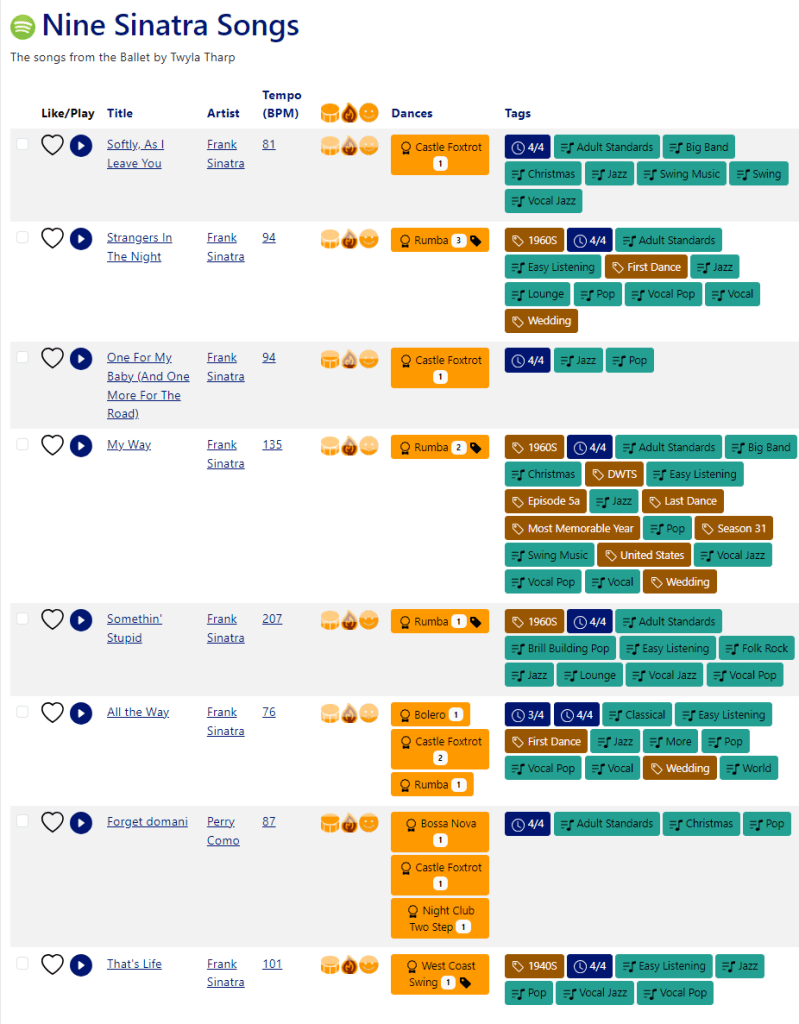
A snapshot of the eight songs used in "Nine Sinatra Songs"
The eight songs used in “Nine Sinatra Songs” as shown on music4dance.

Are there other partner dances that Tharp drew from in this work that we should represent in music4dance? Are there other Ballroom-inspired ballets out there worth viewing? Do they use different music that you’d like to add to the catalog? Are there other playlists that you’d like to overlay the music4dance information on, like I did with this one? If you have ideas about this post or the site, please comment below or use other feedback mechanisms listed here. And if you enjoy the site or the blog (or both), please consider contributing in whatever way makes sense for you.

What is that dance called? Swing, East Coast Swing, Triple Swing, East Coast, or…

When I got into the business of categorizing music by dance style, I knew there would be a lot of ambiguity involved. However, some of the passion behind people’s opinions about what a dance should be called or what tempos are acceptable for the dance called X still takes me by surprise. Several times a year, I get an email from someone who is absolutely livid that I “got the tempo of West Coast Swing completely wrong” or called a dance “Lindy Hop” rather than “Swing” or some other variation on the theme.

I learn a lot from the people who send these emails, and often learn something that helps me improve the site or my general knowledge of dance. One feature I added a while back, based on some of these interactions but haven’t discussed in the blog, was the idea of having “synonyms” for dances.

The way music4dance works, I have to have an unambiguous and unique name for a dance. This leads to somewhat clunky names at times – for instance, the dance that most dances consider “Waltz,” I call “Slow Waltz” to distinguish it from “Viennese Waltz” and to allow for a catch-all category of Waltz. But I want to be able to show other names for dances so people can find the dances even if they know them by another name. This applies both to cases where the dance really is the exact same dance; it’s just named differently to disambiguate it, and in cases where the parameters for what music works are close enough that it makes sense to use the same list of music for both dances.

Cases of actual synonyms:

Cases where the dances are different, but the music is the same:

  • Castle Foxtrot = Slow Dance – I started categorizing music that was basically Slow Dance music as Castle Foxtrot, which is a legacy dance that some studios occasionally teach because Castle Foxtrot showed up in my searches as I was designing the site, and fit nicely into the tempo spectrum of Foxtrot-like dances. The practical use of this ended up being more for people looking for “Slow Dance” music in wedding contexts, so I added the Slow Dance synonym. Perhaps I should change the primary name?
  • Hustle = DiscoFox – As far as I can tell, these have evolved into different dances but are still danced to similar music. But that is based on web searching rather than personal experience, so please correct me if I’m wrong. I’m also now second-guessing myself as to whether I should add “Swing Fox,” “Disco Swing,” and “Rock Fox” as synonyms, or if one or more of these rates is its own category.

In any case, if you go to the main “Dance Style” page, you’ll see all the styles we’ve set up, along with their synonyms. As this list grows, being able to filter it is more important, so the filter control acts on both the primary name and the synonym. I also handle the synonyms when you search in the search control in the menu bar. So if you type “Slow Dance” in that search box, you’ll find a list of slow dance songs (that are actually tagged as “Castle Foxtrot”). I don’t convert the name of the tag in the results, but I could if that seems important…

I’m posting this now in part because, during my recent round of updates, I broke the showing of synonyms in the Dance Styles page and then realized I hadn’t ever asked for feedback on the feature. The only mention in this blog was the post when I added it as an afterthought to adding Single Swing to the catalog.

Are there other synonyms that I should add? Are there dances that I’ve listed as synonyms that I should break out into separate dances? If you have ideas about this post or the site, comment below or use other feedback mechanisms listed here. And if you enjoy the site or the blog (or both), please consider contributing in whatever way makes sense for you.

Are you ready for your Halloween Dance?

Whether you’re a DJ getting your playlist together or a performer looking for that perfect song to craft a routine to, our Halloween collection is a great place to start. I’ve recently spent some time expanding the catalog. As of this writing, there are 222 songs tagged as Halloween with at least one vote for some kind of partner dance like Foxtrot, Cha-Cha, or Salsa.

Several years ago, I made an initial pass at taking generic Halloween playlists and cross-referencing them with the music4dance catalog of songs tagged by dance style. At the time, I did the simplest possible thing: I imported the songs from some Halloween catalogs and then put a link in the songs menu that went to that query. At the time, 80 songs were tagged as Halloween and associated with a dance.

This seemed fine at the time, but recently, I noticed folks searching on the keyword “Halloween.” What does that get someone beyond the songs I had explicitly imported a while ago? One of the side-effects of the system is that I link as many albums that a song has been released on as I can. This means that if a song lands on “Halloween Hits” or something like it, searching by the Halloween keyword will find it even though no one in the music4dance universe tagged it as such.

So, over the last few days, I spent some time reviewing that list and adding an explicit “Halloween” tag where I felt it was appropriate. For the most part, if the song was included on a Halloween Party album, I included it. But I didn’t include songs that were merely on an album because they were used in a horror movie. Some songs will still appear in a search for Halloween that aren’t in the explicit Halloween catalog. If you find one that would make sense to include in a Halloween dance, please tag it.

As I mentioned earlier, between the general evolution of the music4dance catalog and my current efforts, there are, as of this writing, 222 songs that are tagged as Halloween and also have at least one dance vote.

That starts to get interesting and motivated me to generalize the code I wrote a while back for Christmas/Winter holiday music to create a dedicated Halloween page. That’s where you’ll land if you choose Music -> Halloween from the main menu. And that gives an easy route to finding all the Halloween songs to dance a Single Swing to (for instance). You could have done that with the old system, but folks don’t always find the advanced search; this makes things a little easier. In addition, this gave me a smooth path to exporting the results to Spotify. Now, each Halloween Dance page has a Spotify widget with the playlist, and you can go to the music4dance Spotify account and browse the Halloween Playlists. While you’re there, please like the playlist and the music4dance account, which helps spread the word.

As always, I’m very interested in your feedback, so please share any thoughts and ideas about this post or the site by commenting below or using other feedback mechanisms listed here. In addition, if you enjoy the site or the blog (or both), please consider contributing in whatever way makes sense for you.

Would you like more content on music4dance.net? If so, what kind?

Brad’s comment on my Single Swing post made me realize that I’ve done a bunch of research on dancing and dance music that I haven’t effectively conveyed on the site or the blog. He pointed me to a site that listed tempo values for Single Swing that I already had in my notes and used when doing some of my earlier set-up of dances. But I didn’t credit that site or put a reference to it anywhere on music4dance.

So I started down the path of sorting out my notes with the intent of adding a whole bunch of new references to source material throughout the music4dance site. Since much of my initial research is over a decade old, can you guess what I discovered? I won’t keep you in suspense. A working majority, more than 75%, of the links that I used to research music4dance were dead. Most of those were sites that completely disappeared, a few were reworked and dropped the pages I was interested in, and a very few still had the content but at a different location.

Now, that lead me down the path of how many dead links I have on the site. As a programmer, I took a few hours off my content investigation to write a link checker. I was relieved to see that of the external content links I have on the site, less than a dozen were stale. On the other hand, the total number of those links is less than a hundred, so it was still about a ten percent failure rate. (I’m excluding links to songs, I know there is a significant amazon link issue that I need to deal with at some point).

The conclusion: I’m less excited about spending a bunch of time beefing out reference sections for dances and other content. But now that I’ve got the link checker in place, I could do that in a reasonably maintainable way.

This brings me to the main point of this post. I’ve been neglecting content again while spending time keeping code updated and adding features. So, I want to ask you what you’d like to see on the site. To start the conversation off, here are a few things that I’ve heard:

  • More references to information about dances
  • More detailed descriptions of dances
  • Additional dances (Kizomba and Country dances have been the biggest asks other than Single Swing, which is what kicked this all off)
  • More information about dance tempos, where they come from, what they mean, etc.

I’m sure you have many other ideas, so please let me know. I will kick this off by asking folks to add to the comments section of this post (or, if you prefer, you can message me privately). If I get enough interest, I’ll also set up a survey.

And while you’re at it, please let me know if there are other sites relevant enough to music4dance that it would make sense to add links.

As always, if you enjoy the site or the blog (or both), please consider helping by contributing in whatever other way makes sense for you.

New Dance: Single Swing

I’ve added Single Swing as a dance style that can be searched on and voted for in the music4dance catalog. While I think of this dance as a short-cut to use when I want to dance East Coast Swing to faster Jive or Lindy-Hop music, I’ve received enough feedback from the community that it’s considered a unique dance in its own right that I am happy to add it. From some light searching on this dance, it has gone by several names in different regions and times. Some of the names I saw were “Sing-time Swing,” “Single rhythm swing,” and “East Coast Single Swing.” It’s also one of several dances that have been called the Jitterbug at some point in the twentieth century.

I set the initial tempo to 140-184 beats per minute (35-46 measures per minute), which I found listed in several places. Since, as far as I can tell, this isn’t a competition dance, I haven’t found an “official” tempo range and am happy to adjust if someone with more expertise in this particular dance would provide feedback. I also seeded this list of songs with publicly available lists that sounded reasonable. Please feel free to go through to vote up other swing songs that you think are good fits for this dance. You can do this by adding songs or by searching for Swing songs in the Single Swing tempo range and voting up the ones that sound like good Single Swings. I’m also happy to bulk upload lists if you’ve got a CSV file or Spotify playlist of single swings that you’d like me to include.

Over the past several years, I’ve been moving the site in a direction where I hope to be able to handle more different dance styles and add them more easily. I’m getting closer to being able to add dances quickly. However, to add a lot of different dances, I’ll have to replace the underlying search engine (or wait for it to add some new features – it will be interesting to see which comes first). Some of the things I’ve done are to make lists of dances somewhat flatter and allowing search by name in most places where dances are listed. I’ve loosened the tie between types of dances (e.g., Sing, Waltz, Latin) and dance style, so that dance styles don’t have to be as strictly categorized as before. I’ve also added synonyms to dance styles, so in most places where you see the name of a dance style, other names of the dance are shown in parenthesis.

In any case, I’m always interested in what you think would be most helpful. I’m sure there are plenty of dance styles I’m not cataloging that fit into the broad category of partner dances that are danced to a specific tempo range or style of music. If you have a dance style suggestion or other comments, please feel free to reply to this post or contact me here. In addition, if you enjoy the site or the blog (or both), please consider helping by adding to the Single Swing catalog or contributing in whatever other way makes sense for you.

Ask music4dance: Should you add a Single Swing Dance category?

Arne had another great question (paraphrased): I see Single Swing being danced a lot these days.  Should music4dance add another swing category? Is Single Swing a local thing, national, really new? Do people still dance triple-step Swing?

Here is a slightly cleaned-up version of my response:

East Coast Swing (the triple step variety) is a competition dance, so it’s still being danced regularly in ballroom environments. But the Lindy revival of the ’90s seems to have dominated the social swing scene from what I can tell.

In the ballroom community that I learned to dance in during the ’90s, they used the term East Coast Swing to refer to the competition dance, which was definitely a triple-swing. But if one was dancing socially to music too fast to comfortable dance triple swing, you would revert to something they were calling Single Swing or East Coast Single Swing or some variation on that.

I fell down a rabbit hole, trying to see if my recollection had anything to do with current thinking on this. This video shows a “Single Swing” basic that is exactly what I think of as Single Swing. Duet Dance and DanceTime both have descriptions of various kinds of swings. They seem to agree that what I think of as Single Swing could also be reasonably called “The Jitterbug” (which I had thought was just a different name for Lindy Hop). As with any of this stuff, the history is so twisted up that there probably isn’t a correct answer, or if there is, it would require a historian to dig up.

Even without adding a new dance, you should be able to find some good ideas for Single Swings by searching for generic Swing in the tempo range between 140 and 184 MPM. When I first responded to Arne, I had broken that feature, but it’s now up and running again. So you can go to the Advanced Search Page, choose Swing in the dances section, and type in the tempo range you’d like to filter on. 

I am interested in incorporating Single Swing into the music4dance catalog. Should I do this as Jitterbug or Single Swing or by adding single and triple tags to East Coast Swing? I’d love to get others’ thoughts on this so please feel free to send feedback.

Asking to add a new dance style to the catalog is certainly in the top ten questions I’ve been getting. So I’ve been working on streamlining how I manage dance information to make that easier. Most of this work has been under the hood (although the bug mentioned above was one side effect). One of the more visible aspects of this is a small redesign of the Dance Styles page to simplify it a bit and hopefully make it a little more usable.

As always, I’m very interested in your feedback, so please share any thoughts and ideas you have about this post or the site by commenting below or using other feedback mechanisms listed here. In addition, if you enjoy the site or the blog (or both), please consider contributing in whatever way that makes sense for you.