Tag Archives: Tango

What is that dance called? Swing, East Coast Swing, Triple Swing, East Coast, or…

When I got into the business of categorizing music by dance style, I knew there would be a lot of ambiguity involved. However, some of the passion behind people’s opinions about what a dance should be called or what tempos are acceptable for the dance called X still takes me by surprise. Several times a year, I get an email from someone who is absolutely livid that I “got the tempo of West Coast Swing completely wrong” or called a dance “Lindy Hop” rather than “Swing” or some other variation on the theme.

I learn a lot from the people who send these emails, and often learn something that helps me improve the site or my general knowledge of dance. One feature I added a while back, based on some of these interactions but haven’t discussed in the blog, was the idea of having “synonyms” for dances.

The way music4dance works, I have to have an unambiguous and unique name for a dance. This leads to somewhat clunky names at times – for instance, the dance that most dances consider “Waltz,” I call “Slow Waltz” to distinguish it from “Viennese Waltz” and to allow for a catch-all category of Waltz. But I want to be able to show other names for dances so people can find the dances even if they know them by another name. This applies both to cases where the dance really is the exact same dance; it’s just named differently to disambiguate it, and in cases where the parameters for what music works are close enough that it makes sense to use the same list of music for both dances.

Cases of actual synonyms:

Cases where the dances are different, but the music is the same:

  • Castle Foxtrot = Slow Dance – I started categorizing music that was basically Slow Dance music as Castle Foxtrot, which is a legacy dance that some studios occasionally teach because Castle Foxtrot showed up in my searches as I was designing the site, and fit nicely into the tempo spectrum of Foxtrot-like dances. The practical use of this ended up being more for people looking for “Slow Dance” music in wedding contexts, so I added the Slow Dance synonym. Perhaps I should change the primary name?
  • Hustle = DiscoFox – As far as I can tell, these have evolved into different dances but are still danced to similar music. But that is based on web searching rather than personal experience, so please correct me if I’m wrong. I’m also now second-guessing myself as to whether I should add “Swing Fox,” “Disco Swing,” and “Rock Fox” as synonyms, or if one or more of these rates is its own category.

In any case, if you go to the main “Dance Style” page, you’ll see all the styles we’ve set up, along with their synonyms. As this list grows, being able to filter it is more important, so the filter control acts on both the primary name and the synonym. I also handle the synonyms when you search in the search control in the menu bar. So if you type “Slow Dance” in that search box, you’ll find a list of slow dance songs (that are actually tagged as “Castle Foxtrot”). I don’t convert the name of the tag in the results, but I could if that seems important…

I’m posting this now in part because, during my recent round of updates, I broke the showing of synonyms in the Dance Styles page and then realized I hadn’t ever asked for feedback on the feature. The only mention in this blog was the post when I added it as an afterthought to adding Single Swing to the catalog.

Are there other synonyms that I should add? Are there dances that I’ve listed as synonyms that I should break out into separate dances? If you have ideas about this post or the site, comment below or use other feedback mechanisms listed here. And if you enjoy the site or the blog (or both), please consider contributing in whatever way makes sense for you.

Partner Dance Songs in Broadway Musicals

We recently attended a production of Peter Pan. This wasn’t a musical we would normally seek out, but it was part of a season that we subscribe to, so what the heck. Perhaps it was because expectations were low or more likely because of the Jerome Robbins choreography, but we quite enjoyed it.

Why am I telling you this? If you check out the cast recording (this is the  1989 recording, but it’s approximately the same songs as the 2024 production), you’ll see a couple of easily recognizable dance names in “Hook’s Tango” and “Captain Hook’s Waltz” and a couple of slightly less recognizable dances (at least to a ballroom dancer) in “Hook’s Tarantella” and “Pirate March.” There is obviously cross-pollination between dancing and music in Broadway musicals and the partner dancing and related music I catalog here. In fact, one of the friends who originally coaxed me into the ballroom dancing world started dancing when he performed in musicals.

That got me going down the path of what we currently have cataloged in the cross-section between musical theatre and partner dance music. I went to the tag cloud page and looked for relevant tags. There were several, which is a mixed blessing and also pretty common in this system where I’m pulling data from various places, including crowd-sourcing. The most relevant tags I found were “Broadway” (30 songs), “Show Tunes” (43 songs), “Musicals” (36 songs), and “Broadway and Vocal” (98 songs). This got me into the same kind of situation as when  I first looked at holiday music where I wanted to do a search that the system doesn’t allow. But like the holiday music issue, this is a limitation of the interface I built rather than the underlying database, so it’s easy enough to further generalize the code I wrote for holiday music and Halloween music and land on an excellent solution for Broadway music.

Broadway soundtracks are a rich source of fun songs to dance to, but even with this custom search, I don’t think the existing music4dance database does it justice. What songs from musicals inspire you to dance? Do the actors dance a recognizable version of the dance on stage, or do the songs just work for the dance style? I’d love to see more songs from Broadway in the catalog. Please feel free to contact me if you have lists in any form, and I’ll incorporate them. Or even better, feel free to add them yourself if you have some favorites.

Also, please let me know if you have ideas for searches that you can’t make work with the existing system. I am considering generalizing the search in a couple of different ways, and ideas from you will help me pick a direction. I am also considering adding a “fun searches” page to share some of the searches you can do with the current system, but it might not be easily discoverable. Send me your favorite fun searches, and if I get enough, I’ll increase the priority of that feature.

Please share any thoughts and ideas about this post or the site by commenting below or using other feedback mechanisms listed here. In addition, if you enjoy the site or the blog (or both), please consider contributing in whatever way makes sense for you.

Book Review: The meaning of TANGO

The Meaning of TANGO: The Story of the Argentinian Dance by Christine Dennison

This is a fun book for Tango dancers of all types.  The book is very centered around traditional Argentine Tango and does an excellent job of conveying that perspective.  It’s also somewhat unusual in that it is predominantly about the history and philosophy of the dance but contains a section that is straight up technique with diagrams.

The book is a quick read and full of wonderful tidbits about the dance and its history.  Rather than a full-fledged review, I would like to highlight a few points that I feel gave me some useful insight into Argentine Tango.   I am someone with a ballroom background and  I believe this book helped me understand the dance in a way that I didn’t have even after taking a number of beginning Argentine Tango lessons.

Dance to the Melody

There is a section called “One Name, Many Dances” where the author talks about the relationship between Argentine Tango and ballroom dances.  In particular this quote from Freddie Camp, an early German Ballroom dancer:

In Argentina dancers prided themselves on their ability to dance the melody rather than the rhythm. Indeed, Tango orchestras almost never have a drum section. While most other dance music around the world is based on a strong, clear rhythm, generally emphasised by drums, newcomers to Tango music often complain that they find the rhythm of the music difficult to hear. This is one of the qualities that makes Argentinian Tango unique.

The idea of dancing to the melody rather than the rhythm goes a long way to explaining the thing that puzzled me about the practice music that was used in the beginning Argentine Tango lessons that I’ve taken.  I felt that the teachers were choosing music where the beat was hard to find, which I would not expect of a beginning class.  So I’m going to spend some time listening to the melody of Argentine Tango music and see if I can find myself moving to the melody.

Learning to Lead by Following

I found the description of how Argentine Tango was taught traditionally particularly enlightening.  The men would learn in prácticas which were all male and composed predominantly of expert dancers.  When learning to follow a young man would spend his formative years being led by experienced dancers.  Then he would spend additional years within the práctica leading other men before he ever went to a mix sexed milonga and lead a woman.   The fallout of this is that in the context of learning the dance, one was surrounded by experts.  Contrast this with the current practice of dance classes where there are one or two teachers and a crowd of inexperienced dancers.

In addition, from a lead’s perspective, learning to follow is invaluable.  I didn’t do this until I had years of lead experience and when I finally did spend some time learning to follow it fundamentally changed the way I lead.

The Tango Trinity

Finally, the author talks about the “Tango Trinity”: Tango, Milonga, and Vals.  From some other research and some discussion with Argentine Tango dancers, this appears to be the purist’s set of Tango dances.  I had originally categorized Neo Tango into the set of Argentine Tango dances, but that appears not to be the case.  Based on this, I almost went down the path of pulling Neo Tango from the catalog as a distinct dance and reworked it so that Neo Tango (or Tango Nuevo) would just be a style tag on top of the Tango Trinity dances.  But I’m glad I did some further research.  It looks like Neo Tango is a distinct style of dance and related to traditional Argentine tango about as closely as Ballroom Tango is.

The main thing that I got from that set of discussions is that Argentine Tango dancers are even more concerned with the tradition of the music that other styles that I’ve studied.  I got the impression that some would only consider “true tango music” to be that recorded by a specific set of artists from the golden age.  Someday, I’d like to see if I can get things sorted out so that it’s easy to distinguish these from others.

If you have thoughts on the Argentine Tango, the music4dance website or corrections to anything I’ve said about Tango and Tango music, please feel free to comment here or send me feedback.

Also, if this post sparked your interest enough to buy the book, please follow one of the affiliate links below.  And as a small aside, any of the Amazon and ITunes links on the site and blog help support the site, so if you find things of interest here, please use the links to make purchases.

The Meaning of Tango: Kindle Edition

The Meaning of Tango: Hardcover Edition

The Meaning of Tango: Paperback Edition

Finding the latest music on music4dance (take 2)

There are enough people that visit music4dance regularly that I thought it would be worth revisiting how to make it easy to find the most recently added and changed music on the site.  I did one pass at this back in November of 2016 when I had to change the default away from listing songs in order of most recently changed.

But that involved adding a link the home page and some options in the Advanced Search page and didn’t do a great job of leading people to that option if they didn’t know it was already there.

So I’ve added a “New Music” option in the “Music” menu.  This will take you directly to a page showing the songs with the most recently added first as well as an easy link to switch over to the most recently changed songs.  I hope this is a bit more discoverable than previous methods.

Once you’re on the New Music page you can use all of the usual methods of tag filtering to narrow down your search and we’ll preserve the sort order that you started with.

You can still use Advanced Search to do things like finding the most recently added Rumbas or Tangos.

We’re adding new music as we find it.  You can help in a couple of different ways.  Sign up for beta feature1 to add your own songs, mark exiting songs as danceable to a particular style, or send me lists of your favorite songs and what you dance to them – I can import any reasonably formatted list and will be happy to associate those songs with your account and set up a back-link to your site.

It’s great to see so many people use the site.  Please let me know how you use the site, I’m always delighted to hear your feedback both positive and not so positive (the latter is often what leads me down the path of new and revised features).

  1. Update: Adding songs is now out of beta – see the documentation for more info. ↩︎

Tango, Argentine Tango, Ballroom Tango, Oh My!

I just took a beginning Argentine Tango class and really enjoyed the experience.  I’ve had some experience with Ballroom Tango (American Style) and even taken a little Argentine Tango before, but this particular class really underlined the difference in the actually dance style.  Searching the web, I find plenty of evidence for this.

From the musical perspective, I found that I would be comfortable dancing Ballroom Tango to most of what the instructors played for Argentine Tango.  The character of the music seems very much the same.  The tempo was definitely slower than I would choose, but it was a beginner’s class after all.  The beat was less clear in many of the songs than I would expect in a Ballroom tango played at a school, club or competition, which was surprising.  This was a beginner’s class after all.

Now that I think about it, the Spotify EchoNest integration in music4dance could shed some light on the subject of strength of beat.  You can do an informal analysis yourself:

  1. Go to the songs library page.
  2. Choose Argentine Tango.
  3. Click on the strength of beat sort (the header icon that looks like a drum) once for ascending and twice for descending order.
  4. This will get you a list of the (currently) 578 songs that have been classified specifically as Argentine Tango sorted by the strength of beat.
  5. Or just click here to see the list.
  6. In a separate window repeat step’s 1-4 substituting Ballroom Tango for step 2 to get the 438 Ballroom Tango songs that have “strength of beat” information.
  7. Or just click here.

Now you can see the lists of Argentine Tango and Ballroom Tango both sorted by strength of beat.  At a quick glance the distribution seems pretty similar, but if anyone is at all interested let me know via a comment to this blog and I will be happy to do a slightly more formal analysis.

The other aspect of Tango music for dancers that this brought up was where to draw the line on calling something generically Tango vs. Ballroom Tango vs. Argentine Tango, etc.  I am currently calling anything a Tango that someone has tagged as any kind of Tango, which I think is fair.  Often people will just call something just Tango if they are from a particular community and I think that’s fair too.

If you are interested in stretching your reach and finding all Tangoes of whatever classification that fit a specific tempo criteria, you can use advanced search to choose generic Tango as the dance and choose a tempo range you’re interested in.  Or if you’re a Ballroom dancer you can go to the Competition Ballroom Dancing page and just click on the tempo range for the category of Ballroom Tango that you’re interested in.  I’ve set things up with the current official tempos for DanceSport and NDCA competition classes.

Speaking of official tempos.  Although I’ve found quite a number of sites that advertise and even provide rules for Argentine Tango competitions, I have yet to find anything that defines any kind of official tempo ranges for the music played at the competitions.  I suspect this is something fundamentally different about those competitions.  However, if I’m missing something and there are such official ranges, please let me know and I’ll incorporate them into the site.

And as always, please let me know what I’ve missed.  This is a very nuanced subject and I would love to hear other perspectives.  Feel free to comment on this post or send feedback directly.

Oops, I didn’t mean to throw that needle into the haystack…

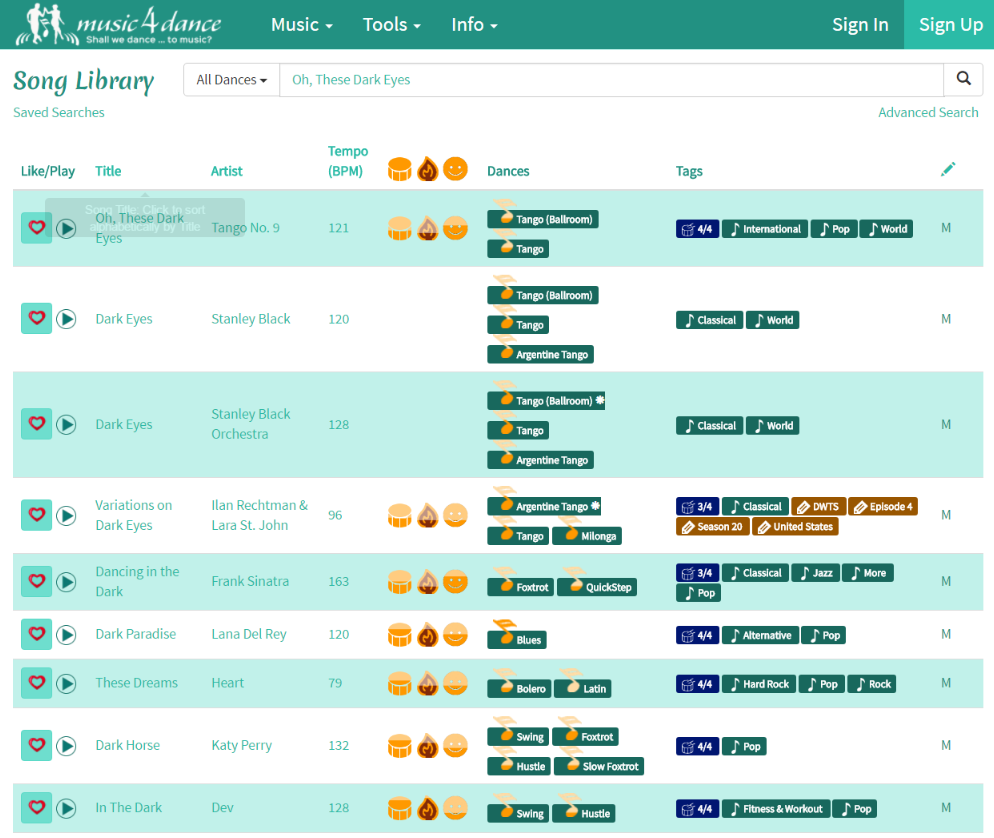
I recently heard from a customer that he was searching for “Oh, These Dark Eyes on the site and this is what he saw:

Search with bad sort

In fact, “Oh, These Dark Eyes” by Tango No. 9  is in the music4dance catalog, but it wasn’t even showing up on the first page.  That seems crazy.  And wrong.

After a little digging, I discovered my mistake.  When I merged the Search Like Google feature into the default search I left the default sort set to “most recent”.  So when you search for anything with a bunch of words in it, there will be a whole lot of results (in this case 464) and if I sort by anything other than closest match what I’m really looking for is likely to get lost like a needle in a haystack.

This should now be fixed.  When you search by default you’ll get the most relevant results at the top of the page (just like a normal search engine).  I’ve also added a “Closest Match” button to the search order possibilities on the Advanced Search Page which is the default.

So hopefully there will be less searching for needles in haystacks.

dark-eyes-good

Thanks to the gentle customer that pointed out my mistake.  I’m always looking for ways to improve the site so please feel free to send me feedback if anything looks like it’s not working the way you suspect.  Even if it’s not an outright bug (like this one was), I’m happy to take feedback and see if I can make music4dance a more useful resource for you and others.

And lest you think I’ve dropped my head completely back into code and failed to continue to improve the content, I’ve added some more DWTS songs this week as well as digging up and integrating some fresh lists of  ballroom music, including some fun new Cha-Cha, Rumba, and Tango songs.  You can still find the most recent changes to the catalog by sorting by modified date.  That’s the little pencil icon right below the “Advanced Search” text on any search results.   Or if you want to get tricky and just find the songs that have been most recently added, you can go to the Advanced Search Page  and choose “When Added” in the “Sort By” field.

What are Your Favorite Song to Dance Bachata?

A number of people have pointed out that my attempt to generalize the “rules” that I use to pick Ballroom music, especially slightly edgy ballroom music have caused the social music parts of the music4dance catalog to veer a bit (or more than a bit) off course.   One way to solve this is to spend some time on each of the social dances and see if I can get some more concentrated people knowledge to help contribute to a better list.

And since I’m going to be taking Bachata lessons for the first time starting next week, that seems like a great place to start.  I’ve pulled together a couple of the albums that the teacher recommended and some Bachatas from a few other sources to get an initial list together here.  What do you think?  Am I anywhere close to a decent list?  What am I missing or what is on this list that you absolutely wouldn’t dance Bachata to?

The other thing I noticed is that it looks like Bachata has a broad enough history that it may make sense to either split them up (like I did with Tango) or maybe more reasonably start tagging them by sub-style?

Please feel free to respond to this post with song ideas or more general suggestions.  You’re also welcome to sign in to the site and start voting on songs.  And if you’re not a Bachata expert, that’s all right, there is plenty of room for improvement elsewhere in the catalog.

The Pink Martini Solution

Not all artists are created equal when it comes to creating dance-able music.  For instance, one of my favorite artists of all time is John Coltrane.  Do you see him well represented in the music4dance catalog?  Absolutely not.   Because a consistent tempo just isn’t a core part of his music.  Which is part of the appeal when listening, but doesn’t work particularly well when trying to Lindy Hop.

Towards the opposite end of the spectrum, sits Pink Martini.  They are a band that plays a combination of original works and updated covers of classic melodies.  Many of both types of song are in a musical style that co-evolved with a partner dance.  Take “Let’s Never Stop Falling In Love“, which is a classic Tango if I ever did hear one, but still has the unique Pink Martini flare.  Or “Amado Mio“, which has a extremely dance-able Rumba beat.  And don’t forget “Hang On Little Tomato“, a wonderful Foxtrot as long as you can dance through the lyrics without cracking up, or possibly tearing up.  That little tomato has quite a challenge ahead of him!  And if you are up for a challenge yourself, try to West Coast Swing to “Hey Eugene” while keeping a straight face.

Pink Martini’s catalog is both broad and deep and most of their songs are well suited to partner dances.  Check them out on music4dance.net and if you like what you hear, let me know and I’ll catalog some more of their songs.