
I’ve addressed questions about tempo in several different ways over the years, and I appreciate the continued feedback, as there is absolutely room for improvement in how the music4dance system handles tempo.
Algorithms are far from perfect:
The issue at hand is that many of the tempos listed for Salsa were exactly half the speed at which one would dance. There is a straightforward explanation for this. Many of the tempos listed on the site are algorithmically generated. The algorithms are decent at this point for many types of music. But with some music (and Salsa definitely falls into this category), the algorithm “hears” a double-time or half-time beat and chooses that over the “correct” tempo for the dance.
I have several mitigations for what I think of as “shadow” tempos that I’ve implemented over the years, including a new one that was prompted by the email that also convinced me to write another post on this subject.
First, the system prefers a user-entered tempo over any algorithmically generated tempo, even if the latter is more recent (the general default for conflicting information is to believe the most recent edit). I currently don’t open up editing tempos to every user, but contact me with an example of something you’d like to change for a quick check that we’re on the same page, and I’d be happy to add that permission to your account. The more people we have catching and correcting these issues, the more reliable the site will be overall.
Second, I occasionally do a pass through the database and adjust the tempo values that are obviously outside a dance’s tempo range if halving or doubling them would put them within the dance’s range. I recently ran this process for Salsa, which significantly reduced the number of songs with the issue that prompted the original complaint. I have considered generalizing this algorithm so that if a song is added without specifying a tempo and the system generates a tempo algorithmically, it would make a simple adjustment to double or halve the tempo if that puts it within the dance’s range. But I haven’t pulled the trigger on that yet. In any case, this process still left a few songs tagged as Salsa with very unsalsa-like slow tempos. I’ll dig into that shortly.
The last feature that I hope mitigates this algorithmically generated tempo issue is brand new. People need to understand that a tempo is algorithmically generated and should therefore be taken with a grain of salt1. But there was no easy way in the music4dance user experience to indicate that the system had generated a tempo algorithmically. Now, near each algorithmically generated tempo listing is a small icon of a computer chip; clicking that icon takes you to our help page with information on how tempos are generated.
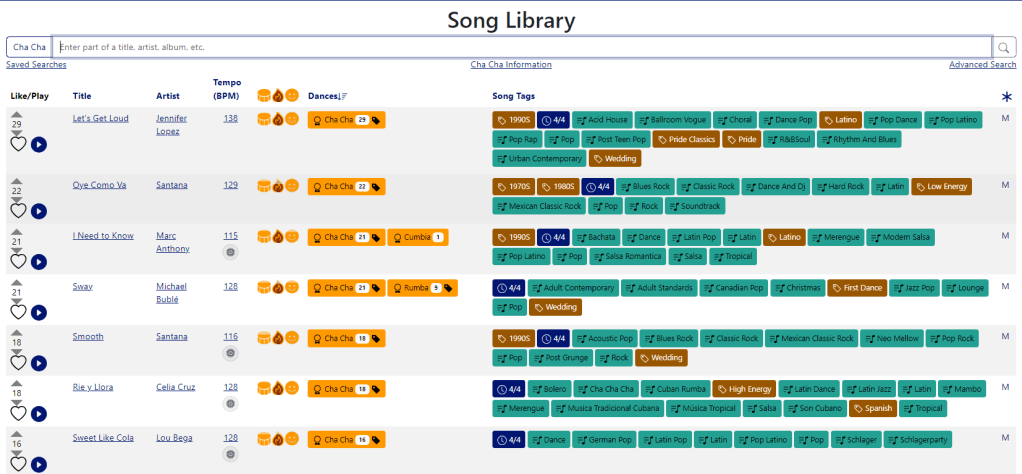
Different dancers can hear different beats:
But there is another, related issue. It’s not just algorithms that can “hear” a double or half-time beat. Dancers can do the same thing2. The algorithm hearing a half-time beat mentioned above is precisely the opposite problem from the one I discussed in this post, where the tempo was twice what one would dance Bolero/International Rumba to. But it was for a similar reason. Some songs have a strong enough double-time or half-time beat that it’s hard to tell which is the primary beat to count or dance to. When you are actually on the dance floor, this generally doesn’t matter, since if you’re at a salsa club and the choice is between dancing to 190BPM and 95PM, you’ll dance at 190BPM. Or conversely, if you’re in a dance studio where you’ve been studying American Rhythm, and have the same choice, you might choose to dance Bolero at 95BPM (or maybe Mambo at 190BPM, depending on the feel of the song).
So the remaining songs in the music4dance Salsa catalog that are listed as much slower than one would dance a salsa remain because someone set that tempo based on a different dance where the slower tempo is appropriate (or because they were added with an algorithmic tempo since the last time I did a pass to clean them up). There is no easy way to solve this problem when each song has only one tempo. But I’ve been refactoring the code and the indexing service to make it easier to carry more information about the intersection between dance and song, which would allow us to list a different Salsa tempo than a Cha Cha tempo for the same song. The problem is that we would have to save a tempo field for every song/dance combination, even in the most common case where all dances to a given song are at the same tempo. I need to do some more testing to make sure that doesn’t degrade the overall search experience. The more I hear from you that this limitation is frustrating, the higher it will rise on my to-do list.
As always, please let me know if you have any thoughts about the subject of this post or the site by commenting below or using other feedback mechanisms listed here. And if you enjoy the site or the blog (or both), please consider contributing in whatever way makes sense for you.
Footnotes
- This strikes me as ironic, since I vibe-coded this feature using GitHub Copilot and Claude. And even though the underlying algorithmically generated tempo issue existed long before the current generative AI situation, it has a similar feel to me. ↩︎
- It’s also really fun to be able to dance a different dance than the rest of the room if you can make it work, but that may just be my rebel nature. ↩︎
What Happens When a Song is Danced at Different Tempos?
Sometimes, a song can be a perfectly good Bolero when heard one way but a Salsa when counting the music differently. Another example is Slow Dance (Castle Foxtrot) vs. Lindy Hop. Generally, this phenomenon is because, with some music, it’s easy to count what the musicians see as either a half note or a quarter…

Ask music4dance: Why is the tempo range you list for West Coast Swing wrong?
A West Coast Swing DJ contacted me and kindly let me know that the tempo range I had listed for West Coast Swing was “entirely wrong.” The average tempos that she plays are between 90 and 110 bpm, while I listed a tempo range of 112-128 bpm. Before I dig further into the details, I’d…
Ask music4dance: Why is the tempo that you’re listing for Ricky Martin’s “Casi Un Bolero” wrong?
I’ve seen a number of questions recently about why information on the site is wrong. So I’ll start with one of the easier ones, which I’ve seen a number of variations on but is basically, “why is the tempo wrong”. Here’s the specific question that prompted me to write this post: There are a lot…

 music4dance