Category Archives: About music4dance

Posts that are about the music4dance.net site features, excluding features that are specifically about searching for music.

Musicians for Dancers

One of the things I enjoy most about the musci4dance project is when I get feedback from people who have found the site useful.  I’m especially happy when it comes from a direction that I don’t expect.  It’s exactly that kind of feedback that I received from Mister “D” (David Simmerly) – a musician who performs for Ballroom clubs and weddings and was looking to expand his repertoire with music that would be well received in those contexts.

I asked Dave to expand a little on how he used music4dance and (paraphrasing) here are a few of the things that he came back with:

The first and second points led to an extended discussion about songs that are listed as Waltzes but are not in 3/4 time – check out my blog post on “Fake” Waltzes for more on that.

But there is a more general point that I would like to make here with respect to “correctness” of music for dance.  I’ve compiled this catalog with an eye for finding music that inspires dancers to dance.  This makes for a very loose definition of what songs “work” to dance a particular dance to.  In a setting where a dancer is choreographing to a specific piece of music, even when that choreography is a traditional ballroom dance like in Dancing With the Stars, there is quite a bit of latitude in what music will “work”.  Whereas in a social situation the dancers are more dependent on the beat and feel of the music to enjoy the experience of partnering in a specific dance style.  And then of course when one is dancing competition rounds, there are even stricter rules about tempo.

In any case, I hope that many of the songs in the music4dance catalog fall into the category (as Mr. “D” says) of “making your pants want to get up and dance.”  In the future, I hope to do a better job of tagging dances in a way that separates the strictly ballroom from the fun to choreograph to from the great songs for social dancing.  The system is at least theoretically set up to do this since I’ve enabled arbitrary tagging of songs.  It’s a big project to go through each song in an 11,000+ song catalog and make the kind of distinction I’m talking about here.  On the other hand, it is exactly the kind of thing that works well when others jump in to add their own ideas to the mix.

As always, I welcome your feedback and participation.  Thanks to David Simmerly for permission to use his name and information in this post.  If you’re in the midwest and are looking for a great solo entertainer for your Ballroom Club, Wedding Reception or another occasion, you can find him on gigsalad.com.

How do I find the latest music added to music4dance?

I’m adding new music just about every week, so if you’re a frequent visitor to music4dance how can you see what is new?

I used to show you music sorted by most recent by default.  But as I noted in this blog post, that’s no longer feasible, when balanced against the ability to do google-like searches.

Don’t panic – it’s still easy to do.  Whenever you’re looking at a list of songs in the song library, you will see that the last column is a single letter and the header for the column is a pencil icon.  Clicking on that icon once will show you the most recently modified songs first, clicking a second time will show the oldest songs first.

If you want to get even fancier, you can go to the advanced search page  and choose either “Last Modified” or “When Added” and a direction.  “Last Modified” is exactly what you get with the pencil icon, “When Added” sorts by when the song was first added rather than when it was last changed.

Are there songs that you love to dance to that you don’t see here?  I’d be delighted to add them, just send me a list include title, artist, album and what kind of dance and I’ll add them to the catalog.  Or would you prefer to add them yourself?


P.S. For those that may be wondering, here is what the letters in the date column mean:

  • s = seconds
  • m = minutes
  • h = hours
  • D = days
  • W = weeks
  • M = months
  • Y = years

You can see the actual date and time that a song has been modified by hovering over the letter.

EchoNest Integration – Loads of new tempo, meter and other information to help you find music to dance to

I’ve cross indexed the music4dance catalog  with the EchoNest database and exposed some new features.

The most fundamental improvement is that EchoNest provides tempo and simple meter information.  So I’ve been able to add tempo information to a number of songs that I didn’t have cataloged that way before.  And I’ve also added the time signature tags to these songs.

But more importantly, EchoNest does some interesting analysis of the music to come up with some acoustic attributes to describe a song musically.  They are:

  • beat-10 Beat: An attempt to characterize the strength and consistency of the beat.
  • Energy-10Energy: The intensity and power of the music – this is probably the most intuitive of the attributes.
  • mood-10 Mood: A measure of the mood from positive or happy down to sad or angry.

I am representing each of these attributes as a graphical column headed with an appropriate icon (drum for beat, flame for energy and smile for mood).  Each column is sortable both from high to low and low to high and when I have data for a song, the icon in that song’s row is ‘filled’ to a proportional amount.  EchoNest provides a number from 0 .0 to 1 .0 and I translate that into icons that are 0 to 100% filled (in 10 bands).

More information on this integration can be found on the help page.  Or just head over to the music library and start experimenting.

For instance, here is a snapshot of a list of songs that are tagged as “First Dance,” can be danced to some form of Foxtrot and contain the word “Love“.  They are sorted by “Beat” from strongest to weakest.  If you’re looking for a song to dance your first dance to and aren’t an experienced dancer, you probably want a strong beat.

EchoNest

What do you think?  Are there other acoustic attributes that I should include?  Would you like to be able to sort on multiple attributes on the same time or filter on one attribute and sort on another?  These are all entirely possibly, but I need your help to prioritize these features.  Please feel free to reply to this post or leave feedback with any thoughts you have on this set of features.

Quality over Quantity?

One of the things that I’m struggling with in the music4dance project is the pull between finding lots of recommendations for songs to dance to against the desire that those recommendations being in some sense ‘good.’  As I noted in my last post, more manual curating will certainly help.

Another way to attack this problem is to tune down the mechanical methods I’m using to find recommendations.  So for now I’ve changed the default for most dance recommendations to only pull up songs that someone has explicitly noted are good to dance to that particular style. So, for instance, the Carolina Shag catalog doesn’t get polluted by songs that someone has tagged generically as ‘Swing‘ that happen to be a reasonable tempo to dance Carolina Shag to.  And the top 10 lists for individual dance style pages are filtered the same way.

Hopefully this will give you a better start at ‘core’ songs that work for each dance style.  Check it out and let me know what you think.

P.S.  What if you’re interested in getting the broader range of recommendations?  Say you’re looks for songs that might work to dance a style to that might not be quite the musical style that is normally danced to.  There are a couple of things you can do.  First, you can go to advanced search page and check the “Include Inferred” check-box.  This will give you the old results where we pull in songs that are marked with a related dance style and are of an appropriate tempo.  Or you can just do a tempo filter on the advanced search page and see what comes up…

Let’s tag some songs

After several rounds of closed beta, I’m ready to open up the account management and tag editing features as public betas.

The tag editor is the first of a  number of features that I’m planning that will enable you to customize your music4dance experience. With the tag editor you can tag songs and the relationships between songs and dance styles based on your own tastes and then use the tag filtering tools to create song lists based on your own tags as all the tags already in the system.  In addition, just the act of tagging a song adds it to your master list of songs.

Get started by registering.  Then take a quick look at the documentation and get started.  Or for the more daring among you, just start tagging songs and see what happens.

Thanks for trying this feature.  Please submit bugs and feature requests with our bug report form.

Question 2: What dance styles can I dance to my favorite song(s)?

Again, I rephrased the question from my original post.

One of the things that amazes me about the best dance teachers I know is that they seem to do this matching instinctively.  They hear the first bar or two of a song and immediately know which dance(s) to dance.  I imagine “instinct” in this case is some combination of natural talent, many hours of practice and the amount of time that they spend listening to music and thinking about how it fits with dance.

After dancing for 20 years, I have something of this sense myself, but being a techie first and a dancer second I feel compelled to break it down a bit more.

There are two sub-questions here; let’s call them 2a and 2b.

Question 2a: “Does the style of music match the style of dance?” This is very much about the general feel of the music – so salsa music sounds like music that you would want to salsa to and swing music sounds like music that you would want to swing to.  But it’s also about the rhythm.  The most straightforward example of this is Waltz, where the three-count rhythm is very distinctive.  Conveniently, every partner dance that you can dance to three-count rhythm has waltz in its name.  There are more subtle variations on this concept: Cha Cha music has a distinct “4 and 1 (or cha cha cha)” emphasis that makes it feel like a cha cha, mambo music sounds a lot like salsa, but with emphasis on the second beat, and there is something called “Swing Rhythm” that distinguishes swing music from other kinds of music. And the list goes on.  I don’t have a great idea for a tool to help with this, but I’m considering writing a more in-depth series on how this relationship works.  So if you’re interested please let me know and I’ll move that up my to-do list.

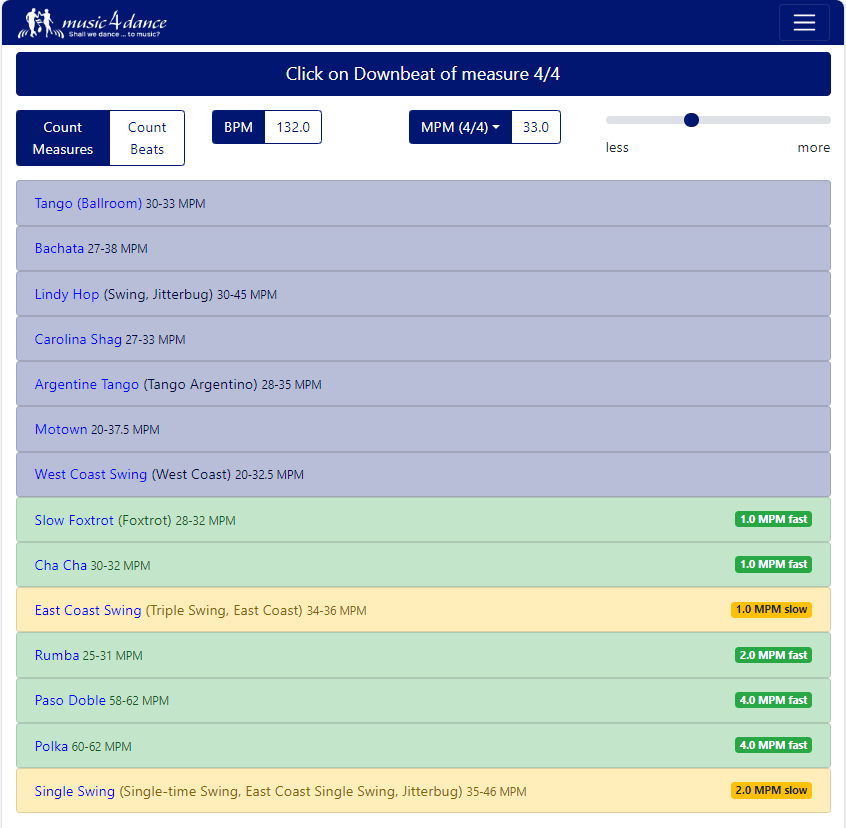
Question 2b: “Does the tempo (speed) of the music work for the dance?”   Swing is a great example since there are a whole bunch of different dances that can be danced to music that is in the swing style, but they are each danced at  a different tempo.  For example, West Coast Swing is best danced between 28 and 32 measures per minute (MPM), East Coast Swing between 34 and 36 MPM and Jive between 38 and 44 MPM.  I’m building a web application  that at least partially solves this problem.

With this app. you can count out a few measures by clicking the count button on the first beat of each measure and it will not only show you what the tempo is, but also suggest a number of dances that will “work” for this tempo.  Pretty slick, no?  What would you add to this to make it more useful?

Question 1: I’m learning to Cha Cha, where is some great music for practicing?

Okay, so that’s a slight rephrasing of the question from my previous post.  But it sticks to the spirit of the idea.  As a dancer learning a specific new dance, be it Cha Cha, Paso Doble or Waltz, where can I find music?

So how do I do that?  Dance generally co-evolves with music, so to get a very traditional song for any dance, it’s usually easy to find a source.  If you like swing dancing, Benny Goodman is a great source or if you like to waltz Strauss is always available.  However, if you’re trying to learn a number of dances at about the same time or if you’ve got taste in music that is more modern than the traditional music that the dance evolved with, this starts to get confusing.

It’s also often the case that some of the most interesting choreography to traditional ballroom dances is performed to music that is entirely different than the style that it evolved with.  A recent example of this is Jean Marc Genereux’s Paso Doble1 on  So You Think You Can Dance Season 11, choreographed to Rob Zombie’s Dragula.

In any case, there are of course as many ways to answer the question at hand as there are dancers.  From my perspective, one way to go about finding dances to Cha Cha to is to it to go ask the internets.

Well, I’ve done internet searches on various dance styles a number of times over the years. I’ve combined the results along with some songs from my personal catalog.  I’ve done a bunch of merging, cleaning up and matching to four of the major music service (Goove®, Amazon® , iTunes® and Spotify®) and the result is the dances page on the site.

What do you think?  Would you use the music4dance dances page now?  What features would you need to make this something you would use? What would make this into a site that you couldn’t live without?

  1. When I originally wrote this post I was able to link to the episode on fox.com. That has since disappeared, so I removed the link. I would like to take this opportunity to express my disappointment that there is no way I can find (even via paid subscriptions) to access back episodes of this show. I’m assuming it has to do with rights (probably especially rights to the music), but it’s still quite frustrating. ↩︎

The Two Questions that Inspired Music4Dance

As a beginning ballroom dancer there were two questions that kept coming up:

  1. What are some songs that I could play to practice the dance that I’m currently learning?
  2. Which dance style(s) can I dance to this song that I’m currently listening to? For instance, would this work for a Cha Cha or an East Coast Swing?

The dances page on the site is the beginning of an answer to question #1.

Dances
A partial snapshot of the Dance Style page from music4dance as of January 22nd, 2024

And, the counter page is the beginning of an answer to question #2.

music4dance beat counter
Snapshot of the beat counter/dance finder as of January 22nd, 2024

Which of these questions is most important to you? Or what other questions are more important to you?

If you’re a dancer or teacher, what are the questions you ask?