
Tag Archives: Peabody

Nine Sinatra Songs – Ballroom inspired Ballet

Pacific Northwest Ballet included Twila Tharp’s Nine Sinatra Songs as part of their Director’s Choice performance this year. I’m not in any way qualified to review a Ballet performance, but I can say that I thoroughly enjoyed it and had a great time playing with the Ballroom-inspired aspects of the dancing as I watched the show unfold. For me, the idea that the dancing was inspired by ballroom rather than in any way attempting to choreograph actual ballroom dance steps on ballet dancers is what made it work (this is the issue I sometimes have with partner dance in Broadway musicals). It was obvious in several of the nine pieces that  Ballroom dance inspired the piece, and the upper body shaping and movements felt quite ballroomesque throughout the performance.

On returning home, I hoped to find a resource that listed the dances that Tharp drew from for each of the first eight pieces (the ninth is a reprise group number), but I failed. The notes from some of the performances mention the roots of one or two dances, but it seems like, for the most part, they name the same couple of songs. So, my guess is that even a thorough search of those through the years wouldn’t yield a complete list. As an aside, it was fun to jump down the rabbit hole of the French Apache Dance that Tharp drew from for the choreography for That’s Life. If someone has such a reference, please let me know.

In the meantime, I will take this as inspiration to play a little with the possibilities of music and dance. Sinatra is already well represented in the music4dance catalog, with 166 songs listed before I started filling out the few missing entries from the ballet. But I’ve always thought of dancing Foxtrot to Sinatra or maybe Swing. In the ballet, Tango, Rumba, and Samba were definitely represented. So, I took a few minutes to see what the music4dance community has to say about dancing to this music.

If you go to the Frank Sinatra artist page, you’ll see Slow FoxtrotLindy HopRumbaCastle FoxtrotEast Coast SwingJive, Quickstep, Peabody, West Coast Swing, Single Swing, Slow WaltzBalboaBoleroBossa NovaViennese Waltz, and Blues all represented.

And here’s a custom music4dance playlist that includes all eight songs (although one song is the Perry Como version since the Sinatra version isn’t available on Spotify or iTunes).
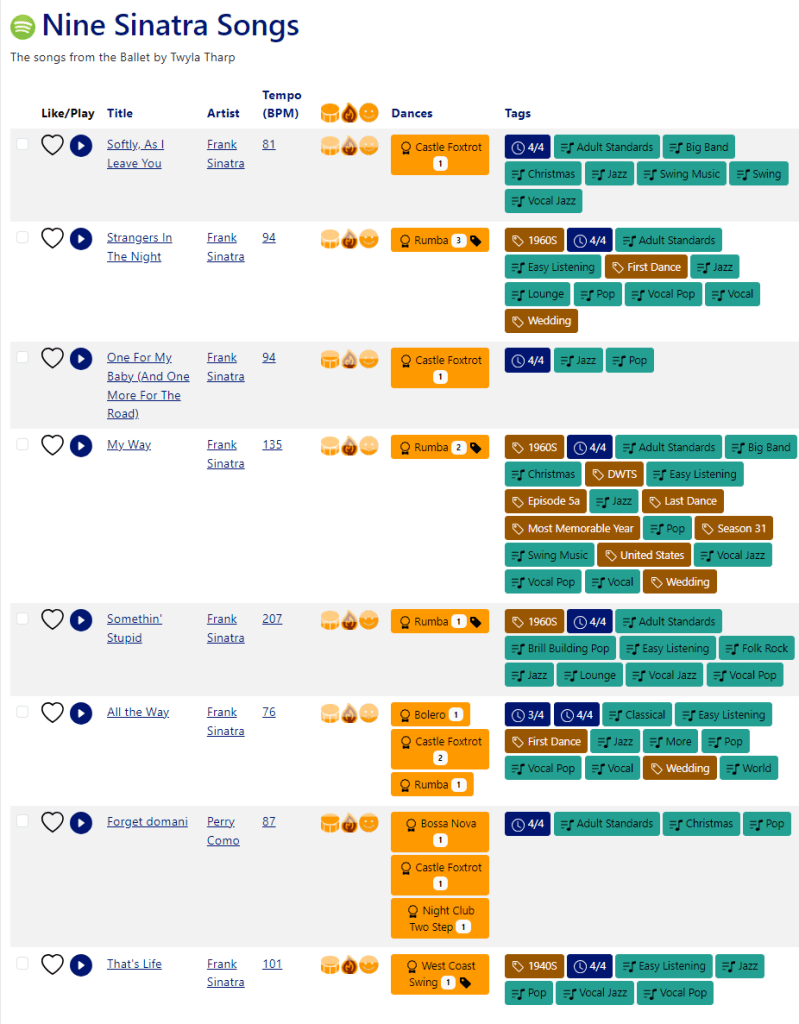
A snapshot of the eight songs used in "Nine Sinatra Songs"
The eight songs used in “Nine Sinatra Songs” as shown on music4dance.

Are there other partner dances that Tharp drew from in this work that we should represent in music4dance? Are there other Ballroom-inspired ballets out there worth viewing? Do they use different music that you’d like to add to the catalog? Are there other playlists that you’d like to overlay the music4dance information on, like I did with this one? If you have ideas about this post or the site, please comment below or use other feedback mechanisms listed here. And if you enjoy the site or the blog (or both), please consider contributing in whatever way makes sense for you.

Search like Google Part II: Autocomplete, Filter by Dance Style and Sorting

I am continuing to rebuild the music4dance database capabilities in the more intuitive style of current search engines like Google and Bing – the initial attempt at this is documented in this post.

Auto-Complete

Auto-complete is something everyone expects when searching these days.  So if you were to type “Peab” into the search box on the simple search page you should see suggestions like the following pop-up:

  • Peabody
  • Peabo Bryson
  • Tonight, I Celebrate My Love (feat. Peabo Bryson)
  • Peabo Bryson & Regina Belle
  • Peabo Bryson And Roberta Flack
  • Love and Rapture: The Best of Peabo Bryson

And just like Bing or Google, clicking on the selection will take you to a list of songs that contain the selected text.

The thing that is a little different for music4dance than a generic search is that one might want to do combinations of things like a fragment of a title and a dance style name.  I haven’t figured out an easy way to do that, but as always I’m open to suggestions.

Filter by Dance Style

But I can fall back to the original way that I landed on for just searching within a single dance style.  So now on the Simple Search page, you can select a dance style from the drop down to the left of the search box and we’ll just show you results for that dance style.  So if you select Cha Cha and then type “tea” into the search box you should get only songs that have the word tea somewhere in the description that have also been tagged as Cha Cha.

Sorting

And finally, I’ve implemented sorting by Title, Artist, Tempo, Beat, Energy, Mood and Recency.  Just click on the appropriate heading in the Simple Search Page, just like you did in the classic search page.  I’m still looking for a reasonable way to sort by votes on dance style.

The Google Miniseries:

I am learning the Foxtrot, where can I find some music?

The quick answer is to just click this link where you will find a list of over a thousand songs that have been labeled as Foxtrot.

But that’s definitely not the full answer.  In that list you will find songs that are too fast or too slow for you to dance to because the Foxtrot is not just one dance style but a family of dances each of which can be danced to a different range of tempos.

When I first started dancing  my teachers were from a background that was influenced by American Smooth style of Ballroom dance.  So there was a very specific dance that I first learned as “The Foxtrot”.   This is what is more precisely known as American Style Foxtrot and the was danced in the range of 30 measures per minute plus or minus a bit depending on competition rules.

In order to answer the more precise question of what kind of music will work for the dance that you are learning, it helps to get a bit of a historical perspective.  The Foxtrot follows a pretty common pattern in how partner dances evolve.  A style is first danced socially and pulls in moves from multiple traditions.  Often something resembling the social dance is performed on stage by exhibition dancers as well.  As the style becomes established, teachers take it and formalize it and possibly simplify it for their students. Then social dancers start pulling in things from different traditions and the dance evolves.  Sometimes it gets renamed, and sometimes the dance with the same name is just danced differently depending on where and when a dancer learned the style.   And never forget the influence of the music that is evolving alongside the dances, perhaps speeding up or slowing down or changing in character in a way that influences how dancers dance to it.

In the case of the Foxtrot, two of the early influences were Peabody and the Tango.  The Peabody was a very fast “one step” dance, and the Tango was imported from Argentina via Paris.  Harry Fox is the exhibition dancer who lent the Foxtrot his name.  Vernon and Irene Castle are the teachers who first formalized the Foxtrot as well as using it in their performances.

Arthur Murray standardized the particular version of the Foxtrot that I learned.  He also revived the Peabody as a competition dance to occupy the fast end of the Foxtrot style dances, as he felt that it was more reasonable for students to learn than the slightly slower but more complicated Quickstep.

At some point Charleston influences crept in as a style dance-able to faster music developed, called appropriately, the Quickstep.

To round out this family of dance styles I’ve adopted the name Castle Foxtrot to represent the slowest variations.   Much of the music that I’ve cataloged as Castle Foxtrot has been labeled by others as Slow Dance, especially when it relates to Wedding Dances.  Many of the moves that are used in Foxtrot can be slowed down and made to stay in place  (or on spot) to create something that is much more elegant than the side to side swaying that I first “learned” as a slow dance.

Here is a snapshot of the Foxtrot filter of the music4dance Tempi Tool, as a jumping off point to help you find music in an appropriate tempo for your style of Foxtrot.  Just click on any of the tempo ranges to get Foxtrot music in that range.

NameMeterMPMBPMTypeStyle(s)
Castle Foxtrot4/415-2560-100FoxtrotSocial
Slow Foxtrot4/428-34112-136FoxtrotAmerican Smooth, International Standard
QuickStep4/448-52192-208FoxtrotInternational Standard
Peabody4/460-62240-248FoxtrotAmerican Smooth

With the full tool on the music4dance site you can dig further into the relationship between dances and tempos.

Foxtrot was further complicated by the fact that it co-evolved very closely with swing and was often danced to the same music, or at least music played by the same bands.   I’ll take at look at what I’ve been categorizing as the Swing family of dances next.

Does this categorization help you at all in how you think about dancing and how it relates to music.  Is there a different way that you would slice and dice these dances?

One thing that I completely over-simplified in my description was the influence of regional traditions.  Would anyone from around the world care to shed some light on your regional influences to the Foxtrot?

Useful Links: