Tag Archives: Waltz

music4dance Goes Country (part I)

One of the most common requests I’ve received is to support Country Western dances. That request has come in many forms, but I don’t have personal experience with Country Western dancing (well, that’s not 100% true, I learned to West Coast Swing at a Country bar in downtown Seattle that my ballroom dancer friends would hang out at after rehearsing). I’m nearly certain that in adapting music4dance to support more country music, I’ll stick my foot in something stinky and get some negative feedback. I’m all right with that – all feedback will make the site better in the long run, just please try to be gentle 🙂 I’ve also stepped on plenty of toes with Ballroom dance which I know quite a bit about, Argentine Tango, which I know a little about and some of the social dances that fall in between on my personal knowledge spectrum.

And music4dance is pretty complicated to begin with, so adding another dimension may make it harder to use. But I’m hoping that, with your help and some iteration on the idea, we can get things to work even better in the long run.

My initial approach to adding Country Western Dance support is to review the organizations that publish competition rules, including tempo information, and see if I can work those dances into the music4dance system in a way similar to how I’ve set up the competition ballroom dances. This turned out to be easier than I expected. All three organizations that I found online (United Country Western Dance Council, World Country Dance Federation, and American Country Dance Association) list eight competition dances. Triple Two, Polka, Night Club Two Step, Cha Cha, Waltz, Two Step, Swing, and West Coast Swing. Only one of those dances wasn’t already in the database (Triple Two). Polka and Country Two Step were random additions early in the site’s evolution because a couple of DJ friends and lists published by ballroom dance studios included enough songs of those styles to make it worth my while to include them.

My biggest question was, should I create new dances for all of the dances that overlapped? After all, the Cha Cha danced in Country Western competitions is certainly not the Cha Cha I learned competing in American Rhythm (heck, the cha cha that the International Latin dancers were learning in the next room wasn’t the same dance either). I decided to follow the pattern that I’ve already established for Ballroom dances with the same name, even if they are pretty different. Rumba is probably the strongest example in the ballroom catalog of two dances with the same name that are not the same dance. But the characteristics of the music that a dancer cares most about are similar – this is true even of Rumba, where the tempo is significantly different.

Not coincidentally, I recently finished a significant project that allowed me to use the core database to easily and accurately search specifically for American Rumba vs. International Rumba. While there are a few drawbacks to grouping America, International, and Country Cha Cha together, there are a lot of advantages both in terms of how the system works internally and in making it easier to find new music for everyone (I’ve always been a proponent of genre-bending in fiction and cross-over choreography in dance).

So, there is now an active “Country Western Competition Dancing” page, and all of the individual dance pages for dances that include Country styles include the competition info for those dances. I’ll continue to tweak some of this information as I get feedback and do more research.

I realized as I was writing this post that I hadn’t addressed the fact that this change also complicated the voting mechanism. I want to encourage folks to vote on a song being a good Cha Cha, but also make it easy for them to specify Country, International, or American. I made some quick tweaks, but this is definitely a feature still under development.

Please let me know what you think (even – possibly especially – if you think I got it completely wrong). I’m interested in whether there are other Country Western dances that I should include, even if they’re not part of the core competition dances. There was a reference to Country Smooth and Country Rhythm rounds in one of the organizations rules, should I be supporting that? I’ve also used the composite tempos from the rules, combining the different levels to give the broadest range. Should I just be using the most advanced category?  What else have I missed?

And as always, if you enjoy the site or the blog (or both), please consider contributing in whatever way makes sense for you.

What is that dance called? Swing, East Coast Swing, Triple Swing, East Coast, or…

When I got into the business of categorizing music by dance style, I knew there would be a lot of ambiguity involved. However, some of the passion behind people’s opinions about what a dance should be called or what tempos are acceptable for the dance called X still takes me by surprise. Several times a year, I get an email from someone who is absolutely livid that I “got the tempo of West Coast Swing completely wrong” or called a dance “Lindy Hop” rather than “Swing” or some other variation on the theme.

I learn a lot from the people who send these emails, and often learn something that helps me improve the site or my general knowledge of dance. One feature I added a while back, based on some of these interactions but haven’t discussed in the blog, was the idea of having “synonyms” for dances.

The way music4dance works, I have to have an unambiguous and unique name for a dance. This leads to somewhat clunky names at times – for instance, the dance that most dances consider “Waltz,” I call “Slow Waltz” to distinguish it from “Viennese Waltz” and to allow for a catch-all category of Waltz. But I want to be able to show other names for dances so people can find the dances even if they know them by another name. This applies both to cases where the dance really is the exact same dance; it’s just named differently to disambiguate it, and in cases where the parameters for what music works are close enough that it makes sense to use the same list of music for both dances.

Cases of actual synonyms:

Cases where the dances are different, but the music is the same:

  • Castle Foxtrot = Slow Dance – I started categorizing music that was basically Slow Dance music as Castle Foxtrot, which is a legacy dance that some studios occasionally teach because Castle Foxtrot showed up in my searches as I was designing the site, and fit nicely into the tempo spectrum of Foxtrot-like dances. The practical use of this ended up being more for people looking for “Slow Dance” music in wedding contexts, so I added the Slow Dance synonym. Perhaps I should change the primary name?
  • Hustle = DiscoFox – As far as I can tell, these have evolved into different dances but are still danced to similar music. But that is based on web searching rather than personal experience, so please correct me if I’m wrong. I’m also now second-guessing myself as to whether I should add “Swing Fox,” “Disco Swing,” and “Rock Fox” as synonyms, or if one or more of these rates is its own category.

In any case, if you go to the main “Dance Style” page, you’ll see all the styles we’ve set up, along with their synonyms. As this list grows, being able to filter it is more important, so the filter control acts on both the primary name and the synonym. I also handle the synonyms when you search in the search control in the menu bar. So if you type “Slow Dance” in that search box, you’ll find a list of slow dance songs (that are actually tagged as “Castle Foxtrot”). I don’t convert the name of the tag in the results, but I could if that seems important…

I’m posting this now in part because, during my recent round of updates, I broke the showing of synonyms in the Dance Styles page and then realized I hadn’t ever asked for feedback on the feature. The only mention in this blog was the post when I added it as an afterthought to adding Single Swing to the catalog.

Are there other synonyms that I should add? Are there dances that I’ve listed as synonyms that I should break out into separate dances? If you have ideas about this post or the site, comment below or use other feedback mechanisms listed here. And if you enjoy the site or the blog (or both), please consider contributing in whatever way makes sense for you.

Partner Dance Songs in Broadway Musicals

We recently attended a production of Peter Pan. This wasn’t a musical we would normally seek out, but it was part of a season that we subscribe to, so what the heck. Perhaps it was because expectations were low or more likely because of the Jerome Robbins choreography, but we quite enjoyed it.

Why am I telling you this? If you check out the cast recording (this is the  1989 recording, but it’s approximately the same songs as the 2024 production), you’ll see a couple of easily recognizable dance names in “Hook’s Tango” and “Captain Hook’s Waltz” and a couple of slightly less recognizable dances (at least to a ballroom dancer) in “Hook’s Tarantella” and “Pirate March.” There is obviously cross-pollination between dancing and music in Broadway musicals and the partner dancing and related music I catalog here. In fact, one of the friends who originally coaxed me into the ballroom dancing world started dancing when he performed in musicals.

That got me going down the path of what we currently have cataloged in the cross-section between musical theatre and partner dance music. I went to the tag cloud page and looked for relevant tags. There were several, which is a mixed blessing and also pretty common in this system where I’m pulling data from various places, including crowd-sourcing. The most relevant tags I found were “Broadway” (30 songs), “Show Tunes” (43 songs), “Musicals” (36 songs), and “Broadway and Vocal” (98 songs). This got me into the same kind of situation as when  I first looked at holiday music where I wanted to do a search that the system doesn’t allow. But like the holiday music issue, this is a limitation of the interface I built rather than the underlying database, so it’s easy enough to further generalize the code I wrote for holiday music and Halloween music and land on an excellent solution for Broadway music.

Broadway soundtracks are a rich source of fun songs to dance to, but even with this custom search, I don’t think the existing music4dance database does it justice. What songs from musicals inspire you to dance? Do the actors dance a recognizable version of the dance on stage, or do the songs just work for the dance style? I’d love to see more songs from Broadway in the catalog. Please feel free to contact me if you have lists in any form, and I’ll incorporate them. Or even better, feel free to add them yourself if you have some favorites.

Also, please let me know if you have ideas for searches that you can’t make work with the existing system. I am considering generalizing the search in a couple of different ways, and ideas from you will help me pick a direction. I am also considering adding a “fun searches” page to share some of the searches you can do with the current system, but it might not be easily discoverable. Send me your favorite fun searches, and if I get enough, I’ll increase the priority of that feature.

Please share any thoughts and ideas about this post or the site by commenting below or using other feedback mechanisms listed here. In addition, if you enjoy the site or the blog (or both), please consider contributing in whatever way makes sense for you.

What Happens When a Song is Danced at Different Tempos?

Sometimes, a song can be a perfectly good Bolero when heard one way but a Salsa when counting the music differently. Another example is Slow Dance (Castle Foxtrot) vs. Lindy Hop.

Generally, this phenomenon is because, with some music, it’s easy to count what the musicians see as either a half note or a quarter note as a beat. Quarter note vs. eight note is another common variation. At one point, I tried to tag dances as half-time or double-time when I saw songs with this property. But honestly, I can tie my head up in knots when I look back at this. Am I dancing double-time to the music (e.g., stepping twice as fast), or is the music half-time to my dance? And, that ‘solution’ also has the limitation that there is no way to sort or filter on tempo and include those songs correctly without doing two searches (maybe 3) and then weaving the results together ‘manually.’

And that doesn’t even take into account Waltzes, where you can get into other fun variations that I talked about in my fake waltz post.

A more robust solution to this problem is to have a separate tempo field for each dance. This would only be filled in if the dance had a positive number of votes. Then, if you search on Foxtrot and sort by tempo, the Foxtrot tempo field will be used. If you search on multiple dances or didn’t include a dance in a search and sort on tempo, I’d have to default to some master tempo field. If I went down this path, I’d have to populate the ‘dance’ tempo fields off of the master tempo fields by default and do some manual searching for the exceptions (and depend on others to update them as they see them).

What do you think? Would this be a significant improvement in how you use music4dance? Or is it a corner-enough case that you’ve never noticed and would prefer I spend my time on improvements in other areas?

Please share any thoughts and ideas about this post or the site by commenting below or using other feedback mechanisms listed here. In addition, if you enjoy the site or the blog (or both), please consider contributing in whatever way makes sense for you.

Translating how dance teachers count

Something came up the other day as I was talking to a friend who just took his first social dance class. He has a musical background and is used to hearing and counting beats as a musician. So he got a little obsessed and distracted with figuring out the translation between what he was hearing in the music and what he was hearing from the dance teacher. In this casual intro to partner dancing class at the local community college, he was learning Night Club Two StepSalsa, and East Coast Swing.

We dance all of those styles to music in 4/4 time. So, as someone with musical training, my friend heard the beat as 1 - 2 - 3 - 4 - 1 - 2 - 3 - 4, etc. But that’s not how the dance teacher was counting. Let’s break these down dance by dance.

Night Club Two Step

Night Club Two Step is generally counted as Slow - Quick - Quick.  For most dances that I count this way or the slight variation Quick - Quick - Slow, the Slow is two beats, and the quicks are each a single beat. The translation is straightforward: In the first case, the quicks are on 1 and 2, and the slow is on 3. In the second, the Slow is stepped on 1, and the quicks are 3 and 4.

– or –

Each box represents a quarter note in 4/4 time.

Salsa

Salsa is even easier. If it’s counted using slows and quicks, it’s Quick - Quick - Slow. Translation: quicks on beats 1 and 2 and slow on 3, holding 4. But many salsa teachers count the phrase, which is a two-measure grouping in dance. When they do that, they generally count 1 - 2 - 3 - (pause) - 5 - 6 - 7 - (pause). That’s my preferred way since it aligns with the musical counting of the beats. Occasionally, I’ve heard a Salsa teacher count 1 - 2 - 3 - (pause) - 4 - 5 - 6 - (pause). That variation drives me up the wall. It completely breaks my musician/programmer’s brain because the second measure is counted with numbers that are off by one from what’s in my head. Fortunately, my friend wasn’t exposed to that variation. 

Each box represents a quarter note in 4/4 time.

East Coast Swing 

East Coast Swing is more complicated for a couple of reasons. 

First, it is generally counted as Tri-ple-step Tri-ple-step Rock Step. Or 1 & 2 - 3 & 4 - 5 - 6. We’re dancing a 6-count basic to 4/4 music, so each basic takes a measure and a half. This timing throws a monkey wrench into counting it like a musician. If you want to be a stickler, it would be something like 1 & 2 - 3 & 4 - 1 - 2, and then the following basic would be 3 & 4 - 1 & 2 - 3 - 4, but I’ve never even tried to do that while dancing. The second is that the triple steps are syncopated, so they don’t fall precisely on the eight notes. But this also maps directly to the music, so it shouldn’t be hard for anyone who has played a bit of Jazz to get their head wrapped around.

Each box represents an eighth note in 4/4 time

Conclusions

Every dance has its nuances. Mambo and International Rumba are counted Quick - Quick - Slow, but start on the 2, Waltzes are danced to 3/4, Samba has its own form of syncopation, etc.

Let me know if you find this kind of analysis helpful and would like this kind of analysis for other dances. I’m considering doing a version of this for each dance on the dance pages, including some prettier charts, if I get some feedback that this is useful. Also, I’d be delighted to hear about other ways you count when partner dancing.

As always, I’m very interested in your feedback, so please share any thoughts and ideas about this post or the site by commenting below or using other feedback mechanisms listed here. In addition, if you enjoy the site or the blog (or both), please consider contributing in whatever way makes sense for you.

Related Posts

Do Dancers Think in Eights?

I was tickled to hear Nigel Lythgoe talk a little about choreographing tap on a recent episode of So You Think You Can Dance. The commentary is at about 1:13, but please start at about 1:10 so you can see the performance that he’s referring to.  It’s a tap piece that Emma, one of the…

Book Review: Hear the Beat, Feel the Music

As anyone who has spent any time reading my blog or interacting with my website should know by now, I’m very passionate about music, dance and the relationship between the two.  I’m also very analytical about those subjects.  And, yes, I believe passion and analysis can co-exist, don’t you? The fatal flaw with my perspective…

Musicians for Dancers

One of the things I enjoy most about the musci4dance project is when I get feedback from people who have found the site useful.  I’m especially happy when it comes from a direction that I don’t expect.  It’s exactly that kind of feedback that I received from Mister “D” (David Simmerly) – a musician who performs for Ballroom clubs and weddings and was looking to expand his repertoire with music that would be well received in those contexts.

I asked Dave to expand a little on how he used music4dance and (paraphrasing) here are a few of the things that he came back with:

The first and second points led to an extended discussion about songs that are listed as Waltzes but are not in 3/4 time – check out my blog post on “Fake” Waltzes for more on that.

But there is a more general point that I would like to make here with respect to “correctness” of music for dance.  I’ve compiled this catalog with an eye for finding music that inspires dancers to dance.  This makes for a very loose definition of what songs “work” to dance a particular dance to.  In a setting where a dancer is choreographing to a specific piece of music, even when that choreography is a traditional ballroom dance like in Dancing With the Stars, there is quite a bit of latitude in what music will “work”.  Whereas in a social situation the dancers are more dependent on the beat and feel of the music to enjoy the experience of partnering in a specific dance style.  And then of course when one is dancing competition rounds, there are even stricter rules about tempo.

In any case, I hope that many of the songs in the music4dance catalog fall into the category (as Mr. “D” says) of “making your pants want to get up and dance.”  In the future, I hope to do a better job of tagging dances in a way that separates the strictly ballroom from the fun to choreograph to from the great songs for social dancing.  The system is at least theoretically set up to do this since I’ve enabled arbitrary tagging of songs.  It’s a big project to go through each song in an 11,000+ song catalog and make the kind of distinction I’m talking about here.  On the other hand, it is exactly the kind of thing that works well when others jump in to add their own ideas to the mix.

As always, I welcome your feedback and participation.  Thanks to David Simmerly for permission to use his name and information in this post.  If you’re in the midwest and are looking for a great solo entertainer for your Ballroom Club, Wedding Reception or another occasion, you can find him on gigsalad.com.

What is a fake Waltz?

I was recently asked why there are songs tagged as Waltz in the music4dance catalog that are in 4/4 time.  This seems almost like the dance version of an oxymoron.   In my brief description of the Waltz on the website I start with “Waltzes are dances that are danced to music in 3/4 time…”

To be honest, the main reason that there are “Waltzes” that aren’t Waltzes in the catalog is that I pull from lots of different sources and even with something this fundamental there are different schools of thought.  I intentionally error towards the inclusive in these decisions since I think that dance should be as inclusive as possible.

A substantial number of these songs come from sources that cater to people looking for wedding dances.  But there are definitely “Waltzes” in 4/4 coming from other sources as well, I’ve certainly seen some exhibition Waltzes performed to music that has almost no discernable beat,  much less a strong 3/4.

I’m not sure where I picked up this term, but these songs are what I have been calling “Fake” waltzes.  If anyone has a better term for this, I would love to hear it.

In any case, a “Fake” waltz is generally a song that is in 4/4 but has a strong downbeat and very weak rhythm otherwise, so that one can dance three steps to a measure without being too distracted by the actual rhythm of the song.   You can find all of the songs that I’ve tagged as “Fake” waltzes by following these steps:

  1. Go to the Advanced search page
  2. Under “Dance styles”, choose Waltz
  3. Under “Include tags” , Choose “Fake”
  4. Click the Submit button

Or just click here for the pre-built search.

You can use the same process, but replace step (4) with choosing “4/4” and you can find all the songs that are cataloged as both waltz and 4/4.

The more interesting variations are to use the same process to find all waltzes that are not tagged “Fake” and not tagged “4/4”.  You can do this by using “Exclude Tags” in step 3 above.

And while I’m on the subject of unusual waltzes, there is another variation on this theme. It is a song with an extremely slow primary tempo where you can fit a very fast waltz half basic (three steps) on each beat. I’ve been labeling these as “triple-time” and the list can be found here.  Although that’s an exaggeration, there is only one song on that list as of this writing – Louis Armstrong’s “What a Wonderful Life”.  Perhaps I’ll find more by the time you read this.

I’m looking into ways to make the fact that a waltz is “Fake” more obvious.  Currently, it’s a tag on the dance which can only be seen when you click on the dance tag in a song list or by going to the song details page.

In the meantime, if you have a strong objection to songs in 4/4 being labeled as Waltz, you’re welcome to sign up and start voting them down or tagging them as “Fake.”

Even more than usual, I’m interested in how other people view this, so please feel free to comment on this post or send feedback directly to me.

Do Dancers Think in Eights?

I was tickled to hear Nigel Lythgoe talk a little about choreographing tap on a recent episode of So You Think You Can Dance. The commentary is at about 1:13, but please start at about 1:10 so you can see the performance that he’s referring to.  It’s a tap piece that Emma, one of the young competitors, choreographed to “Rather Be” by the Pentatonix.  Just amazing – pause for a moment of silent appreciation for some real talent.

Nigel asked if she choreographed by listening to the rhythm or by counting eights. Quickly followed by the statement – “Musicians only count to four, dancers count to eight.”  Funny!

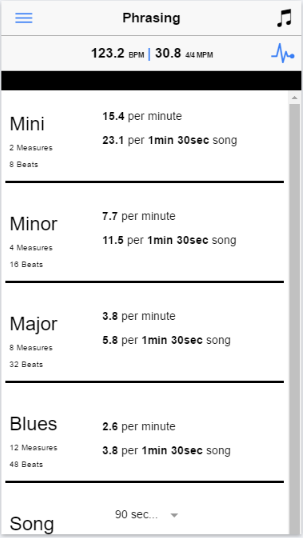
Besides making for a pithy quote, it ties right into a project that I’ve been working on recently.  I am experimenting with a phone application that I hope will be useful to choreographers and one of the things that I’ve been thinking about is phrasing of music.  It’s a variation on the web-app that I have on the site for counting out tempos. When choreographing for many ballroom dances, the basic unit of measure tends to be a two-measure mini-phrase, which would be 8 counts in most dances and 6 for the waltz.  And then there are longer phrases, which are closer to what musicians think in.  Here’s a quick mock-up of the phrasing page for the app – the idea is that you can count out (or just enter) the tempo of the song, choose a standard length and get a quick cheat-sheet of the number of phrases of various types that one would need to choreograph to fill the song.

Phrasing Page

Would this be useful to you as a choreographer?  Are there other features that might make as much or more sense to have your phone figure out for you?  I’m always looking for feedback, and the early the better since most of this isn’t even coded yet.

What if I just want to search for songs on music4dance like I do on Google?

One of the things that I’ve had a lot of fun with is building a sophisticated search engine where I (and you) can do things like find songs that someone has tagged as Waltz and someone else has tagged as Foxtrot.  Or find all swing songs that are in a particular tempo range.  There are lots of neat things that you can do with the Advanced Search system if you’ve got some knowledge of dance and music and want to dig deep into these corners of the music4dance catalog.

But what if you just want to search through the catalog the same way you would on Google or Bing?   For instance, what if you’re looking for a song that has been tagged as Wedding and has the words “Love” and “Time” in it?  With simple search you can just type Wedding Love Time into the search box and you’ll get some useful results.  You can further refine the search by using some of the standard search modifiers like + and – and putting quotes (“) around phrases to be more precise about your searches (for instance try “First Dance” +Foxtrot +Rock).  But if you’re the type that doesn’t bother with that on Google you should be fine not worrying about it here as well.

More information is available on the help page but you should be able to go to Simple Search from the “Music” menu on the music4dance home page and dive right in.

The Google Miniseries:

What if I want to build a list of songs that are tagged as either Bolero or Rumba?

There are a bunch of different reasons that you might want to build lists of songs that are more sophisticated than just the songs that can be danced to a specific style.  For instance you may be choreographing a piece that you want to switch between Cha Cha and East Coast Swing.  Or you might want to get a more comprehensive list of songs that are in the Bolero/Rumba range so you want everything that’s tagged with either of those dance styles.  Or, you’re like me and just want to see what dances people have tagged as both Waltz and Foxtrot (two apparently contradictory labels – more on that in a future post).

I’ve just added a feature that enables all of those scenarios.  The documentation is here, but let me break a couple of the scenarios down into specifics.

First, let’s say you’re looking for a song to choreograph a mixed East Coast Swing/Cha Cha routine to. Here’s what you do:

  1. Go to the song list page by clicking on Music -> Songs in the menu at the top of the music4dance.net website.
  2. Click on the “more” button near the top of the page
  3. Click on the “any” button that appears and choose “all”
  4. Click in the text box that says “Choose some dance styles…” and start typing “East Coast Swing”, after the first letter or two you should be able to choose from a list.  Do the same with Cha Cha
  5. Click on the search (magnifier) button and you should see a list of songs all of which are tagged with both East Coast Swing and Cha Cha

Next, let’s take a look at finding a mixed list of songs.  For example, if we want to find all songs that are labeled as either Rumba or Bolero, here’s what you do:

  1. Go to the song list page by clicking on Music -> Songs in the menu at the top of the music4dance.net website.
  2. Click on the “more” button near the top of the page
  3. Make sure that the “any” button that next to the “Dance to” label reads “any.”  If it reads “all” then click to choose “any.”
  4. Click in the text box that says “Choose some dance styles…” and start typing “Bolero”, after the first letter or two you should be able to choose from a list.  Do the same with Rumba
  5. Click on the search (magnifier) button and you should see a list of songs all of which are tagged with both East Coast Swing and Cha Cha

I hope this is useful to you.  If there are combinations of dances that you find particularly useful, please let me know by commenting.  Similarly, if there are combinations that you can’t manage with the current implementation please comment and I’ll look at extending this capability even more.