
How to find the most popular songs to dance to

The core mission of music4dance.net is to help you find music to dance to, whether you’re a ballroom dancer, social dancer, or really any kind of dancer. Sometimes I look at the site and say, “This could be better.” Or “Here’s a place that I’ve wanted to improve for a while but couldn’t figure out how; maybe I should try something different.” I had an “aha” moment when I was going through the site for my annual Holiday Music post. I’ve been frustrated that many of the lists of songs on music4dance.net default to some nearly random order that tended to put songs on top that only one or two people had voted for. In the Holiday Music catalog, if you choose a specific dance (like Foxtrot), the list is sorted by the number of votes for that dance. But that wasn’t true of the main list, and there wasn’t an obvious way to sort that list by dance votes.

So I took a step back to think about the general problem of getting the songs with the most dance votes to the top of lists and search results and started digging into the corner cases, which is generally where I get stuck on this kind of problem. For song sorting, I was particularly worried about an issue that a customer brought up when I first implemented the general search like google feature that enabled full-text search. In that case, I was sorting by most recent by default, and when the customer tried to do a full-text search, the song he was looking for ended up on the second page of results because there were a bunch of songs that matched his search less well but had been added more recently.

After thinking about this for a while and looking through search history, I concluded that there are two main ways people search for songs to dance to on music4dance.net. The most common search is for a specific song or artist, in which case you want the song you’re searching for to end up as close to the top of the list as possible, whether or not it is highly rated. The other way is to build lists to browse or create playlists from. In these cases, having the most popular songs at the top makes sense (unless you’ve specified something else like tempo).

Given the above, I’m more explicitly handling the case where you don’t specify a sort order as a special “default” case. If you search for specific text, I assume that’s the most important part of your search, and I sort by most relevant to the text part of the search. This part should take care of the customer I  mentioned above and folks doing that kind of search. In all other cases, I’ll sort by dance votes. You can, of course, always use the Advanced Search page to specify a sort order to override the default.

One of the reasons that I didn’t do this a long time ago is that there are some other corner cases. The biggest one is that there is no way in the underlying search engine to sort on the sum of the votes for different dances. So I can sort on votes for Rumba or even votes on Rumba, then votes for Cha Cha, but I can’t sort by the sum of the votes for Rumba and Cha Cha or even on the most total votes. I still haven’t fully solved this problem, but I have reduced it to a corner case that I believe is a better compromise than the random sort I started with.

I added a new sortable field in the database representing the sum of all dance votes on each song. With the new field, when looking at the default song list you see when you go to the Song Library, you’ll see the most popular songs on the first page. That also helps pages like the main Holiday Dance Music page, where you’ll also see the most popular songs first. The dance-specific pages were already sorted by dance votes for the Holiday, Broadway, and Halloween pages but not for the main dance lists (e.g., East Coast Swing Songs). That’s now fixed.

Unfortunately, in cases where you search for multiple dance styles, I can’t sort by the sum of the votes of those styles. Instead, I sort by each dance style vote in the order you specified them. So, if you search for all songs with Rumba, Bolero, and Cha Cha votes, you’ll get a list starting with the songs with the most votes for Rumba, then Bolero, and finally by Cha Cha votes. It’s not a perfect solution, but I think it’s still an improvement over the previous random ordering in these cases. What do you think?

Following the line of reasoning that started this post, I’m sure there are things that aren’t quite working for many of you when searching on music4dance. Please let me know. Sometimes, I just need to see the problem to come up with a fix. That’s especially true if you’re using the site in a way I didn’t expect, so even if everything is working smoothly, I’d love to hear how it’s helping you.

In addition to the specific ask above, I’m always happy to hear ideas about this post or the site by commenting below or using other feedback mechanisms listed here. And if you enjoy the site or the blog (or both), please consider contributing in whatever way makes sense for you.
Holiday Music for Ballroom and Partner Dancing 2024

Christmas and other holiday dances are just around the corner, so it’s time to take another look at music ideas to dance to. As of this writing, we have 1759 songs cataloged, up from 1536 songs last year and close to doubling the “nearly two hundred” holiday songs I saw when I added the first version of this feature in the twenty-seventeen! Thanks again to everyone who has contributed by adding songs and tagging songs with dances.

Most years, I’ve tried to do small things to improve the browsing experience for holiday songs. This year, I’ve been in the code, generalizing it to support Broadway lists. But I haven’t done anything to improve the core Holiday Music experience. This phenomenon may be a sign that the feature is mature enough that it doesn’t need additional improvement. But more likely, it’s a sign that I’ve run low on ideas. I’d like to know if there are any improvements that you would like to see in the holiday music browsing experience.

Here are a few ideas to get you started; none of them are clicking enough form to implement without some encouragement from you:

  • Add the ability to sort by most recently added rather than just by dance rating.
  • Add the ability to sort the main holiday list by aggregate dance rating. If I do this, it would likely be part of a larger project to enable more emphasis on sorting and filtering by dance rating.
  • Add the ability to ingest albums that were specifically designed for ballroom dancers, such as DanceLife’s Christmas Best, where the song name encodes the dance name and tempo. Many songs from these types of albums have already been added to the music4dance catalog, but I’d be able to pull in a bunch more if I automated the process.
  • Add the ability to gather statistics on how many songs were in the catalog at a particular date – right now, the only history I have on how big the holiday catalog is these blog entries. The raw data exists to get those answers, but it would require a significant lift. I am curious about this, but not enough to do anything about it unless someone could suggest a more general use for the ability.

I am sure there are many other ideas I haven’t come to that would improve the holiday music browsing experience. Please let me know what would help you the most, and I’ll see what I can do.

In addition to the specific ask above, I’m always happy to hear ideas about this post or the site by commenting below or using other feedback mechanisms listed here. And if you enjoy the site or the blog (or both), please consider contributing in whatever way makes sense for you.
Halloween Ballroom Music 2024

Halloween is fast approaching, and I’m updating the music4dance Halloween catalog to include more partner dance Halloween music. I’ve pulled some generic Halloween playlists and cross-referenced them with the existing music4dance catalog. Using this method and some help from the community, we now have 340 songs available in the Halloween catalog that are also tagged with at least one dance style.

One of the side effects of pulling in generic playlists is that many songs in the database are tagged as Halloween but don’t have any associated dances. These songs are hidden by default since they don’t do a lot of good for someone searching for music to dance to. But premium members can see them and other songs that I haven’t been able to match to online music catalogs, which lets those folks dig into some of the data that might have hidden gems.

I’ve been going through these songs and adding dance tags where they make sense to me, but I could use some help. If you’re interested in pitching in and aren’t already a premium member, I’d happily give you a month’s premium subscription in return for your help. If you are already a premium member, I’d extend your membership for a month if you tag some Halloween songs with dances. Let me know if you’re interested in the offer.

Even if you’re not up for helping with Halloween song cataloging, please share any thoughts and ideas about this post or the site by commenting below or using other feedback mechanisms listed here. In addition, if you enjoy the site or the blog (or both), please consider contributing in whatever way makes sense for you.

Partner Dance Songs in Broadway Musicals

We recently attended a production of Peter Pan. This wasn’t a musical we would normally seek out, but it was part of a season that we subscribe to, so what the heck. Perhaps it was because expectations were low or more likely because of the Jerome Robbins choreography, but we quite enjoyed it.

Why am I telling you this? If you check out the cast recording (this is the  1989 recording, but it’s approximately the same songs as the 2024 production), you’ll see a couple of easily recognizable dance names in “Hook’s Tango” and “Captain Hook’s Waltz” and a couple of slightly less recognizable dances (at least to a ballroom dancer) in “Hook’s Tarantella” and “Pirate March.” There is obviously cross-pollination between dancing and music in Broadway musicals and the partner dancing and related music I catalog here. In fact, one of the friends who originally coaxed me into the ballroom dancing world started dancing when he performed in musicals.

That got me going down the path of what we currently have cataloged in the cross-section between musical theatre and partner dance music. I went to the tag cloud page and looked for relevant tags. There were several, which is a mixed blessing and also pretty common in this system where I’m pulling data from various places, including crowd-sourcing. The most relevant tags I found were “Broadway” (30 songs), “Show Tunes” (43 songs), “Musicals” (36 songs), and “Broadway and Vocal” (98 songs). This got me into the same kind of situation as when  I first looked at holiday music where I wanted to do a search that the system doesn’t allow. But like the holiday music issue, this is a limitation of the interface I built rather than the underlying database, so it’s easy enough to further generalize the code I wrote for holiday music and Halloween music and land on an excellent solution for Broadway music.

Broadway soundtracks are a rich source of fun songs to dance to, but even with this custom search, I don’t think the existing music4dance database does it justice. What songs from musicals inspire you to dance? Do the actors dance a recognizable version of the dance on stage, or do the songs just work for the dance style? I’d love to see more songs from Broadway in the catalog. Please feel free to contact me if you have lists in any form, and I’ll incorporate them. Or even better, feel free to add them yourself if you have some favorites.

Also, please let me know if you have ideas for searches that you can’t make work with the existing system. I am considering generalizing the search in a couple of different ways, and ideas from you will help me pick a direction. I am also considering adding a “fun searches” page to share some of the searches you can do with the current system, but it might not be easily discoverable. Send me your favorite fun searches, and if I get enough, I’ll increase the priority of that feature.

Please share any thoughts and ideas about this post or the site by commenting below or using other feedback mechanisms listed here. In addition, if you enjoy the site or the blog (or both), please consider contributing in whatever way makes sense for you.

What Happens When a Song is Danced at Different Tempos?

Sometimes, a song can be a perfectly good Bolero when heard one way but a Salsa when counting the music differently. Another example is Slow Dance (Castle Foxtrot) vs. Lindy Hop.

Generally, this phenomenon is because, with some music, it’s easy to count what the musicians see as either a half note or a quarter note as a beat. Quarter note vs. eight note is another common variation. At one point, I tried to tag dances as half-time or double-time when I saw songs with this property. But honestly, I can tie my head up in knots when I look back at this. Am I dancing double-time to the music (e.g., stepping twice as fast), or is the music half-time to my dance? And, that ‘solution’ also has the limitation that there is no way to sort or filter on tempo and include those songs correctly without doing two searches (maybe 3) and then weaving the results together ‘manually.’

And that doesn’t even take into account Waltzes, where you can get into other fun variations that I talked about in my fake waltz post.

A more robust solution to this problem is to have a separate tempo field for each dance. This would only be filled in if the dance had a positive number of votes. Then, if you search on Foxtrot and sort by tempo, the Foxtrot tempo field will be used. If you search on multiple dances or didn’t include a dance in a search and sort on tempo, I’d have to default to some master tempo field. If I went down this path, I’d have to populate the ‘dance’ tempo fields off of the master tempo fields by default and do some manual searching for the exceptions (and depend on others to update them as they see them).

What do you think? Would this be a significant improvement in how you use music4dance? Or is it a corner-enough case that you’ve never noticed and would prefer I spend my time on improvements in other areas?

Please share any thoughts and ideas about this post or the site by commenting below or using other feedback mechanisms listed here. In addition, if you enjoy the site or the blog (or both), please consider contributing in whatever way makes sense for you.

What is Your Favorite music4dance Feature? (2024 Edition)

I am in the middle of another substantial rewrite of parts of music4dance.net. This is why you haven’t seen much blogging or new features recently. Sorry!

In any case, I should ask this question at least once a year: What do you like about music4dance, and how do you use the site?

As I rework the code, I don’t always keep everything exactly the same, and as a solo project owner, I feel that I have license to cut features if it’s not apparent that customers heavily use them. I am able to get an idea of how folks use the site through analytics, but these tools often lose essential nuances. So, please let me know what is most important to you about the site so that I don’t accidentally cut it!

On a similar note, what are features that almost but don’t quite do what you want them to do? Or features that work but take more effort than they should? These ideas are easiest for me to incorporate as I’m doing a major rewrite, but feel free to let me know about them at any time.

Unlike my previous rewrite, this project involves “just” upgrading to new versions of front-end libraries rather than changing to a new framework, so there should be less of an impact on the site. It would also be faster, except that one of the libraries I depend on requires some help, so I’m diving into the next level of infrastructure, which is fun but time-consuming.

I value your thoughts and ideas. Please share them by commenting below or using other feedback mechanisms listed here. If you want to explore more ways to participate in the musci4dance community, please check out this page. Your contributions are highly appreciated, and your engagement is what makes this community thrive. Thank you.  

I’m a ballroom dancer. Can I find practice songs that are at competition tempo? (Revisited)

This is an update to a post I wrote in 2015Music4Dance has come a long way since then, so the answer to the title question is completely different than it was nearly a decade ago.  In fact, the top-level answer is so simple I was tempted to just put a note at the top of the old post, but I had a few other things to say, so I went this route instead.

So here it is: Go to the Ballroom page and check it out.  The page is accessible from the “Music” menu.

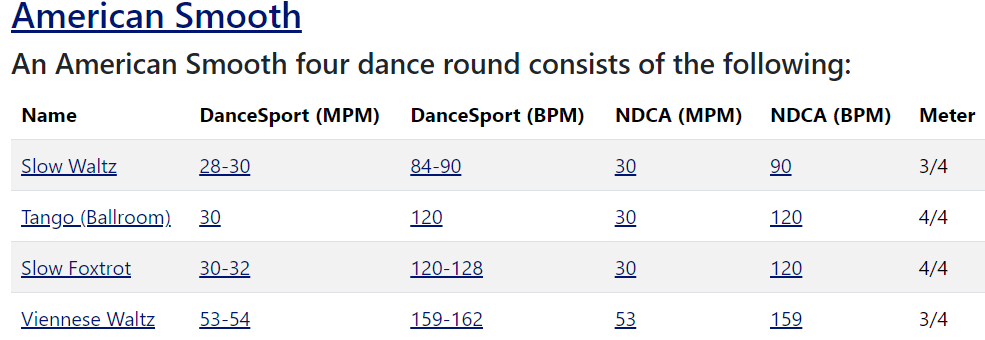
A table showing the tempi of American Smooth dances

Clicking on the round title takes you to a page with more information about that style.  For the American styles, that includes other dances that aren’t part of a round.

The Competition Ballroom page has sections for American SmoothAmerican RhythmInternational Standard, and International Latin. Each section contains basic information about the dances, including tempo in measures per minute and beats per minute1 for both of the major organizations that run Ballroom Dance Competitions.

Clicking on any tempo listings will take you to a list of songs tagged with that dance style and set to within that tempo range.  Note that I’m not currently also filtering on the American or International tag on the dance. This is for two reasons. First, the underlying database, which has a lot of excellent qualities, won’t let me do that particular search.  Second, because many of my sources don’t routinely specify the style, we’d be leaving out many great songs if we filtered that tightly.

And that’s it!


Here are some additional things that you might want to try that are adjacent to the simple answer:

If you disagree with the tempo listings and believe they’re wrong, please let me know, and if possible, cite your sources.  Tempo recommendations change occasionally, and I’m not always on top of the changes – the NDCA made some substantial changes a couple of years ago, and it took me over a year to notice.

If you want to find songs that are slower or faster than the listed tempos (e.g., if you want a slow set and a fast set), you can go through the process above and then click “change search” on the results. This will take you to the advanced search page, where you can change the tempo range without changing anything else and re-run the search.

If you have a premium subscription you can export the results of any of the above searches to Spotify.

If you would like to have this kind of support for other styles of dance, let me know where I can find reliable tempo information, and I’ll look into adding them. Some similar functionality is available on all of the dances we list, but the full tables only make sense if we have the kind of information that the ballroom dance organizations give for their competitions.

As always, I’m very interested in your feedback, so please share any thoughts and ideas about this post or the site by commenting below or using other feedback mechanisms listed here. In addition, if you enjoy the site or the blog (or both), please consider contributing in whatever way makes sense for you.


  1. Before you ask, I’m leading with “Measures Per Minute” rather than “Beats Per Minute,” as that’s how NDCA and DanceSport list tempo in their rules. If anyone in the ballroom world knows why that is, please let me know. ↩︎

New Feature: Improved Text Searching

I’ve always been a bit dissatisfied with how I set up the Artist field in music4dance.  A free text field for the artist generally works, but it doesn’t capture everything I’d like.  But since the core functionality of music4dance is to associate songs with dance styles, keeping the rest of the system simple is a sound decision, and I stand by it.

However, something comes up every few years that makes me want to at least incrementally improve the text search part of the system.  When Prince left us, I broke down and created artist pages based on the text of the artist field.  This was a significant improvement, and I returned to that when writing my DWTS Taylor Swift/Whitney Houston post.  In that post, I listed a few things that I thought could be improved with artist search and then let things rattle around in my brain for a few months.

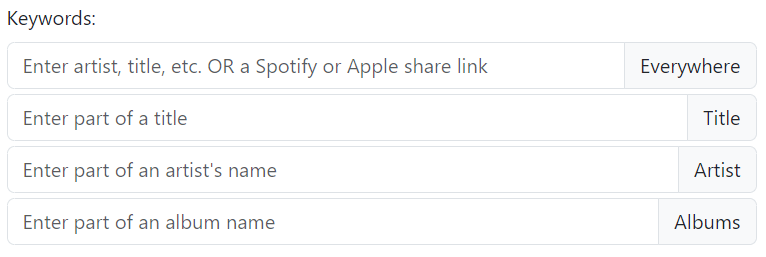
Last week, I decided to spend a little while seeing what I could do to make a worthwhile improvement in a short time.  What came out was a pair of changes.  The more visible change is an addition to the advanced search page

I’ve added some additional controls to explicitly search each of the three primary text fields in the music4dance database – Title, Artist, and Albums.  This enables a more direct way to get to all of the songs by an artist.  It also allows the inverse.  While adding the artist page let you get to all of the songs by “Prince,” it didn’t let you find all of the songs with “Prince” in the Title without also seeing the Prince and Prince Royce songs or, for that matter, songs with Prince in album names.  That is, if you can find one song with Prince as the artist you can click on the link to get to the artist page.

One side effect of this change is that if you search for Prince in the artist field, you also get Prince Royce songs, although they end up at the end of the list.  While that’s not great in the case of Prince, you now have a fast way to get to a link that will send you to the Prince artist page, which does only list Prince songs.  The good part of this quirk is that if you’re looking for songs by Benny Goodman, you’ll get a list containing not just songs with exactly “Benny Goodman” in the artist field.  You also get songs by “Benny Goodman Sextet,” “Benny Goodman Quartet,” “Benny Goodman and Charlie Christian,” “Peggy Lee and Benny Goodman,” etc.

The other more subtle improvement is that I dug into how the underlying database ranks the results of a search.  With my new understanding, I decided to weight the Title and Artist fields considerably higher than the other fields, including the Albums fields.  This helps more than one would think because I grab as many albums as I can associate with a song, and there may be a word in several of those album titles that doesn’t show up in the title or artist. Since the database uses the frequency of a word in the text as part of the weighting, those songs will show up high in the ranking, while it’s not obvious why that song showed up at all since you have to click through to the song details page to see the album names.

Give it a whirl and tell me what you think.  I will probably still do an artist index and possibly figure out a way to do some cleaning up of the database.  There are still songs where the title contains a featured artist, and that artist isn’t represented in the artist field at all, for instance.

As always, I’m very interested in your feedback, so please share any thoughts and ideas about this post or the site by commenting below or using other feedback mechanisms listed here. In addition, if you enjoy the site or the blog (or both), please consider contributing in whatever way makes sense for you.

What are your favorite Prince songs for partner dancing?

Update 2024: The content of the post is still generally accurate. There is a more recent post that outlines a new feature that adds yet another way to narrow down songs that have “Prince” in the artist’s name. New Feature: Improved Text Searching I, like many, am mourning and listening to Prince’s music. Over and…

Keep reading

Ballroom Dancing to Whitney Houston and Taylor Swift

The recent Dancing With the Stars episodes featuring Whitney Houston and Taylor Swift’s music caused a significant spike in traffic at music4dance.net, with dancers looking for music by those artists. I find this exciting for many reasons.  There’s the obvious reason that more traffic means more people showing interest in this project.  It also reinforces…

Keep reading

Ask music4dance: Why is the tempo range you list for West Coast Swing wrong?

A West Coast Swing DJ contacted me and kindly let me know that the tempo range I had listed for West Coast Swing was “entirely wrong.” The average tempos that she plays are between 90 and 110 bpm, while I listed a tempo range of 112-128 bpm. 

Before I dig further into the details, I’d like to take a moment to thank this DJ and everyone who has taken the time to point out issues with the site.  Curating a site like music4dance is a big job, and mistakes will creep in. So, having the community members speak up when they see something that seems wrong is essential to keeping the site as accurate as possible.

In this particular case, I found it surprising that the information I listed was entirely wrong.  I don’t claim to be an expert on all (or even most) of the dances I cover on the site.  But West Coast Swing is one of the dances I’m most comfortable actually dancing.  My first thought was that some kind of regional difference was going on.  But one of the DJs my interlocutor referred to plays at a venue I’ve danced at within the last decade.

My second thought was that this was a difference between the Ballroom community and the “Westie” community.  That’s a bit closer to the mark. But as mentioned, I have done some social WCS dancing in the same venues where the DJs write about playing much slower tempos than I’m used to, so it couldn’t be the whole story.

The only other thing I could think of was that dances evolve over time.  This is especially true with dances like WCS, which are danced to popular music that is also changing.  In fact, that’s one of the things that I enjoy about WCS.  As primarily a ballroom dancer, WCS is the dance that I can take out to a club and just get funky with.  So, I’m pretty sure the combination of these three things brings me to a reasonable explanation of the difference that prompted the original email.

Dances evolving over time is something that both intrigues me and confounds the part of my brain that wants to be able to neatly categorize things.  And the categorizing part of my brain is fairly dominant in building a site like music4dance.

One of the reasons that it even occurred to me that I could do this kind of categorization is that competition dances tend to “lock in” the tempo somewhat, at least for competitions where the DJs are required to play music within a specific range.  That is true of Ballroom competitions but apparently not true of West Coast Swing competitions. I’ve updated my WCS social tempo to 80-130bpm, the broadest tempo range suggested by DJ Koichi Tsunoda in his post. This is the most authoritative source I could find.  It doesn’t look like World Swing Dance Council or National Associate of Swinge Dance Events publishes requirements or recommendations for WCS tempo.

Contrary to my previous point, even Ballroom dance tempos evolve.  I discovered that the Ballroom Dance organizations (NDCA and DanceSport) updated their tempo recommendations for competition dances since the last time I looked.  But there wasn’t a lot of shift.  The most significant change was that NDCA went from a complicated matrix of tempos that included different recommendations for ProAm vs Professional/Amateur and level (Bronze, Silver, Gold) to a single tempo for each dance.  I’ve updated those tempos as well.  But there wasn’t any significant shift in direction – none of the tempo recommendations for dances were much faster or slower than previously.

I’m considering adding a “Social” style to the Americana and International styles that are dictated by the Ballroom associations.  It’s certainly true that even ballroom dances can be danced to a broader range of tempos than what is dictated by competition rules, and the site should reflect that.

All of this is to lead up to a couple of specific requests for anyone who has some expertise in these areas.

  1. Please let me know if you have an issue with any of the tempos I list on the site.  I depend on the community to help keep me up-to-date and catch any errors.  While there isn’t a “right” answer unless stated by competition rules, I’d like to do my best to land on numbers that are not “entirely wrong.”
  2. Specifically, if anyone has a good source for comfortable or social ranges of tempos for the ballroom dances, I’d like a place to start.

In addition to the above specific requests, if you have comments or suggestions or stumble upon other errors, please feel free to reply to this post or contact me here. And finally, if you enjoy the site or the blog (or both), please consider contributing in whatever way makes sense for you.

Translating how dance teachers count

Something came up the other day as I was talking to a friend who just took his first social dance class. He has a musical background and is used to hearing and counting beats as a musician. So he got a little obsessed and distracted with figuring out the translation between what he was hearing…

Do Dancers Think in Eights?

I was tickled to hear Nigel Lythgoe talk a little about choreographing tap on a recent episode of So You Think You Can Dance. The commentary is at about 1:13, but please start at about 1:10 so you can see the performance that he’s referring to.  It’s a tap piece that Emma, one of the…