
Category Archives: Music and Dance

Posts that are about music as it relates to dance and dance as it relates to music.

Ask Music4Dance: Why is a song tagged with the wrong dance style?

Variations on that question make up a significant amount of the feedback I get here at music4dance.  The first answer to these questions is that music4dance is crowd-sourced.  So someone at some point said that they could dance that style to that song.  They may or may not be right, but I think it’s worth stopping to think for a moment – is there a way they could they be right?

That’ s because of the second answer – which is that the dance world is diverse, so what people mean by naming a dance style can mean different things to different dancers.  Now, I could lock down the site and say that only songs that meet a very specific criteria of being strict tempo for American Style East Cost Swing can be marked as Swing.  There are advantages to being that strict – the biggest one is that it would make auto-generating playlists or rounds much more accurate.  But the disadvantage is that it narrows the world of dance.  Especially in these times I feel that it’s important to foster diversity even in the small ways, like what kind of music I would dance a swing to.

In any case, I bring this up now is in part because of a discussion I had with Brent T. Mills who found a song that he had produced listed on the site as a Swing rather than as a Foxtrot. He clearly intended this song to be a Foxtrot.  And aside from the (very important) fact that he has every right as the producer of that song to assert what he intended it to be danced to, he and I both come from a ballroom background and so share the same definitions of dance styles, at least at some level. Mr. Mills also wanted to make it clear that his main interest in contacting me was to help avoid confusion for dancers that aren’t experienced enough to know that many songs have a lot of crossover rather than anything negative. I very much appreciate the sentiment – and he speaks from experience – check out what he’s up to at www.MusicMills.net.

The thing that I realized as part of this discussion is that it wasn’t obvious from the page that he landed on that the dance information was crowd-sourced.  I hadn’t thought about that in exactly those term before, but as I’ve been reworking the site I’ve been trying to do a better job of re-using more common user interface elements than I did the first time around.  In the particular case of the voting mechanism for dances I think this I’m making some progress in making things like the crowd-sourced aspect of the site more clear.

In the original version (which is the current version running on the site as of mid-march 2021) I have a musical note next to a dance style that is filled up (like a thermometer) based on how many votes it’s gotten.  The only way to tell that this is a voting mechanism is to hover over the icon and read the text that says that this song has one vote. In my defense this is a little clearer when you’re on a page that lists a bunch of songs with their respective votes, but it’s still not great.
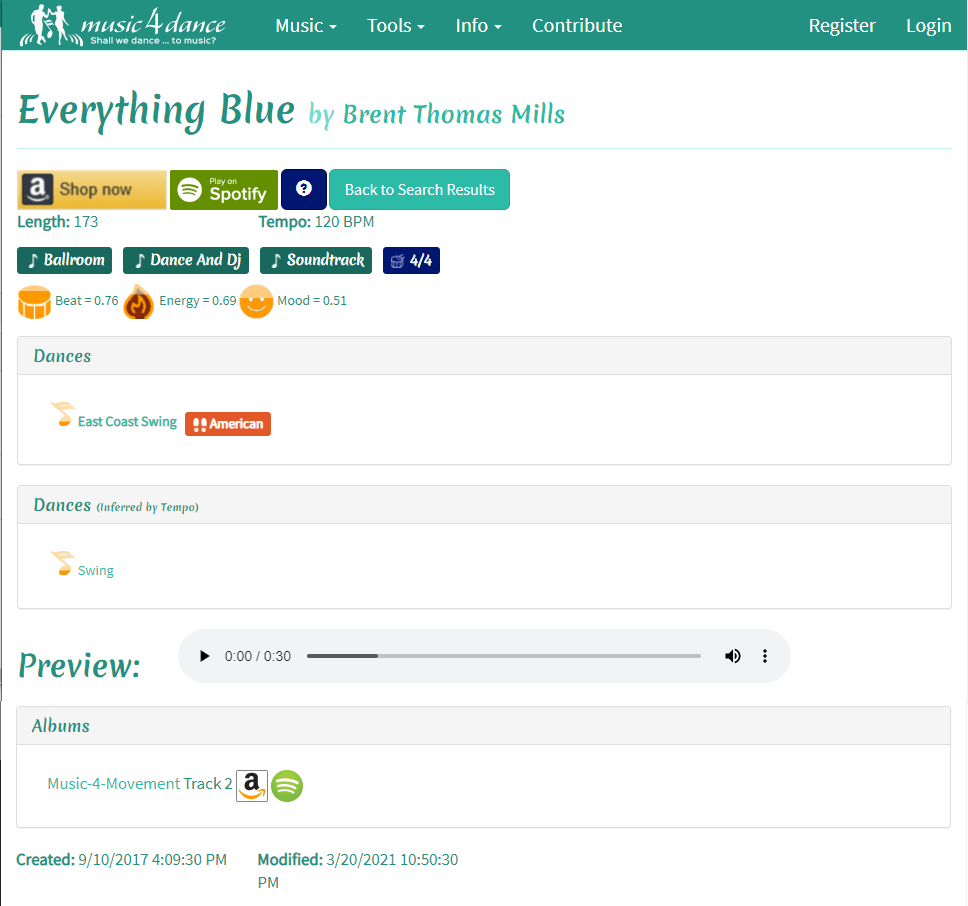
Original version of a song page on music4dance.net
An example song page from music4dance.net (current version)

In the new version (which I hope to release shortly), I use what I believe is a pretty standard mechanism to indicate voting. At least this is how the Stack Exchange family of sites that I spend an inordinate amount of time handles voting.   It’s the number of votes vertically framed by up and down arrows. Clicking on the arrows will allow you to vote (or ask you to sign in to vote).

An example song page from music4dance.net (upcoming version)

What do you think, is the new version easier to understand?  Or should I go back to the drawing board again? As always, I welcome feedback.

Quick Tip:

If you would like to vote on what dance you would dance to a song, create an account and start voting.

Ask music4dance: Why is the tempo that you’re listing for Ricky Martin’s “Casi Un Bolero” wrong?

I’ve seen a number of questions recently about why information on the site is wrong.  So I’ll start with one of the easier ones, which I’ve seen a number of variations on but is basically, “why is the tempo wrong”.  Here’s the specific question that prompted me to write this post:

There are a lot of Ricky Martin songs where the beats/minute are twice what they should be (186 for “Casi un Bolero” ?!?!).

The quick answer is that this is wrong for a dancer – listening to this music, I would dance to it at 93 beats per minute rather than 186.  And the fact that people have voted for this song to be danced as Bolero (96-104bpm) or International Rumba (100-108bpm)  indicates that others would agree.

So why was this listed incorrectly?  Unlike other things on the music4dance site like which dance you would dance to a song, tempo at least of a particular recording of a song is not subjective.  And even amongst recordings of a song, there is generally not that much variation.  Sheet music generally has some kind of tempo marking which will tell musicians the tempo at which they should perform the music.  This can range from a general marking like Presto that indicates a range of about 168-200bpm to actual metronome markings of a precise bpm tempo.  Music Theory Academy has a great explanation of reading tempo markings if you would like to dig deeper.  But my main point is that there is generally a “right answer” to what the tempo is of a piece of music.

This is a piece of music that is intended to be played ate 120 beats per minute as indicated by the quarter note = 120 marking circled in red

But if you notice the tempo that was listed for “Casi un Bolero” (186bpm) is exactly twice the tempo that we would dance to the music (93bpm).  Take a moment to listen to it (you can listen to a snippet on the “Casi Un Bolero” page on music4dance or the whole song on Spotify.com).  There are two instruments that are defining the beat – bass guitar and drum.  If we interpret this song as 4/4 at 93bpm, the bass guitar is emphasizing the first and third beats and playing occasional more complex phrases.  But you definitely hear a consistent one/three from that instrument.  on the other hand if you listen closely to the drum, it’s playing every eighth note (or 8 times each measure).  If you take the drum as the primary beat and definite that as a quarter note rather than an eighth note, you get a tempo of 186bmp.  Which is probably not what the musicians are thinking, and certainly not what a dancer is listening for.

Why is this important?  Because while many of the tempos listed on music4dance came from dancers who would hear the tempo that they can dance to a song, many other listings are generated via machine learning algorithms.  And the machine hasn’t quite figured out how to decide between listening to the bass or listening to the drums. In fact, both algorithms that I’ve used seem to prefer the drums.  So I occasionally go though and fix things up.  But with a catalog of nearly 40,000 songs and growing I’m not always keeping on top of that task.

As I rework the site, I’m hoping to get a moderation/curation function in to make it easy for others to help out with this.  So if you’re interested in helping out in that way, please let me know.  And as always I’m happy to hear from you with any kind of question, comment or feedback.

Quick Tip:

In this post I talk about the beats per minute of Bolero and International Rumba.  You can find listings of tempos for these and other dances in different forms on the tempi tool and competition ballroom page.

Playing with Dance Tempos

I just rewrote the Tempo tool for the music4dance site as part of the current effort to update the site.  In the process I went back and revisited the reasons for writing the tool in the first place. 

The main reason for this tool is to have a single place to do a bit of slicing and dicing of the relationship between the tempo of different partner dances.  It allows one to filter on the dances that you’re interested in (all Swing dances, or American Style dances) and sort by tempo to see the relationships.    This could, for instance, help find dances that one might mash up into an exhibition routine.

Another reason is just because I could.  The Tempo tool is really just a thin layer on top of the data that I use to drive the Counter tool and many other parts of the site.  I almost didn’t rewrite the tool because since I originally wrote it I added slightly less interactive but possibly more directly useful pages that lay out the different competition dances and their tempos in what I hope is an easily digestible way.

This is part of a larger rewrite of the site that I’ve been working on to get the code to a place where I can comfortably start adding more requested features.  The Counter and Tempo tools are a couple of the most isolated pages, but I’ll start digging into more core functionality soon.

As always, please send me feedback if you have ideas about the site, dancing, music, or how any or all of those subjects relate. And please consider supporting the music4dance project by sharing with your friends or any of the other ways listed here.

Quick Tip:  Many pages (like the ones mentioned above) have documentation pages that are easily accessible from the page.  Just go to the “Info” menu and choose “Help”, this will generally take you to a documentation page specifically about the feature that you were using.

Tango, Argentine Tango, Ballroom Tango, Oh My!

I just took a beginning Argentine Tango class and really enjoyed the experience.  I’ve had some experience with Ballroom Tango (American Style) and even taken a little Argentine Tango before, but this particular class really underlined the difference in the actually dance style.  Searching the web, I find plenty of evidence for this.

From the musical perspective, I found that I would be comfortable dancing Ballroom Tango to most of what the instructors played for Argentine Tango.  The character of the music seems very much the same.  The tempo was definitely slower than I would choose, but it was a beginner’s class after all.  The beat was less clear in many of the songs than I would expect in a Ballroom tango played at a school, club or competition, which was surprising.  This was a beginner’s class after all.

Now that I think about it, the Spotify EchoNest integration in music4dance could shed some light on the subject of strength of beat.  You can do an informal analysis yourself:

  1. Go to the songs library page.
  2. Choose Argentine Tango.
  3. Click on the strength of beat sort (the header icon that looks like a drum) once for ascending and twice for descending order.
  4. This will get you a list of the (currently) 578 songs that have been classified specifically as Argentine Tango sorted by the strength of beat.
  5. Or just click here to see the list.
  6. In a separate window repeat step’s 1-4 substituting Ballroom Tango for step 2 to get the 438 Ballroom Tango songs that have “strength of beat” information.
  7. Or just click here.

Now you can see the lists of Argentine Tango and Ballroom Tango both sorted by strength of beat.  At a quick glance the distribution seems pretty similar, but if anyone is at all interested let me know via a comment to this blog and I will be happy to do a slightly more formal analysis.

The other aspect of Tango music for dancers that this brought up was where to draw the line on calling something generically Tango vs. Ballroom Tango vs. Argentine Tango, etc.  I am currently calling anything a Tango that someone has tagged as any kind of Tango, which I think is fair.  Often people will just call something just Tango if they are from a particular community and I think that’s fair too.

If you are interested in stretching your reach and finding all Tangoes of whatever classification that fit a specific tempo criteria, you can use advanced search to choose generic Tango as the dance and choose a tempo range you’re interested in.  Or if you’re a Ballroom dancer you can go to the Competition Ballroom Dancing page and just click on the tempo range for the category of Ballroom Tango that you’re interested in.  I’ve set things up with the current official tempos for DanceSport and NDCA competition classes.

Speaking of official tempos.  Although I’ve found quite a number of sites that advertise and even provide rules for Argentine Tango competitions, I have yet to find anything that defines any kind of official tempo ranges for the music played at the competitions.  I suspect this is something fundamentally different about those competitions.  However, if I’m missing something and there are such official ranges, please let me know and I’ll incorporate them into the site.

And as always, please let me know what I’ve missed.  This is a very nuanced subject and I would love to hear other perspectives.  Feel free to comment on this post or send feedback directly.

What is a fake Waltz?

I was recently asked why there are songs tagged as Waltz in the music4dance catalog that are in 4/4 time.  This seems almost like the dance version of an oxymoron.   In my brief description of the Waltz on the website I start with “Waltzes are dances that are danced to music in 3/4 time…”

To be honest, the main reason that there are “Waltzes” that aren’t Waltzes in the catalog is that I pull from lots of different sources and even with something this fundamental there are different schools of thought.  I intentionally error towards the inclusive in these decisions since I think that dance should be as inclusive as possible.

A substantial number of these songs come from sources that cater to people looking for wedding dances.  But there are definitely “Waltzes” in 4/4 coming from other sources as well, I’ve certainly seen some exhibition Waltzes performed to music that has almost no discernable beat,  much less a strong 3/4.

I’m not sure where I picked up this term, but these songs are what I have been calling “Fake” waltzes.  If anyone has a better term for this, I would love to hear it.

In any case, a “Fake” waltz is generally a song that is in 4/4 but has a strong downbeat and very weak rhythm otherwise, so that one can dance three steps to a measure without being too distracted by the actual rhythm of the song.   You can find all of the songs that I’ve tagged as “Fake” waltzes by following these steps:

  1. Go to the Advanced search page
  2. Under “Dance styles”, choose Waltz
  3. Under “Include tags” , Choose “Fake”
  4. Click the Submit button

Or just click here for the pre-built search.

You can use the same process, but replace step (4) with choosing “4/4” and you can find all the songs that are cataloged as both waltz and 4/4.

The more interesting variations are to use the same process to find all waltzes that are not tagged “Fake” and not tagged “4/4”.  You can do this by using “Exclude Tags” in step 3 above.

And while I’m on the subject of unusual waltzes, there is another variation on this theme. It is a song with an extremely slow primary tempo where you can fit a very fast waltz half basic (three steps) on each beat. I’ve been labeling these as “triple-time” and the list can be found here.  Although that’s an exaggeration, there is only one song on that list as of this writing – Louis Armstrong’s “What a Wonderful Life”.  Perhaps I’ll find more by the time you read this.

I’m looking into ways to make the fact that a waltz is “Fake” more obvious.  Currently, it’s a tag on the dance which can only be seen when you click on the dance tag in a song list or by going to the song details page.

In the meantime, if you have a strong objection to songs in 4/4 being labeled as Waltz, you’re welcome to sign up and start voting them down or tagging them as “Fake.”

Even more than usual, I’m interested in how other people view this, so please feel free to comment on this post or send feedback directly to me.

Share Your Favorite Searches

Have you found a particularly useful or exciting way to search for music on the music4dance site?  Just for instance, were you choreographing a swing-cha combo and constructed a search for songs that can be danced to both East Coast Swing and Cha Cha and that are not categorized as Latin Music?  Or did you perhaps want to see a list of songs that could be danced to Cha Cha, Bachata, or Rumba but that are specifically 120 beats per minute?

You can do both of those pretty easily by using the Advanced Search page.  And then you can get back to your own searches by using the My Searches page.  But what if you want to share that cool list of songs with someone else?  You can do exactly what I’ve been doing here – do the search and then copy the link from the address bar in your browser.  That is a perma-link to the search that you just did and can be shared with anyone, anywhere.

As a bonus, if you’ve created an account, the searches that you share with your friends can include your likes and dislikes.  For instance, you can share a list of all Cha Cha songs that you have “liked”.  Or if you have a search you are particularly fond of but one of the songs just doesn’t work for you, you can unlike that song and then when you or your friends look at the list using the link you built you won’t see that song, and neither will your friends.

Feel free to share your favorite or most interesting searches here.  If enough people do that, we can add a new section for interesting searches to the site.

Dancing With The Stars, Revisited

Dancing With The Stars Season 23 is in full swing here in the US, and very entertaining as always.  Although I’m a bit disappointed that they appear to have stopped showing quick glimpses of the pros dancing the show back in after commercial – that was a lot of fun.

As I’ve talked about before, I use this show and others as a source for new music for the catalog.  But that definitely biases things towards performance pieces and less traditional songs.  What do you think, should I continue to do this, or should I concentrate on more traditional music?

Farewell to Rio 2016, but we’ll always have the Samba

Now that the 2016 Olympics are over and the Paralympics are wrapping up, it seems like a good time to highlight the two dances I’ve included in the music4dance catalog that originated in Brazil. Samba and Bossa Nova are closely related musically and have similar characteristic rhythms, but the Samba is considerably faster than the Bossa Nova.  I’ve updated the catalogs for both dances and added a bunch of new (to me) songs for each dance; check them out:  Samba Song List, Bossa Nova Song List

If you have other songs you think should be on these lists, please let me know by commenting on this post or submitting feedback.  Or participate by creating an account and voting songs up and down.

Before I leave the topic of the Paralympics, I wanted to shout out to one of my personal heroes – Kerri Morgan.

And back on topic (kind of ) – I just noticed that Wheelchair  Dance is a recognized sport in the Paralympics.  I’m off to watch some videos…

Do Dancers Think in Eights?

I was tickled to hear Nigel Lythgoe talk a little about choreographing tap on a recent episode of So You Think You Can Dance. The commentary is at about 1:13, but please start at about 1:10 so you can see the performance that he’s referring to.  It’s a tap piece that Emma, one of the young competitors, choreographed to “Rather Be” by the Pentatonix.  Just amazing – pause for a moment of silent appreciation for some real talent.

Nigel asked if she choreographed by listening to the rhythm or by counting eights. Quickly followed by the statement – “Musicians only count to four, dancers count to eight.”  Funny!

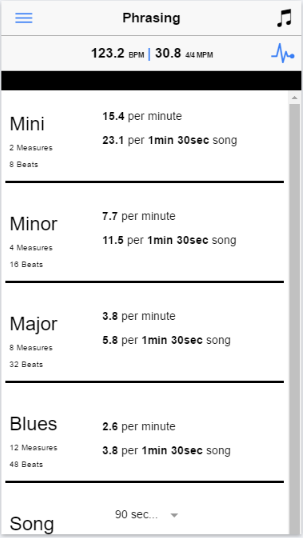
Besides making for a pithy quote, it ties right into a project that I’ve been working on recently.  I am experimenting with a phone application that I hope will be useful to choreographers and one of the things that I’ve been thinking about is phrasing of music.  It’s a variation on the web-app that I have on the site for counting out tempos. When choreographing for many ballroom dances, the basic unit of measure tends to be a two-measure mini-phrase, which would be 8 counts in most dances and 6 for the waltz.  And then there are longer phrases, which are closer to what musicians think in.  Here’s a quick mock-up of the phrasing page for the app – the idea is that you can count out (or just enter) the tempo of the song, choose a standard length and get a quick cheat-sheet of the number of phrases of various types that one would need to choreograph to fill the song.

Phrasing Page

Would this be useful to you as a choreographer?  Are there other features that might make as much or more sense to have your phone figure out for you?  I’m always looking for feedback, and the early the better since most of this isn’t even coded yet.

What are your favorite Prince songs for partner dancing?

I, like many, am mourning and listening to Prince‘s music. Over and over again.

Since I’ve been thinking a lot about music and partner dancing recently, this lead me to think about what I would dance to each song.  Especially when Leader of the Band popped up in my playlist and screamed Cha-Cha at me.  Of course a lot of his seminal work has more of a blues feel that I would associate with West Coast Swing (or possibly even more directly blues dancing).  But there are certainly some things in his catalog that one might Quickstep to (Let’s Go Crazy) or dance a Slow Foxtrot (Strollin‘) to.

Here’s a link to the list of Price songs currently in the music4dance catalog.  If you’ve got other favorites (along with what you would dance to them) let me know by responding to this post or sending feedback and I’d be happy to add them.  Or sign in and vote on what style you would dance to the songs already in the catalog.

The Prince Feature

One of the things that I noticed as I was looking for Prince music in the music4dance catalog was that I hadn’t implemented an artist page of any kind.  You could search for Prince but you would both get everything I had catalog by Prince and everything by Prince Royce songs with Prince in the title.  So I did a quick fix – if you click an artist’s name you’ll be taken to a page with a list of the first 100 songs I’ve catalog by that artist.  Since I’m only tracking artist by the full name this has a couple of implications, one of which is that Leader of the Band won’t show up under Prince since the artist is actually “Sheila E. featuring Prince and The E Family.”

You can, of course, still search for Prince and manually go through the songs to find the ones that actually involve Prince, but that’s obviously not the perfect solution.  How much does this matter to you?  Is it important to have a more specific idea of artist when you’re sorting through songs to dance to?

As always, please send me feedback or just respond to this post with any issues or ideas.