music4dance Goes Country (part I)

One of the most common requests I’ve received is to support Country Western dances. That request has come in many forms, but I don’t have personal experience with Country Western dancing (well, that’s not 100% true, I learned to West Coast Swing at a Country bar in downtown Seattle that my ballroom dancer friends would hang out at after rehearsing). I’m nearly certain that in adapting music4dance to support more country music, I’ll stick my foot in something stinky and get some negative feedback. I’m all right with that – all feedback will make the site better in the long run, just please try to be gentle 🙂 I’ve also stepped on plenty of toes with Ballroom dance which I know quite a bit about, Argentine Tango, which I know a little about and some of the social dances that fall in between on my personal knowledge spectrum.

And music4dance is pretty complicated to begin with, so adding another dimension may make it harder to use. But I’m hoping that, with your help and some iteration on the idea, we can get things to work even better in the long run.

My initial approach to adding Country Western Dance support is to review the organizations that publish competition rules, including tempo information, and see if I can work those dances into the music4dance system in a way similar to how I’ve set up the competition ballroom dances. This turned out to be easier than I expected. All three organizations that I found online (United Country Western Dance Council, World Country Dance Federation, and American Country Dance Association) list eight competition dances. Triple Two, Polka, Night Club Two Step, Cha Cha, Waltz, Two Step, Swing, and West Coast Swing. Only one of those dances wasn’t already in the database (Triple Two). Polka and Country Two Step were random additions early in the site’s evolution because a couple of DJ friends and lists published by ballroom dance studios included enough songs of those styles to make it worth my while to include them.

My biggest question was, should I create new dances for all of the dances that overlapped? After all, the Cha Cha danced in Country Western competitions is certainly not the Cha Cha I learned competing in American Rhythm (heck, the cha cha that the International Latin dancers were learning in the next room wasn’t the same dance either). I decided to follow the pattern that I’ve already established for Ballroom dances with the same name, even if they are pretty different. Rumba is probably the strongest example in the ballroom catalog of two dances with the same name that are not the same dance. But the characteristics of the music that a dancer cares most about are similar – this is true even of Rumba, where the tempo is significantly different.

Not coincidentally, I recently finished a significant project that allowed me to use the core database to easily and accurately search specifically for American Rumba vs. International Rumba. While there are a few drawbacks to grouping America, International, and Country Cha Cha together, there are a lot of advantages both in terms of how the system works internally and in making it easier to find new music for everyone (I’ve always been a proponent of genre-bending in fiction and cross-over choreography in dance).

So, there is now an active “Country Western Competition Dancing” page, and all of the individual dance pages for dances that include Country styles include the competition info for those dances. I’ll continue to tweak some of this information as I get feedback and do more research.

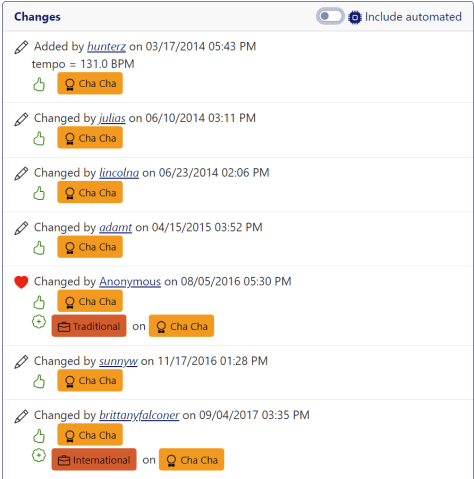
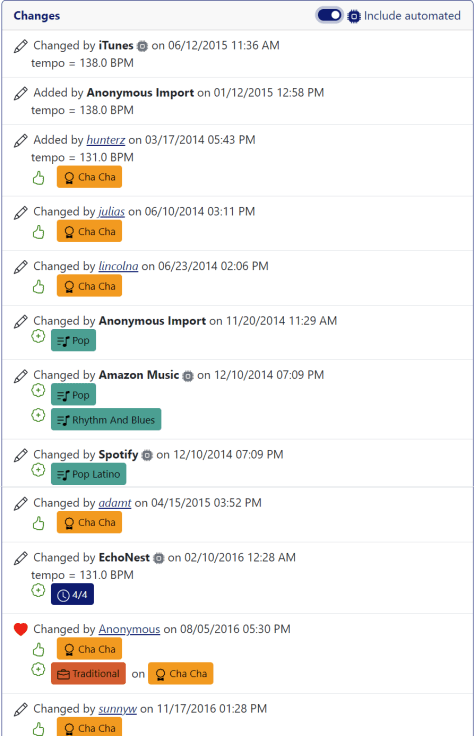
I realized as I was writing this post that I hadn’t addressed the fact that this change also complicated the voting mechanism. I want to encourage folks to vote on a song being a good Cha Cha, but also make it easy for them to specify Country, International, or American. I made some quick tweaks, but this is definitely a feature still under development.

Please let me know what you think (even – possibly especially – if you think I got it completely wrong). I’m interested in whether there are other Country Western dances that I should include, even if they’re not part of the core competition dances. There was a reference to Country Smooth and Country Rhythm rounds in one of the organizations rules, should I be supporting that? I’ve also used the composite tempos from the rules, combining the different levels to give the broadest range. Should I just be using the most advanced category?  What else have I missed?

And as always, if you enjoy the site or the blog (or both), please consider contributing in whatever way makes sense for you.

Songs for Halloween Ballroom and Partner Dances – 2025 edition

We continue to add to the music4dance Halloween song catalog. As of this writing, there are 1151 songs tagged as Halloween with a positive number of dance votes.

As I’ve noted in previous posts, we’ve gone from using the general tagging mechanism where you could search on songs that had a musical genre of “Halloween” and a particular dance, to having a dedicated Halloween Songs page. Other than pulling some new lists of Halloween songs, there isn’t a lot new to highlight in this post. But I think it’s always worthy of a reminder when a dance-worthy holiday is approaching. I also don’t have a great way other than these posts to track the number of songs in these kinds of queries year over year (although that’s technically possible – probably not the most productive use of my coding time). Hopefully, the state of the Halloween and Holiday catalogs is mature enough to be generally helpful.

While I’ve got you, though, here are a few questions. Please feel free to reach out via the comment on this post or any of the other feedback mechanisms with your answers. I read all responses and respond to everything that I can.

First, the obvious: is there anything about searching for Halloween music that you would like to see improved? Most of the new features over the last few years have come out of conversations with members of the community. And on a tangentially related note, are there other holidays or more complex queries that you’d like to see represented on the site?

Next, if you have Halloween playlists you’re willing to share, please do. I can reasonably easily pull in lists of various formats. My main requirement is that the songs be well-defined (title, artist, album, if possible) and that they be associated with a form of partner dance. Or take a run at adding a few of your favorite songs or voting on your favorite dance styles for songs that are already in the catalog. If you’re up for a bit more of a project, I’m still offering free premium memberships for folks who have the knowledge and are willing to vote on the danceability of songs, especially those that don’t have any votes at all. There are about 500 Halloween songs currently in the catalog that don’t have any dance votes. 

Finally, as always, please let me know if you have any thoughts about the subject of this post or the site by commenting below or using other feedback mechanisms listed here. And if you enjoy the site or the blog (or both), please consider contributing in whatever way makes sense for you.

Please help us catalog new music

A Swing Band leader (Glenn Crytzer) reached out to me recently, asking if it would be possible to add his entire catalog to the music4dance.net database. He found a few of his songs already listed, but has a published catalog of well over a hundred songs, most of which should be danceable to partner dances…

Keep reading

Halloween Ballroom Music 2024

Halloween is fast approaching, and I’m updating the music4dance Halloween catalog to include more partner dance Halloween music. I’ve pulled some generic Halloween playlists and cross-referenced them with the existing music4dance catalog. Using this method and some help from the community, we now have 340 songs available in the Halloween catalog that are also tagged…

Keep reading

Are you ready for your Halloween Dance?

Whether you’re a DJ getting your playlist together or a performer looking for that perfect song to craft a routine to, our Halloween collection is a great place to start. I’ve recently spent some time expanding the catalog. As of this writing, there are 222 songs tagged as Halloween with at least one vote for…

Keep reading

Are you looking for Halloween Music to dance to?

Halloween is almost here and yet again I am late setting up something for Halloween related playlists.  In past years, I’ve just let this go since it feels like it’s too late to get something together when I start thinking about it in mid-October.  But this year I decided to just do it. After all,…

Keep reading

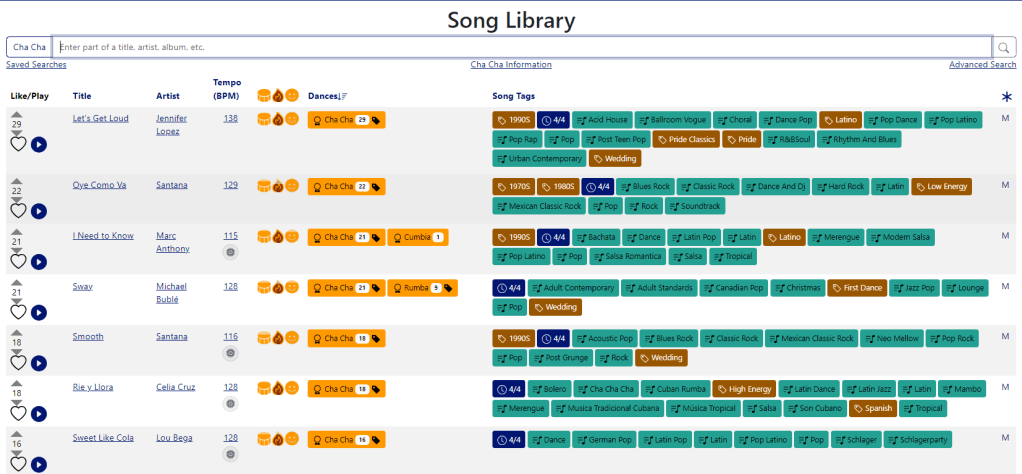
What if I want to find just Cha Chas tagged as American Style?

Or one of the many variations, such as Slow Foxtrots labeled as “Traditional,” or Boleros labeled as “fast”?

Queries like the above have always been possible, but with a very major caveat. Up until now, you could search on Cha Cha dance and “American” style. But what that did was find all songs that had a net Cha Cha vote of at least one and a tag on any dance of “American” style. So if someone voted on a song as Rumba and tagged the Rumba as American, then someone else voted for the song as Cha Cha, searching on Cha Cha and American would include that song.

This behavior was particularly troublesome if you wanted to do something like search for fast Salsas, because you’d end up with songs that are fast Rumbas or Cha Chas, but slow Salsas, which is precisely what you don’t want. Side note: the workaround for that particular issue is to search on specific tempos, but that isn’t really the same as searching for songs that someone explicitly tagged as slow or fast for a particular dance, since there is more thought put into tagging (and not every song has a tempo associated with it).

I’ve done a bunch of restructuring and added more than a bit of UI to enable the kinds of searches that I’m describing here. I’m currently busy updating the documentation to catch up, but I hope that the fundamental change is relatively intuitive.

There have always been two kinds of tags: tags on songs and tags on top of a dance style for a song. I’m gravitating to calling the latter dance-specific tags, although I haven’t been 100% consistent yet. If you go to any of the dance details pages (try Slow Waltz), you’ll see two tag clouds now, labeled Dance Tags and Song Tags. Clicking on any of the tags in the Dance (specific) Tags section will give you the option to list the songs with that tag on Rumba.

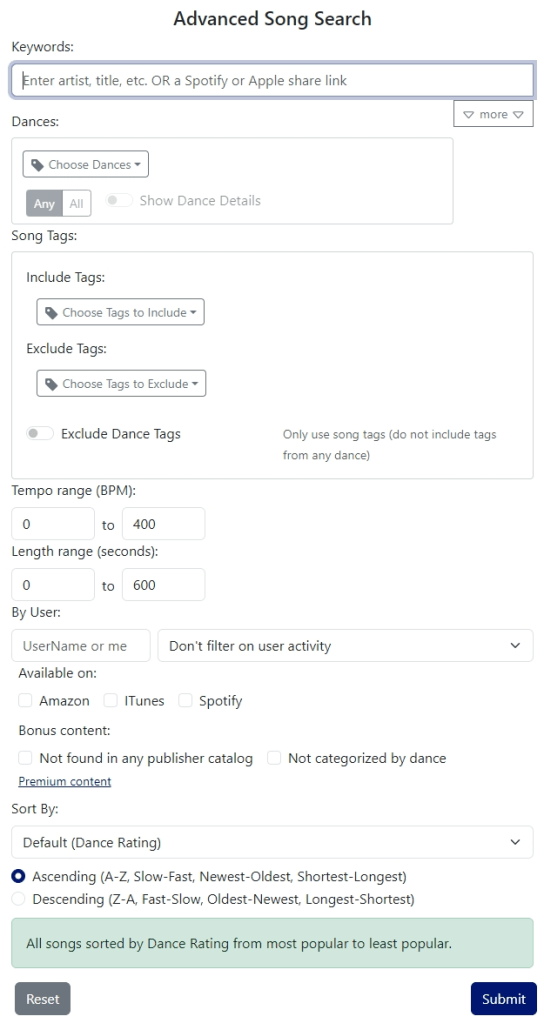
Alternatively, you can navigate to the Advanced Search page, add Rumba to the list of dances, toggle the “Show Dance Details” switch, and select the option to include the American tag. In either case, you’ll end up with this result. Or we can answer the original question of All Cha Cha songs tagged as “American” style.

In any case, this is a very large new feature that includes a breaking schema change in the search index, so there are bound to be bugs. Please poke at it and let me know what you think. I’m doing my best to enable the deep scenarios that you ask for without overly complicating the core scenarios. Part of what I’m trying to do is what I alluded to in my last post, where I made a reference to making it easier to add refinements to dance searches, so that you can more accurately find all American Style Slow Foxtrots – once could theoretically do something similar with Country Cha Chas (which aren’t currently supported at all).

Please let me know if you have any thoughts about the subject of this post or the site by commenting below or using other feedback mechanisms listed here. And if you enjoy the site or the blog (or both), please consider contributing in whatever way makes sense for you.

New Feature: Searching on songs with a minimum number of dance votes

Several folks have been frustrated with the number of songs in the music4dance catalog that only have one or two votes for a particular dance style. This limitation doesn’t matter for many searches because you can sort by dance votes, and the most popular songs end up at the top. But if you want to…

New Dance: Single Swing

I’ve added Single Swing as a dance style that can be searched on and voted for in the music4dance catalog. While I think of this dance as a short-cut to use when I want to dance East Coast Swing to faster Jive or Lindy-Hop music, I’ve received enough feedback from the community that it’s considered a unique dance in its own right that…

“Search like Google” is now the default

Update (July 2024): This underlying search mechanism described in this series of posts is still in place and functions as described here, but the user interface has changed. Please see the Simple Search and Advanced Search documentation for how the current user interface works. I’ve just updated the music4dance site to make the new search engine the…

Defining dance is hard. On further consideration language is hard, full stop.

I’ve been building music4dance for well over a decade now, and I am still amazed at how passionate people can be about what is right or wrong, not just with respect to dance, but also with many other aspects of the site. Two such instances came up in a recent piece of feedback that I’d like to address, as they are related to ambiguities in language.

Dance

The first is that the site is oriented to a particular local community and is “completely useless” for dancers from other locales. I’ve never heard that specific feedback before. But I do read it as a variation on other feedback that amounts to how I’ve organized the site doesn’t line up with how everyone thinks about dance. I believe that is a good thing. Dance is diverse. A single individual shouldn’t be able to wrap their head around the whole breadth of the dance world, or even something slightly less broad like the partner dance world. Here are some previous posts where I’ve explored this idea in more depth:

I have lived in the Pacific Northwest for most of my adult life and learned to dance here. And while I’ve spent some time social dancing over the years, my primary focus was on competitive ballroom dancing. Indeed, with social dancing, there will be some bias towards what I know, and that is the scene in the area where I dance. With ballroom, not so much, as there are standards and organizations.

But the bottom line is that the more the community gets involved, the less the site will reflect my editorial viewpoint. My focus is on making it easier for anyone with an account to add songs and tag them with dances, which will shift the “editorial center” of the site slightly closer to their viewpoint. Some design limitations make it more difficult than I’d like to add new dance styles. But I’ve been rearchitecting the site to make that easier, so if dance styles are missing from the site that you would like to see represented, please get in touch with me. I’ll be happy to work with you to add them.  I am also working on a feature that I hope will make it easier to filter on variations of dances – more on that in a future post.

Donate

Another aspect of the site that has bugged me for some time, but that I haven’t addressed, is the use of the word “Donate” on the site. I’ve never received any feedback on this subject before now. However, I understand that using the word ‘donate’ can imply that the money spent would be a tax-deductible donation. That is not my intent, as I would use the phrase “charitable donation” and include a tax ID if it were. If someone could give me a better word than donate, I’d be happy to update the site with it. The only other contender I have come up with is “give,” but that has pretty much the same issue. I have not registered music4dance as a non-profit in any jurisdiction. For more details, please visit the subscription page.

The other word that this person objected to was “contribute.” My intention in using that word was to encompass different ways that someone could help improve the site. That does include monetary contributions in the form of subscriptions or (non-tax-deductible) donations. But it also covers voting on dances, adding songs, sharing the site with friends, and any of the other ways I’ve listed on the contribute page. I’m less concerned about the ambiguity of that term. But apparently at least one other person is, so I’d be happy to change that as well if someone has a better term.

While we’re on the subject of contributions, I want to take the time to thank everyone who has financially contributed to the site, including the person who provided the feedback that inspired this post. Ad and referral revenue only covers about 10% of my core operating costs; your (non-tax-deductible) subscriptions cover more than that. So thank you!

Please let me know if you have any thoughts about the subject of this post or the site by commenting below or using other feedback mechanisms listed here. I’ve still got a ways to go to get to the goal of covering the core operating costs of music4dance that I set in 2019 when I first turned on the subscription feature, so if you’re not already subscribing and would like to continue to enjoy the site and the blog, please consider contributing (in a non-tax-deductible sense).

Please help us catalog new music

A Swing Band leader (Glenn Crytzer) reached out to me recently, asking if it would be possible to add his entire catalog to the music4dance.net database. He found a few of his songs already listed, but has a published catalog of well over a hundred songs, most of which should be danceable to partner dances (mostly Swing variations).

Glenn graciously provided me with a spreadsheet of his music, and I was able to upload it to music4dance. This was particularly nice because I could include his data on tempo and genre tags, as well as some other miscellaneous metadata from his comments that I turned into tags. But that led me to the next issue – his data didn’t include anything about which dance or dances would be particularly suitable for each of the songs. Which is entirely reasonable, he’s not actually dancing to them, and most of them would work for a generic swing night – the dancers can choose to dance Lindy, Balboa, East Coast, or something else to any particular song. Although that’s a vast over-simplification, if you’re interested in how a musician thinks about these things, Glenn’s article On Programming an Original Swing Music Album is an illuminating read.

That leaves me in a bit of a bind. I can certainly go through the 100+ songs myself and vote on which dances work for those songs, and I probably will. But I dance East and West Coast Swing and a bit of Lindy and Charleston – oh, and a bit of Slow Foxtrot, as Foxtrot and Swing music overlap – so I’m not familiar enough with some of the other dances to say whether a song would be suitable for Balboa, Jump Swing, Quickstep, etc. And more importantly, even with the dances I do know well, I’m only one opinion. Music4dance works much better when others in the community contribute by voting on dances that they are familiar with for songs in the catalog.

That line of reasoning led me down the path that I’ve considered several times before, of unlocking premium membership for free for members who vote on dances. I’ve thought and rejected several complex mechanisms to enable this. While some of them seem plausible, I don’t want to spend time writing code until I prove that there are enough members of the music4dance community willing to participate to make it worth my while.

Something about the interaction with Glenn and the thought that I’d love to get his songs showing up with associated dances sooner rather than later made me look at the problem a little differently. What if I went the low-tech/high-trust method of giving out premium memberships to anyone who committed to voting on a certain number of songs per month? I wouldn’t have to write any code at all for that, and if enough people take me up on it to make manual management of the “feature” cumbersome, I can always write the code later. That will also let me play with the parameters without building a whole dashboard of knobs and dials.

The Offer:

If you are familiar enough with at least one dance to confidently listen to an arbitrary song and say, “I would dance that dance to the song,” and are willing to spend some time each month doing that on the music4dance website, I’ll extend you a premium membership for each month that you do. Furthermore, I’ll take your word for it and give you the premium membership ahead of time. That will let you look at songs that no one has voted on yet (which is essential for things like the Glenn Crytzer catalog – at least until someone has voted on a song). To make this somewhat measurable on my end, let’s set the number of votes at 50 per month to keep your premium membership going. I’ll reserve the right to change the parameters at any time, including cancelling the program, since this is an experiment. But at minimum, if you contact me to try this out, you’ll get the first month of premium free, and I won’t turn that off before the end of the first month unless I detect you doing something malicious.

Why should you care about a premium account? In this case, it allows you access to more songs, including songs that no one has voted on yet and songs that I’ve pulled in from someone’s list of danceable songs but haven’t matched to a music catalog. With a premium account, ad content is turned off, and you can export results of your searches to Spotify – see details here.

Musicians (a quick aside):

Before I get into the nitty-gritty details of how to take me up on this offer, let me take a moment to reach out to other musicians who would perform music suitable for partner dancers. If you are interested in having me bulk upload your catalog to music4dance, please contact me, and I’d be happy to do that.

Here’s how to go about taking me up on my offer:

  • Create an account on music4dance.net here if you don’t have one already. (Account management help)
  • Email me at info@music4dance.net from the email you used to create your music4dance account and include “I’d like to Help Cataloging Music” in the title. Feel free to include any other details you’d like to share or questions about the offer in the email. I read everything that I get.
  • I expect to be able to upgrade your account and respond to your email within forty-eight hours (but this is an intention, not a commitment – read the notes above about this being an experiment) – if you haven’t heard from me in that timeframe, please try again.
  • Read the information about Dance Tags to understand how to vote.
  • Start voting!

This offer is for voting on dances, not for clicking the like button on songs. The latter is a feature that helps you organize your use of the music4dance catalog, but doesn’t do much for other users, so I’d like to focus on the core music-to-dance relationship of the voting mechanism for this offer.

Useful links:

What if you want to support music4dance but don’t have either the time or the experience to catalog songs by dance? There are plenty of other ways to contribute, as described on our “Contribute” page.

Open Source music4dance

I’ve been considering publishing the music4dance source code as open source for some time now. I finally pulled the trigger!

You can find the source code for music4dance on GitHub, located at music4dance / music4dance; I’ve published the code under the MIT License. Note that this covers the code; I haven’t published the database.

I’ve documented the new ways (and some pre-existing ways) of contributing to music4dance in the contribution guide, and you can get an idea of what I (hopefully soon we) are working on by looking at the issues database. If you’re not a programmer, you can probably stop reading now. But, before you go, I would like to remind you that if you use music4dance there are plenty of ways to contribute to music4dance, including voting on which dance you would dance to a song or upgrading to a paid subscription.

Why Open Source?

My primary motivation for considering open source is that several people have reached out to me over the years, offering to help in general or implement a specific feature that they’re particularly interested in seeing. Making the project Open Source would be much easier than giving them access to a closed-source project.

I’ve also spent the last few years leading college students in contributing to other open-source projects as their capstone projects. While I’m not necessarily going to put music4dance features up for student projects, that experience combined with my contributions to BootstrapVueNext (the front-end framework I use for music4dance) has given me enough background in open-source projects to be more comfortable opening up my own codebase.

Another benefit of creating a GitHub project for music4dance is that I automatically get a reasonably well-designed issues database to manage code bugs, data bugs, and features that is visible to everyone. While you need a GitHub account to add issues, you don’t need an account to view them and get some idea of where I’m going with music4dance. Once more people start entering bugs, you’ll be able to see if others have run into the same issue you’ve discovered.

To top off my list of reasons to move to open source, I’ve been using some of the problems I’ve worked on with music4dance as fodder for technical articles on Medium. Since the source code for music4dance wasn’t publicly available, I built small projects to demonstrate the issues. While having small, isolated projects to demonstrate technical issues is useful – in at least one case, I’m maintaining the sample project as a means of testing updates to the affected systems in isolation – I’d also like to be able to show the solutions in the context of the real-world project that inspired them. Now I can.

What took so long?

I’ve been working on music4dance for over fifteen years. Why haven’t I made this move earlier? One reason is that by the time it occurred to me to move to open source, the codebase was well over a decade old. Much of the code was dated, there were many things I’d rewrite given time, and test coverage was abysmal. My impulse was to clean things up before publishing. I even started doing so with some of the oldest code. But I concluded that it would take approximately forever to get the code into shape, especially if I spent some of my time on new features and contributing to the song database.

I didn’t initially create music4dance as an open-source project because I hoped it would be the seed of a profitable business. I’ve pulled back that expectation to the hope that I can generate enough revenue from referrals, ad revenues, and subscription fees to cover the server fees and other expenses, making this passion project a revenue-neutral proposition.

In conclusion: For better or worse, the code is now out in the wild. Please take a look and let me know your thoughts.

Please let me know if you have any thoughts about the subject of this post or the site by commenting below or using other feedback mechanisms listed here. And if you enjoy the site or the blog (or both), please consider contributing in whatever way makes sense for you.

Nine Sinatra Songs – Ballroom inspired Ballet

Pacific Northwest Ballet included Twila Tharp’s Nine Sinatra Songs as part of their Director’s Choice performance this year. I’m not in any way qualified to review a Ballet performance, but I can say that I thoroughly enjoyed it and had a great time playing with the Ballroom-inspired aspects of the dancing as I watched the show unfold. For me, the idea that the dancing was inspired by ballroom rather than in any way attempting to choreograph actual ballroom dance steps on ballet dancers is what made it work (this is the issue I sometimes have with partner dance in Broadway musicals). It was obvious in several of the nine pieces that  Ballroom dance inspired the piece, and the upper body shaping and movements felt quite ballroomesque throughout the performance.

On returning home, I hoped to find a resource that listed the dances that Tharp drew from for each of the first eight pieces (the ninth is a reprise group number), but I failed. The notes from some of the performances mention the roots of one or two dances, but it seems like, for the most part, they name the same couple of songs. So, my guess is that even a thorough search of those through the years wouldn’t yield a complete list. As an aside, it was fun to jump down the rabbit hole of the French Apache Dance that Tharp drew from for the choreography for That’s Life. If someone has such a reference, please let me know.

In the meantime, I will take this as inspiration to play a little with the possibilities of music and dance. Sinatra is already well represented in the music4dance catalog, with 166 songs listed before I started filling out the few missing entries from the ballet. But I’ve always thought of dancing Foxtrot to Sinatra or maybe Swing. In the ballet, Tango, Rumba, and Samba were definitely represented. So, I took a few minutes to see what the music4dance community has to say about dancing to this music.

If you go to the Frank Sinatra artist page, you’ll see Slow FoxtrotLindy HopRumbaCastle FoxtrotEast Coast SwingJive, Quickstep, Peabody, West Coast Swing, Single Swing, Slow WaltzBalboaBoleroBossa NovaViennese Waltz, and Blues all represented.

And here’s a custom music4dance playlist that includes all eight songs (although one song is the Perry Como version since the Sinatra version isn’t available on Spotify or iTunes).

A snapshot of the eight songs used in "Nine Sinatra Songs"
The eight songs used in “Nine Sinatra Songs” as shown on music4dance.

Are there other partner dances that Tharp drew from in this work that we should represent in music4dance? Are there other Ballroom-inspired ballets out there worth viewing? Do they use different music that you’d like to add to the catalog? Are there other playlists that you’d like to overlay the music4dance information on, like I did with this one? If you have ideas about this post or the site, please comment below or use other feedback mechanisms listed here. And if you enjoy the site or the blog (or both), please consider contributing in whatever way makes sense for you.

What is that dance called? Swing, East Coast Swing, Triple Swing, East Coast, or…

When I got into the business of categorizing music by dance style, I knew there would be a lot of ambiguity involved. However, some of the passion behind people’s opinions about what a dance should be called or what tempos are acceptable for the dance called X still takes me by surprise. Several times a year, I get an email from someone who is absolutely livid that I “got the tempo of West Coast Swing completely wrong” or called a dance “Lindy Hop” rather than “Swing” or some other variation on the theme.

I learn a lot from the people who send these emails, and often learn something that helps me improve the site or my general knowledge of dance. One feature I added a while back, based on some of these interactions but haven’t discussed in the blog, was the idea of having “synonyms” for dances.

The way music4dance works, I have to have an unambiguous and unique name for a dance. This leads to somewhat clunky names at times – for instance, the dance that most dances consider “Waltz,” I call “Slow Waltz” to distinguish it from “Viennese Waltz” and to allow for a catch-all category of Waltz. But I want to be able to show other names for dances so people can find the dances even if they know them by another name. This applies both to cases where the dance really is the exact same dance; it’s just named differently to disambiguate it, and in cases where the parameters for what music works are close enough that it makes sense to use the same list of music for both dances.

Cases of actual synonyms:

Cases where the dances are different, but the music is the same:

  • Castle Foxtrot = Slow Dance – I started categorizing music that was basically Slow Dance music as Castle Foxtrot, which is a legacy dance that some studios occasionally teach because Castle Foxtrot showed up in my searches as I was designing the site, and fit nicely into the tempo spectrum of Foxtrot-like dances. The practical use of this ended up being more for people looking for “Slow Dance” music in wedding contexts, so I added the Slow Dance synonym. Perhaps I should change the primary name?
  • Hustle = DiscoFox – As far as I can tell, these have evolved into different dances but are still danced to similar music. But that is based on web searching rather than personal experience, so please correct me if I’m wrong. I’m also now second-guessing myself as to whether I should add “Swing Fox,” “Disco Swing,” and “Rock Fox” as synonyms, or if one or more of these rates is its own category.

In any case, if you go to the main “Dance Style” page, you’ll see all the styles we’ve set up, along with their synonyms. As this list grows, being able to filter it is more important, so the filter control acts on both the primary name and the synonym. I also handle the synonyms when you search in the search control in the menu bar. So if you type “Slow Dance” in that search box, you’ll find a list of slow dance songs (that are actually tagged as “Castle Foxtrot”). I don’t convert the name of the tag in the results, but I could if that seems important…

I’m posting this now in part because, during my recent round of updates, I broke the showing of synonyms in the Dance Styles page and then realized I hadn’t ever asked for feedback on the feature. The only mention in this blog was the post when I added it as an afterthought to adding Single Swing to the catalog.

Are there other synonyms that I should add? Are there dances that I’ve listed as synonyms that I should break out into separate dances? If you have ideas about this post or the site, comment below or use other feedback mechanisms listed here. And if you enjoy the site or the blog (or both), please consider contributing in whatever way makes sense for you.

Ballroom Songs for Your First Dance

Wedding season is upon us again, so I thought I’d take another run at filling out the music4dance.net wedding dance catalog with wedding spotlight songs cross-referenced by partner/ballroom dance style. It’s pretty common to choreograph a first dance, and I’ve seen mothers and fathers learn a particular style of dance so they could lead/follow their offspring in a partner dance, especially among friends who are part of a social dance or ballroom community.

Cross-referencing between a tag and a dance style is something that the music4dance database is set up to handle exceptionally well. But, of course, someone has to add the tags and vote on the dances. I recently did a round of collecting information from Spotify playlists, but that is never as good as community members contributing their ideas. Please consider adding your own first dance or other wedding spotlight songs to the database.

On that note, I’m seeing more and more different wedding spotlight dances (for lack of a better term). I mentioned Mother/Daughter the last time I looked at wedding dances, but now I’m also seeing Father/Son, Brother/Sister, and Last Dance, just to name a few. This pattern has me thinking about the most helpful format for the wedding dance page. I like the simple table format because I can get a quick idea of the distribution of different dance styles of songs in the database compared to the spotlight event, but that probably isn’t the best way to look at the data from the perspective of someone looking for a song to dance to and gets worse if I add more columns.  I’m leaning towards another generalization of the Holiday page. The top-level page would be linked to each of the spotlight dances (First Dance, Mother/Son, etc.), and then each of those pages would look like the holiday page with a list of all songs that suit the event and links to drill down to a particular style of dance.

I don’t think I should be adding wedding songs like processionals, recessionals, etc., because I’m pretty sure people don’t dance partner dances to those. But as I type this, I can’t shake the thought of a father and daughter Viennese Waltzing down the aisle to Kelly Clarkson’s “Breakaway.” I’m also not ready to tackle the line dances that are often done during the reception, as there are sites that specialize in line dances, and from what I can tell, the set of these dances that are used at wedding receptions is small enough that it doesn’t require a database to keep track of them.

But are there other spotlight dances that we should be tagging? Can you think of different ways to organize the catalog? If you have ideas about this post or the site, comment below or use other feedback mechanisms listed here. And if you enjoy the site or the blog (or both), please consider contributing in whatever way makes sense for you.

P.S. Since I don’t have a great way of tracking historical song counts, I will note here that as of this writing, there are 1771 songs tagged as Wedding and have at least one dance vote, of which 1131 are tagged as First Dance.

We’d like to dance a “real” partner dance as the first dance at our wedding (Part I: We already chose our song)

Wedding season is upon us, and one of the things that come with weddings is receptions with first dances, father/daughter dances, mother/son dances, mother/daughter dances, and any other variation you can think of. I think it’s extra special when those dances are recognizably partner dances like Foxtrot, Rumba, or Swing. Of course, I have a bit of a bias. If you want to find…

Western Partner Dances and Line Dances?

One of the comments on my last post asked:

A lot of our dance groups over here love to dance the partnered dance sea shells The song “Blue night” by Michael learns to Rock sings the song they dance to. Is there a list on your data base of similar songs to that one that they can also dance Sea Shells to?

This question lead me down one of those beautiful rabbit holes that dance often does.

I had never heard of this dance, but I looked it up and found a YouTube video with the choreographer demonstrating the dance. It was 32 counts (four 8-counts) danced line of dance using a vocabulary that I’m not familiar with but would guess was some flavor of country dance.

Now, when I was learning to lead as a ballroom dancer, my teacher often put together a few eight counts of choreography that I could use so that I wouldn’t have to think as much about what my next move was and concentrate instead on leading my partner and making sure I didn’t run into anyone (or step on my partner’s feet). I understand this is a common technique in the Ballroom community. I ran across similar methods when learning social dances in group classes. So my first instinct was – this is just a slightly more formalized version of that technique – and it has the advantage that your follow knows that you will be doing this same sequence, so the lead should be much easier.

Following that thread, I listened to the song more closely and counted it out. It’s about 97BPM 4/4 and had the feel of an International Rumba or Bolero to me. This gave me the first level answer to the question of what else would someone play if people wanted to dance “Sea Shells” – I went to Advanced Search and selected Bolero and Rumba, limited the tempo to 95-99 BPM (an arbitrary bracket around 97 BPM) and sorted by the most popular – that resulted in this list. I’m convinced that someone who learned “Sea Shells” could dance it to any of the top songs on the list.

But I felt like I was missing something fundamental about this type of dance, and I dug deeper. I didn’t have to do much searching to find a “Dance Step Sheet” with the specific choreography that Dan and Kelly Alboro created. In fact, there were a bunch of places that listed this dance and described the steps. Poking around the websites that hosted such sheets, I found that this is a whole thing. Please pardon my ignorance here since I’m sure many people reading this post know more about such things than I do, but the concept of choreographing a few eight counts of a partner dance and naming it was completely new to me.

My understanding from a relatively brief perusal of these sites is that there is a branch of country dancing similar to line dancing where someone choreographs a number of eight counts using a specific vocabulary, teaches it at an event, and then a whole group of people can dance the same “dance.” The most experience I’ve had with these personally is Wedding Line Dances, but it seems like a fun experience. Doing this kind of dance with a partner rather than the individual line dances I’ve seen in the past feels like a great way to become more comfortable as a partner dancer. In any case, I’ll put a bunch of links at the bottom of this post to sites written by people who know a lot more about this than I do.

Back to the original question: Another answer is that some of the “Dance Step Sheets” for “Sea Shells” list an alternate song that it can be danced to. The song they list is “jumpin’ the jetty” by Coastline. Now, this is a song that shouts Swing to me and is considerably faster (126BPM) than “Blue Night.” So that blows my original thought out of the water. Here is a search for swing songs between 124 and 128BPM. Unsurprisingly, there is no overlap between this list and the one I generated for “Blue Night.” I suspect someone who knows the choreography well can probably dance it to any reasonably consistent 4/4 music at a wide range of tempos. For those who are less expert, there is perhaps an advantage to being on the slower side and having strong phrasing. And I’m sure there are plenty of folks who only want to dance this particular dance to the music that they learned it to in the first place. But as I’ve said repeatedly, I’m way out of my depths here, so if someone who actually knows something about this kind of dancing would care to jump in and help me out, please do.

The last thing I wanted to say about this subject is that I’ve had several requests to support country and line dances on the site. I plan to enable the more traditional country partner dances once I get past some infrastructure issues that are currently blocking me from adding a bunch of new dances. I’m confident I can do that and seed the lists from reliable sources to get something up and running despite my lack of specific knowledge of those dances. Then, hopefully members of the community who know more about those dances can add more. Please let me know if you’re interested in this feature. The more people raise their hands for this feature, the faster it will move up my TODO list.

I hadn’t devised a method for handling line dances before this, partly because I assumed they were all choreographed to a single song. It didn’t seem like the system I’d built would handle that very well. But based on this experience, I’ve come up with a way to “support” line dances without adding code. I’ll throw it out there, and if anyone wants to start adding line dances to the database, I’ll document it more closely and possibly even add some code to make the experience smoother. The idea is pretty simple. Just add a comment with a quoted version of the name of the line dance to the song. Then, people can search on that and get a list of songs to line dance to. Here’s the search for “Sea Shells,” which returns the two songs I’ve discussed in this post.

I will dig myself out of the rabbit hole for now and see if I can make some progress on the infrastructure issue I mentioned above.

Please let me know if you have any thoughts about the subject of this post or the site by commenting below or using other feedback mechanisms listed here. And if you enjoy the site or the blog (or both), please consider contributing in whatever way makes sense for you.

Some interesting links related to the Western Partner dances:

Copper Knowb Stepsheets

DiceMemory Parter / Circle Dances

DiceMemory Line Dance Steps

CoutryDancingTonight – 10 Popular Partner Country Dances

Wikipedia – Partner Dance

Wikipedia – Country Western Dance

Wikipedia – Round Dance