Tag Archives: Ballroom

I’m a ballroom dancer. Can I find practice songs that are at competition tempo? (Revisited)

This is an update to a post I wrote in 2015Music4Dance has come a long way since then, so the answer to the title question is completely different than it was nearly a decade ago.  In fact, the top-level answer is so simple I was tempted to just put a note at the top of the old post, but I had a few other things to say, so I went this route instead.

So here it is: Go to the Ballroom page and check it out.  The page is accessible from the “Music” menu.

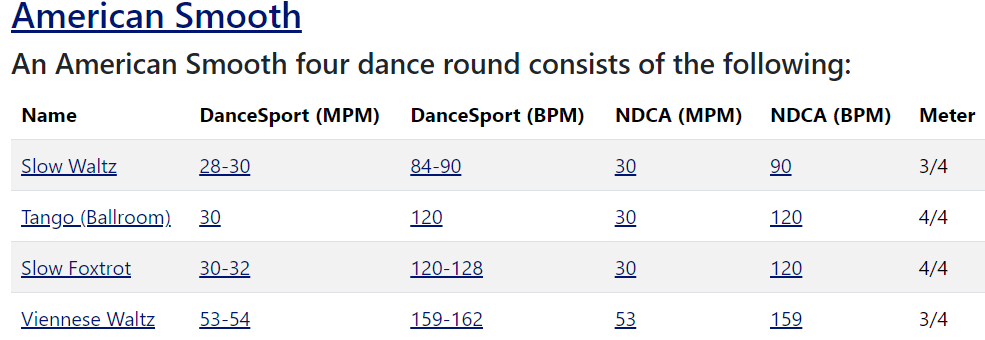
A table showing the tempi of American Smooth dances

Clicking on the round title takes you to a page with more information about that style.  For the American styles, that includes other dances that aren’t part of a round.

The Competition Ballroom page has sections for American SmoothAmerican RhythmInternational Standard, and International Latin. Each section contains basic information about the dances, including tempo in measures per minute and beats per minute1 for both of the major organizations that run Ballroom Dance Competitions.

Clicking on any tempo listings will take you to a list of songs tagged with that dance style and set to within that tempo range.  Note that I’m not currently also filtering on the American or International tag on the dance. This is for two reasons. First, the underlying database, which has a lot of excellent qualities, won’t let me do that particular search.  Second, because many of my sources don’t routinely specify the style, we’d be leaving out many great songs if we filtered that tightly.

And that’s it!


Here are some additional things that you might want to try that are adjacent to the simple answer:

If you disagree with the tempo listings and believe they’re wrong, please let me know, and if possible, cite your sources.  Tempo recommendations change occasionally, and I’m not always on top of the changes – the NDCA made some substantial changes a couple of years ago, and it took me over a year to notice.

If you want to find songs that are slower or faster than the listed tempos (e.g., if you want a slow set and a fast set), you can go through the process above and then click “change search” on the results. This will take you to the advanced search page, where you can change the tempo range without changing anything else and re-run the search.

If you have a premium subscription you can export the results of any of the above searches to Spotify.

If you would like to have this kind of support for other styles of dance, let me know where I can find reliable tempo information, and I’ll look into adding them. Some similar functionality is available on all of the dances we list, but the full tables only make sense if we have the kind of information that the ballroom dance organizations give for their competitions.

As always, I’m very interested in your feedback, so please share any thoughts and ideas about this post or the site by commenting below or using other feedback mechanisms listed here. In addition, if you enjoy the site or the blog (or both), please consider contributing in whatever way makes sense for you.

  1. Before you ask, I’m leading with “Measures Per Minute” rather than “Beats Per Minute,” as that’s how NDCA and DanceSport list tempo in their rules. If anyone in the ballroom world knows why that is, please let me know. ↩︎

Ask music4dance: Why is the tempo range you list for West Coast Swing wrong?

A West Coast Swing DJ contacted me and kindly let me know that the tempo range I had listed for West Coast Swing was “entirely wrong.” The average tempos that she plays are between 90 and 110 bpm, while I listed a tempo range of 112-128 bpm. 

Before I dig further into the details, I’d like to take a moment to thank this DJ and everyone who has taken the time to point out issues with the site.  Curating a site like music4dance is a big job, and mistakes will creep in. So, having the community members speak up when they see something that seems wrong is essential to keeping the site as accurate as possible.

In this particular case, I found it surprising that the information I listed was entirely wrong.  I don’t claim to be an expert on all (or even most) of the dances I cover on the site.  But West Coast Swing is one of the dances I’m most comfortable actually dancing.  My first thought was that some kind of regional difference was going on.  But one of the DJs my interlocutor referred to plays at a venue I’ve danced at within the last decade.

My second thought was that this was a difference between the Ballroom community and the “Westie” community.  That’s a bit closer to the mark. But as mentioned, I have done some social WCS dancing in the same venues where the DJs write about playing much slower tempos than I’m used to, so it couldn’t be the whole story.

The only other thing I could think of was that dances evolve over time.  This is especially true with dances like WCS, which are danced to popular music that is also changing.  In fact, that’s one of the things that I enjoy about WCS.  As primarily a ballroom dancer, WCS is the dance that I can take out to a club and just get funky with.  So, I’m pretty sure the combination of these three things brings me to a reasonable explanation of the difference that prompted the original email.

Dances evolving over time is something that both intrigues me and confounds the part of my brain that wants to be able to neatly categorize things.  And the categorizing part of my brain is fairly dominant in building a site like music4dance.

One of the reasons that it even occurred to me that I could do this kind of categorization is that competition dances tend to “lock in” the tempo somewhat, at least for competitions where the DJs are required to play music within a specific range.  That is true of Ballroom competitions but apparently not true of West Coast Swing competitions. I’ve updated my WCS social tempo to 80-130bpm, the broadest tempo range suggested by DJ Koichi Tsunoda in his post. This is the most authoritative source I could find.  It doesn’t look like World Swing Dance Council or National Associate of Swinge Dance Events publishes requirements or recommendations for WCS tempo.

Contrary to my previous point, even Ballroom dance tempos evolve.  I discovered that the Ballroom Dance organizations (NDCA and DanceSport) updated their tempo recommendations for competition dances since the last time I looked.  But there wasn’t a lot of shift.  The most significant change was that NDCA went from a complicated matrix of tempos that included different recommendations for ProAm vs Professional/Amateur and level (Bronze, Silver, Gold) to a single tempo for each dance.  I’ve updated those tempos as well.  But there wasn’t any significant shift in direction – none of the tempo recommendations for dances were much faster or slower than previously.

I’m considering adding a “Social” style to the Americana and International styles that are dictated by the Ballroom associations.  It’s certainly true that even ballroom dances can be danced to a broader range of tempos than what is dictated by competition rules, and the site should reflect that.

All of this is to lead up to a couple of specific requests for anyone who has some expertise in these areas.

  1. Please let me know if you have an issue with any of the tempos I list on the site.  I depend on the community to help keep me up-to-date and catch any errors.  While there isn’t a “right” answer unless stated by competition rules, I’d like to do my best to land on numbers that are not “entirely wrong.”
  2. Specifically, if anyone has a good source for comfortable or social ranges of tempos for the ballroom dances, I’d like a place to start.

In addition to the above specific requests, if you have comments or suggestions or stumble upon other errors, please feel free to reply to this post or contact me here. And finally, if you enjoy the site or the blog (or both), please consider contributing in whatever way makes sense for you.

Translating how dance teachers count

Something came up the other day as I was talking to a friend who just took his first social dance class. He has a musical background and is used to hearing and counting beats as a musician. So he got a little obsessed and distracted with figuring out the translation between what he was hearing…

Do Dancers Think in Eights?

I was tickled to hear Nigel Lythgoe talk a little about choreographing tap on a recent episode of So You Think You Can Dance. The commentary is at about 1:13, but please start at about 1:10 so you can see the performance that he’s referring to.  It’s a tap piece that Emma, one of the…

Ballroom Christmas Music (2023)

Christmas and other holiday dances are just around the corner, so it’s time to take another look at music ideas to partner dance to.  I haven’t made any major changes to the Holiday Dance Pages this year, but there is plenty of new music to browse.  Last year, we were at 667 songs, and I was hoping to break 1000 for this year.  Which we did.  As of this writing, music4dance has 1536 songs cataloged that are tagged as both Holiday and have some kind of partner dance associated with them.

Thanks to everyone who has contributed to this effort!

Hear the Beat, Feel the Music:  James Joseph

This Holiday season, I am trying something new.  I’ve partnered with James Joseph to offer a special holiday promotion.  From now until the end of the year, if you support music4dance by subscribing at the Bronze ($25) level or donating $25, you’ll receive an electronic copy of Jim’s book Hear the Beat, Feal the Music .  This is a great resource for dancers working on improving their musicality (see my full review here), and I’m grateful to Jim for providing this opportunity for the music4dance community.

Click here to subscribe or donate.

If you aren’t in a position to provide financial support for this project, there are plenty of other ways to contribute.  Specifically, to help build the Holiday Music catalog, you can:

  • Browse our music catalog and tag songs as Holiday when you find them.
  • Add new music through the Add Song form.
  • If you have a list of holiday songs categorized by dance style that you are willing to share, please email me at info@music4dance.net or contact me through the feedback form.

As always, if you have comments or suggestions, please reply to this post or contact me here. Please consider helping with the music4dance project either by helping with the Holiday Music catalog mentioned above or any other ways listed on the “Contribute” page.

Ask music4dance: Should you add a Single Swing Dance category?

Arne had another great question (paraphrased): I see Single Swing being danced a lot these days.  Should music4dance add another swing category? Is Single Swing a local thing, national, really new? Do people still dance triple-step Swing?

Here is a slightly cleaned-up version of my response:

East Coast Swing (the triple step variety) is a competition dance, so it’s still being danced regularly in ballroom environments. But the Lindy revival of the ’90s seems to have dominated the social swing scene from what I can tell.

In the ballroom community that I learned to dance in during the ’90s, they used the term East Coast Swing to refer to the competition dance, which was definitely a triple-swing. But if one was dancing socially to music too fast to comfortable dance triple swing, you would revert to something they were calling Single Swing or East Coast Single Swing or some variation on that.

I fell down a rabbit hole, trying to see if my recollection had anything to do with current thinking on this. This video shows a “Single Swing” basic that is exactly what I think of as Single Swing. Duet Dance and DanceTime both have descriptions of various kinds of swings. They seem to agree that what I think of as Single Swing could also be reasonably called “The Jitterbug” (which I had thought was just a different name for Lindy Hop). As with any of this stuff, the history is so twisted up that there probably isn’t a correct answer, or if there is, it would require a historian to dig up.

Even without adding a new dance, you should be able to find some good ideas for Single Swings by searching for generic Swing in the tempo range between 140 and 184 MPM. When I first responded to Arne, I had broken that feature, but it’s now up and running again. So you can go to the Advanced Search Page, choose Swing in the dances section, and type in the tempo range you’d like to filter on. 

I am interested in incorporating Single Swing into the music4dance catalog. Should I do this as Jitterbug or Single Swing or by adding single and triple tags to East Coast Swing? I’d love to get others’ thoughts on this so please feel free to send feedback.

Asking to add a new dance style to the catalog is certainly in the top ten questions I’ve been getting. So I’ve been working on streamlining how I manage dance information to make that easier. Most of this work has been under the hood (although the bug mentioned above was one side effect). One of the more visible aspects of this is a small redesign of the Dance Styles page to simplify it a bit and hopefully make it a little more usable.

As always, I’m very interested in your feedback, so please share any thoughts and ideas you have about this post or the site by commenting below or using other feedback mechanisms listed here. In addition, if you enjoy the site or the blog (or both), please consider contributing in whatever way that makes sense for you.

Dance in Science Fiction and Fantasy

The music4dance project is an expression of the overlap of three of my lifelong interests – music, partner dancing, and programming. Reading Science Fiction and Fantasy is another life-long pass time that precedes both my entry into computer science and my introduction to ballroom dance. So I thought I’d share a few works of fiction that I’ve enjoyed over the years that have substantial dance components.

Stardance by Spider and Jeanne Robinson is an example of science fiction at its best. The authors take an idea, in this case, “what would it be like to dance in space,” and explore it in a way that makes you see implications that make you do a double-take. At the same time, they build believable and relatable characters that carry you through the story and leave you wanting more. The novella is an excellent read by itself. Still, if you’re an SF/Dancer hybrid like myself, I’d definitely recommend the full Stardance Trilogy that goes deeper into the realm of Science Fiction to explore some concepts around first contact. I read this trilogy in my mid-twenties as I was learning to dance. While the dance portrayed was obviously very different than the dance that I was learning, even absent the outer space element, the way of thinking about dance was enlightening and helped shape my appreciation of dance, both as a performer and an audience member.

The first several books in Seanan Mcguire‘s InCryptid series feature a Professional Ballroom Dancer who happens to be a “crypto-zoologist” who studies and protects fantastic creatures that live unseen among us in the modern world. This series is straight-up fun urban fantasy, and I got a real kick out of Verity Price and her struggles to balance the different aspects of her life.

Confessions of a Ballroom Diva by Irene Radford is another straight-up fun Urban Fantasy. In this case, one of the two main characters is a celebrity on a television show called “Dancing from the Heart,” who is a psychic vampire. The other main character is a judge on the show who also happens to be a member of a guild of vampire and demon hunters. If you’re a “Dancing from the Heart” (I mean, “Dancing With the Stars”) fan, you can just read this as “Len Goodman, Vampire Slayer.”

I stumbled across Ballroom Diva while looking for another early read that I can no longer find. As I was learning to ballroom dance, a friend recommended a book that featured a vampire ballroom dance teacher. As I recall, the book was basically an extended metaphor for some of the worst aspects of what a ballroom teacher and a ballroom studio can be. I can’t remember the title or the author, so please point me in the right direction if anyone recalls that book from this very vague synopsis.

If you have books that you’ve enjoyed that feature dance in any kind of fiction (don’t limit yourself to Science Fiction and Fantasy), please comment on this post. 

As always, any kind of feedback is welcome both on the site and the blog. If you’ve enjoyed this little romp through dance in fiction, please consider supporting the music4dance project. If you purchase any books from these recommendations, please do so through the links provided, as that helps fund the site.

P.S. The books in this post and other books about dance can always be found on the reading list page of the music4dance site.

Book Review: Partner Dance Success

Partner Dance Success by Don Baarns is a great collection of practical advice for anyone new to partner dancing.  The author is a professional drummer turned social dancer who brings experience from building skill as a musician to the dance floor.  The subtitle “What I Wish I Knew When I Started Dancing” is very on point.    While I come from a Ballroom background rather than social dancing background, I wish I had heard this advice early on.

The book is a series of independent chapters with good advice on many aspects of partner dancing.  It appears to be a cleaned up “best of” plus some extras from the author’s blog.  Unfortunately, it appears that the blog is no longer available.

His chapters on how to learn to dance are as relevant to American style Foxtrot as they are to social Salsa.  And while the club scene is significantly different than the social/practice dances at the Ballroom studios that I learned in, most of the snippets about etiquette and optimizing your dance experience work in both contexts.

Some of my favorite chapters are the ones where he emphasizes listening to songs many times and to listen deeply to the music off the dance floors as a form of practice.  I also particularly liked the chapter about protecting your partner.

I am particularly interested in a drummer turned dancer’s perspective on the relationship between music and partner dancing.  While his blog seems to no longer be available, his YouTube channel is still up and running as of the time of this writing – Music4Dancers – YouTube.  I’ve listened to a number of episodes and while there is less actual music than I would prefer, I will likely go through the rest soon and post if I find any special gems.

As a quick reminder: If you buy this book by clicking through a link on this site, it helps support music4dance.  Also, if you are feeling particularly generous, clicking through any Amazon link on this site before doing even unrelated shopping help a little.

And as always I love to hear from you – so please send me feedback about the site or with questions about this post.

P.S. As I was putting the finishing touches on this post, I realized that there is a Second Volume to this series, so I’ll give that a read.  If there is anything to say beyond “more good stuff” I’ll post again.

Ask Music4Dance: How do I find a “Pop Rock” song to dance a Slow Foxtrot to?

This is another question that I’ve seen a bunch of variations on over the years.  It’s one of the reasons that I started music4dance.  I love Big Band music and grew up playing Basie and Goodman in Jazz bands.  And my dad was a big fan of Buddy Rich.  On top of that Foxtrot and Swing co-evolved with this kind of music, so there is no problem finding plenty of music of that style to dance to.

But I’m also pretty eclectic in my musical tastes and some of the most fun I’ve had as a dancer is choreographing an exhibition dance to music that wasn’t written to be danced to – or at least not a traditional ballroom style dance.  There are obviously limits to this, but you see it all the time on shows like Dancing With the Stars and So You Think You Can Dance.

When I received a variation on this question again recently, I checked and realized that in my big rewrite of the site, I had broken the easiest way to do this kind of search.  This is now fixed,  so you can go to the info page for the dance style you’re interested in by choosing “Dances” from the Music menu. Pick the dance style you’re interested in (in this case Slow Foxtrot). Scroll down to the bottom of the page and you’ll see a tags section.  This is a tag cloud that includes all of the tags (other than dance style tags) that people have associated with songs that someone has also tagged as danceable to Slow Foxtrot.  From there you can explore all the unusual songs and musical styles that someone at some point has attempted to dance the Slow Foxtrot to.

I have to admit, going through some of these, that there are plenty that are a stretch – even with a choreographed set piece.  But still a lot of fun to think about.  If you go down this road and find things that stretch your ability to imagine dancing a particular style to and feel that they’re a mistake rather than a fun (but out there) variation, please feel free to vote them down.  Remember all of this content is crowd-sourced, so you’ve got a vote if you choose to use it.

One thing that I realized as I was writing this is that there isn’t an easy way to go the other direction.  You can use Advanced Search or the main Tag Cloud to list all of the songs associated with any tag.  But that doesn’t give you a direct list of all of the dance styles, you have to scroll through all the songs and figure that out yourself.  Let me know if that would be interesting to you and I’ll increase the priority of that feature. 

And as always I love to hear from you – so please send me feedback about the site or with questions about this post.  I may even feature your question in a future post.

Quick Tip:

If you want to be able to listen to a Spotify Playlist of all of the songs that you find in a search like the one above (or any other search on the site), you can do so by signing up for a premium subscription. I took the liberty of generating a playlist for the example above here in case you want to check it out – while you’re on Spotify, please “like” the music4dance account and any of the other playlists that you enjoy.

What is Your Favorite music4dance Feature?

I’m in the middle of doing a substantial rewrite of music4dance to modernize it and, hopefully, clean up the code enough that I can start adding new features without breaking things.  I had originally intended to keep all of the functionality of the site as I moved forward.  But this has been a bigger undertaking than I anticipated.  In additional, the original site grew somewhat organically, so there are multiple ways of doing things that weren’t so much designed as grown. I’m not sure that it makes sense to preserve all of the different ways of doing the same thing.

Right now I am rewriting the core song list functionality that is used on all or the pages that (surprise) list songs.  This includes the main song library, all of the dance pages, and the holiday music pages.  In addition the results of advanced search and the pages that you navigate to from many of the other pages like the wedding music, tags, and the ballroom dance pages will be affected by this round of changes.  And I’m finding it difficult to reproduce all of the existing functionality while keeping the code clean enough to feel like I can move forward.  Not to mention that I’m itching to get through this to start writing new features.

So, before I arbitrarily start cutting things, I thought I’d ask:  How do you use music4dance?  What are your favorite features?  Please let me know, so I don’t go and remove something that I don’t think is essential, but that is the reason that you love the site.

Please reply to this post or send feedback with your favorite features or a description of how you use the site.

Quick Tip: You can share your searches.  Any time you create a list of songs, whether that is through using advanced search, or by refining a search in other ways, you can copy the URL out of the browsers address bar and share it with friends and fellow dancers.

Is Simple Better?

I’m making a good deal of progress on updating the music4dance site to more modern technologies.  The main reason for doing this, as I’ve noted before, is to make it easier to add new functionality.

While I’m still in transition, it seems like a good time to get feedback on the new look.  I’m going for the simpler is better concept.  Where the old site had a different color for each section, the new pages are all themed in the same way.  I’ve also dropped back to using standard fonts and styles.  Among other things, it’s faster to do it this way (which will let me get to new features more quickly), it’s more accessible, and it is generally the direction I’m trying to go with things like simplifying search.

As of now (August of 2020), I’m about halfway through the transition.  Pretty much all of the pages except for the core pages that include song lists and the home page are converted.  So you can compare a page like the song library page (old style) to one like the ballroom page.  Or you can compare the dance style page to the help for the dances style page (which still contains an image of the old page).

So what do you think?  Old or new?  It’s not too late for me to add back in some of the customization if you think that’s a key part of what makes music4dance a place you spend time.

Oh, and while I’m at it – can I get feedback on how useful the help pages are?  I’ve not written help for all of the functionality and I haven’t bothered to convert help pages where the functionality is close to the original even if the look is different.  But if I get feedback that they are particularly useful, I’ll prioritize help higher.

As always, feedback is always welcome on any part of the site.

Quick Tip: If you’re looking for music that is within the specific tempo guidelines for NDCA or DanceSport guidelines, you can find links on the ballroom page.  Each of the tables on that page links to lists of songs listed at the correct tempo for that dance.

Tango, Argentine Tango, Ballroom Tango, Oh My!

I just took a beginning Argentine Tango class and really enjoyed the experience.  I’ve had some experience with Ballroom Tango (American Style) and even taken a little Argentine Tango before, but this particular class really underlined the difference in the actually dance style.  Searching the web, I find plenty of evidence for this.

From the musical perspective, I found that I would be comfortable dancing Ballroom Tango to most of what the instructors played for Argentine Tango.  The character of the music seems very much the same.  The tempo was definitely slower than I would choose, but it was a beginner’s class after all.  The beat was less clear in many of the songs than I would expect in a Ballroom tango played at a school, club or competition, which was surprising.  This was a beginner’s class after all.

Now that I think about it, the Spotify EchoNest integration in music4dance could shed some light on the subject of strength of beat.  You can do an informal analysis yourself:

  1. Go to the songs library page.
  2. Choose Argentine Tango.
  3. Click on the strength of beat sort (the header icon that looks like a drum) once for ascending and twice for descending order.
  4. This will get you a list of the (currently) 578 songs that have been classified specifically as Argentine Tango sorted by the strength of beat.
  5. Or just click here to see the list.
  6. In a separate window repeat step’s 1-4 substituting Ballroom Tango for step 2 to get the 438 Ballroom Tango songs that have “strength of beat” information.
  7. Or just click here.

Now you can see the lists of Argentine Tango and Ballroom Tango both sorted by strength of beat.  At a quick glance the distribution seems pretty similar, but if anyone is at all interested let me know via a comment to this blog and I will be happy to do a slightly more formal analysis.

The other aspect of Tango music for dancers that this brought up was where to draw the line on calling something generically Tango vs. Ballroom Tango vs. Argentine Tango, etc.  I am currently calling anything a Tango that someone has tagged as any kind of Tango, which I think is fair.  Often people will just call something just Tango if they are from a particular community and I think that’s fair too.

If you are interested in stretching your reach and finding all Tangoes of whatever classification that fit a specific tempo criteria, you can use advanced search to choose generic Tango as the dance and choose a tempo range you’re interested in.  Or if you’re a Ballroom dancer you can go to the Competition Ballroom Dancing page and just click on the tempo range for the category of Ballroom Tango that you’re interested in.  I’ve set things up with the current official tempos for DanceSport and NDCA competition classes.

Speaking of official tempos.  Although I’ve found quite a number of sites that advertise and even provide rules for Argentine Tango competitions, I have yet to find anything that defines any kind of official tempo ranges for the music played at the competitions.  I suspect this is something fundamentally different about those competitions.  However, if I’m missing something and there are such official ranges, please let me know and I’ll incorporate them into the site.

And as always, please let me know what I’ve missed.  This is a very nuanced subject and I would love to hear other perspectives.  Feel free to comment on this post or send feedback directly.