Update (July 2024): This underlying search mechanism described in this series of posts is still in place and functions as described here, but the user interface has changed. Please see theSimple Search and Advanced Search documentation for how the current user interface works.
Music4Dance was conceived to help dancers find music that inspires them to dance. My posts about this from last year are still right on point even if the screenshots are a bit out of date. I have been adding capabilities to the music4dance advanced search control as they are suggested and as time permits. And it got a bit out of control, so to speak. As of yesterday, that control looked like this:
And now thanks to some hard work by the fabulous music4dance intern, the advanced search form looks like this:
Much improved, no? Basic documentation is available here and we’ll be updating the rest of the affected documentation shortly. We’re also looking at other advanced search features. Saving your searches and making it easier to filter on songs that you have tagged are two of our top candidates. What else would you like to see? Please let me know by leaving feedback in the comments section of this page or via our feedback form.
The quick answer is to just click this link where you will find a list of over a thousand songs that have been labeled as Foxtrot.
But that’s definitely not the full answer. In that list you will find songs that are too fast or too slow for you to dance to because the Foxtrot is not just one dance style but a family of dances each of which can be danced to a different range of tempos.
When I first started dancing my teachers were from a background that was influenced by American Smooth style of Ballroom dance. So there was a very specific dance that I first learned as “The Foxtrot”. This is what is more precisely known as American Style Foxtrot and the was danced in the range of 30 measures per minute plus or minus a bit depending on competition rules.
In order to answer the more precise question of what kind of music will work for the dance that you are learning, it helps to get a bit of a historical perspective. The Foxtrot follows a pretty common pattern in how partner dances evolve. A style is first danced socially and pulls in moves from multiple traditions. Often something resembling the social dance is performed on stage by exhibition dancers as well. As the style becomes established, teachers take it and formalize it and possibly simplify it for their students. Then social dancers start pulling in things from different traditions and the dance evolves. Sometimes it gets renamed, and sometimes the dance with the same name is just danced differently depending on where and when a dancer learned the style. And never forget the influence of the music that is evolving alongside the dances, perhaps speeding up or slowing down or changing in character in a way that influences how dancers dance to it.
In the case of the Foxtrot, two of the early influences were Peabody and the Tango. The Peabody was a very fast “one step” dance, and the Tango was imported from Argentina via Paris. Harry Fox is the exhibition dancer who lent the Foxtrot his name. Vernon and Irene Castle are the teachers who first formalized the Foxtrot as well as using it in their performances.
Arthur Murray standardized the particular version of the Foxtrot that I learned. He also revived the Peabody as a competition dance to occupy the fast end of the Foxtrot style dances, as he felt that it was more reasonable for students to learn than the slightly slower but more complicated Quickstep.
At some point Charleston influences crept in as a style dance-able to faster music developed, called appropriately, the Quickstep.
To round out this family of dance styles I’ve adopted the name Castle Foxtrot to represent the slowest variations. Much of the music that I’ve cataloged as Castle Foxtrot has been labeled by others as Slow Dance, especially when it relates to Wedding Dances. Many of the moves that are used in Foxtrot can be slowed down and made to stay in place (or on spot) to create something that is much more elegant than the side to side swaying that I first “learned” as a slow dance.
Here is a snapshot of the Foxtrot filter of the music4dance Tempi Tool, as a jumping off point to help you find music in an appropriate tempo for your style of Foxtrot. Just click on any of the tempo ranges to get Foxtrot music in that range.
With the full tool on the music4dance site you can dig further into the relationship between dances and tempos.
Foxtrot was further complicated by the fact that it co-evolved very closely with swing and was often danced to the same music, or at least music played by the same bands. I’ll take at look at what I’ve been categorizing as the Swing family of dances next.
Does this categorization help you at all in how you think about dancing and how it relates to music. Is there a different way that you would slice and dice these dances?
One thing that I completely over-simplified in my description was the influence of regional traditions. Would anyone from around the world care to shed some light on your regional influences to the Foxtrot?
After several rounds of closed beta, I’m ready to open up the account management and tag editing features as public betas.
The tag editor is the first of a number of features that I’m planning that will enable you to customize your music4dance experience. With the tag editor you can tag songs and the relationships between songs and dance styles based on your own tastes and then use the tag filtering tools to create song lists based on your own tags as all the tags already in the system. In addition, just the act of tagging a song adds it to your master list of songs.
Get started by registering. Then take a quick look at the documentation and get started. Or for the more daring among you, just start tagging songs and see what happens.
Thanks for trying this feature. Please submit bugs and feature requests with our bug report form.
There are a bunch of different reasons that you might want to build lists of songs that are more sophisticated than just the songs that can be danced to a specific style. For instance you may be choreographing a piece that you want to switch between Cha Cha and East Coast Swing. Or you might want to get a more comprehensive list of songs that are in the Bolero/Rumba range so you want everything that’s tagged with either of those dance styles. Or, you’re like me and just want to see what dances people have tagged as both Waltz and Foxtrot (two apparently contradictory labels – more on that in a future post).
I’ve just added a feature that enables all of those scenarios. The documentation is here, but let me break a couple of the scenarios down into specifics.
First, let’s say you’re looking for a song to choreograph a mixed East Coast Swing/Cha Cha routine to. Here’s what you do:
Go to the song list page by clicking on Music -> Songs in the menu at the top of the music4dance.net website.
Click on the “more” button near the top of the page
Click on the “any” button that appears and choose “all”
Click in the text box that says “Choose some dance styles…” and start typing “East Coast Swing”, after the first letter or two you should be able to choose from a list. Do the same with Cha Cha
Click on the search (magnifier) button and you should see a list of songs all of which are tagged with both East Coast Swing and Cha Cha
Next, let’s take a look at finding a mixed list of songs. For example, if we want to find all songs that are labeled as either Rumba or Bolero, here’s what you do:
Go to the song list page by clicking on Music -> Songs in the menu at the top of the music4dance.net website.
Click on the “more” button near the top of the page
Make sure that the “any” button that next to the “Dance to” label reads “any.” If it reads “all” then click to choose “any.”
Click in the text box that says “Choose some dance styles…” and start typing “Bolero”, after the first letter or two you should be able to choose from a list. Do the same with Rumba
Click on the search (magnifier) button and you should see a list of songs all of which are tagged with both East Coast Swing and Cha Cha
I hope this is useful to you. If there are combinations of dances that you find particularly useful, please let me know by commenting. Similarly, if there are combinations that you can’t manage with the current implementation please comment and I’ll look at extending this capability even more.
Update (May 2024): Music4dance has evolved enough that this post is stale. Please check out the updated version of this post for current information.
The quick answer to this question is yes, definitely!
First, many of the songs in our catalog have been tagged with a tempo, so it is easy to get a list of suggestions. However, these are tempi that have been sourced from all over the web, so please use this as a first approximation rather than some kind of official source.
That said, it’s very easy to get a list of songs of a particular tempo. Just go to the song list page (the “Songs” item in the “Music” menu), choose the style of dance you’re interested in practicing [A] and click on the “More” button [B].
Then you can fill the minimum tempo (C) an the maximum temp (D), and click the search button (E) to get a list of songs.
If the list is empty we haven’t tagged any songs in that tempo range for that dance style. Which is the perfect segue into the another way to do this kind of search.
If you are competing in a particular category (International Standard, International Latin, American Smooth and American Rhythm), you can go to the info page for that category by clicking on the name of the category on the Ballroom Dancer section of the home page or at the bottom of the dance style page. The core of each of these pages is a table with the dances styles for that competition category and the competition tempo ranges. The tempo ranges are active links to just the kind of song search that I described in the last paragraph. Starting here will assure that you’ve started with the approved competition tempo range. Full documentation for the dance category pages can be found here.
Finally, if you are practicing a particular dance you can start from the dance style page (from the “Dances” item in the “Music” menu) and click on the dance style that you’re practicing. The tempo info link on that page will take you to the same table as the category page but with just the single dance style specified. Full documentation for the dance style pages can be found here.
Hope that helps. If you are interested in helping refine our catalog (by, for instance, adding ‘strict’ tags) please sign up for our upcoming beta via this feedback form, or use the same form to report incorrect tempi or other information in our database.
I’ve added a brief description of the tag cloud page, as well as modifying the documentation for the song list and dance style pages to reflect changes that I made to add capabilities to filter on tags. With this the documentation is roughly up to date with the code (a strangely odd feeling from a programmer’s perspective) and I’ll be rolling out a beta for user tags soon. If you’re interested in participating in the beta, please sign up via this feedback form.
One of the things that was difficult for me as a beginning ballroom dancer (even though I had decent amount of musical background) was to judge the tempo of a song at the level required to know if the song could be danced to in a particular style. I talked about the tool I created to help me with this in one of my early posts (Question 2: What dance styles can I dance to my favorite songs?) Today I’ve added some more complete documentation for the tempo counter tool.
Another thing that always bugs me is the relationship between the tempi of different dance styles. I created another tool to help me visualized the relationships between dances and also posted some detailed documentation for that tool today.
In my last post I showed you how to use the music4dance website if you already had a song in mind that you wanted to use for your first dance, and wanted to figure out which dance style(s) would work with the song. But what if you are particularly in love with one dance style or are just learning to dance one particular style and are looking for an inspiring first dance song in that style?
Let’s take a concrete example. Assume for a moment that you are learning to Rumba, so you’re looking for songs that will work for rumba but are also good songs for a first dance.
Choose Music->Tags from the menu at the top of the site by first clicking on Music (A) then on Tags (B).
Click on the “Wedding” tag (C).
A menu will pop up, choose the option “List all songs tagged as Wedding.” A list of all of the songs in our catalog that have been tagged “Wedding” appears. Since this list includes not only songs tagged as “First dance” but also “Father Daughter” and “Mother Son” tagged songs, let’s further refine our list to just “First Dance” songs.
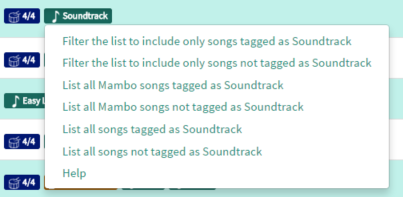
Click on any “First Dance” tag (D) in the tags column, a small menu will pop up. Choose “Filter the list to include only songs tagged as First Dance.” You will now have a list of songs that have been tagged both as “First Dance” and “Wedding.”
But you are looking specifically for songs that you can dance the Rumba to. So click on the dance selector button (E) (All Dances) and choose Rumba (F).
You will now have songs that you can dance the rumba to that have been tagged as “Wedding” and “First Dance.”
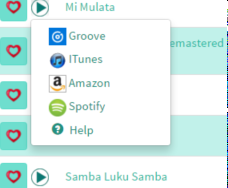
The play button (G) on any song will give you a list of music streaming and purchase options, which at minimum will let you listen to 30 seconds for free to make sure this is the song you were thinking of at if you’re subscribed to one of the services like Spotify or Groove you can listen to the entire song.
You can click on the title link of any song (H) to get even more details including albums that contain this song.
Or click on the Tempo column header (I) to sort the songs by tempo.
Is the style of dance you’re interested in not included please leave a comment or take a few minutes to go through my dance classification survey and help me generalize this system to the style of dance that you know.
For many people it was so that they could dance at their wedding. Most especially so that they could enjoy the first dance but also perhaps for the Father/Daughter or Mother/Son dance. If you’re just starting to learn to partner dance it can be pretty intimidating to both learn to dance and try to figure out what the possible dances are for your favorite song(s) and to dig through lists of suggested wedding songs to find the ‘right’ one for the dance style that you’re learning.
The Ray Charles and Natalie Cole version of “Fever” should show up near the top of the list (E), if not try sorting by Artist by clicking on the Artist column header (F).
The row already shows you some suggested dance styles in the dance column (G) including Foxtrot and Swing. And you can see that others have tagged (H) this as a good Wedding and First Dance song.
The play button (I) will give you a list of music streaming and purchase options, which at minimum will let you listen to 30 seconds for free to make sure this is the song you were thinking of at if you’re subscribed to one of the services like Spotify or Groove, you can listen to the entire song.
You can click on the title link (J) to get even more details including albums that contain this song.
Hope that helps. If you can’t find your song in our catalog, let me know what it is by commenting on this thread and I’ll see if I can add it.
Next time I’ll walk you through the other direction – starting with a dance that you know and finding music that others have identified as good First Dance songs for that style of dance.
I have resisted writing any real documentation for the music4dance website as it is evolving quickly enough that keeping up with the changes will be difficult. But I did some user testing on several of the key features of the site and they just aren’t self documenting yet. So while I will continue to work on the features to make them as intuitive as I can and reduce the need for documentation, for now documentation seems to be an essential feature.
The first thing that I’ve documented is the use of the songs list. Please take a look and let me know what you think.