
The Tempo Counter helps you find the tempo of a song you’re listening to, and then shows which dances fit that tempo. You can find it under Tools > Tempo Counter in the menu at the top of every page on music4dance.net.
You can tap out the beat of a song as it plays, or type in a tempo you already know. Either way, the list below the controls shows the dances whose tempo is close to yours, with the closest matches first. Once you’ve found a tempo, you can copy a link to it and share it, or bookmark it and come back later.
Entering a tempo
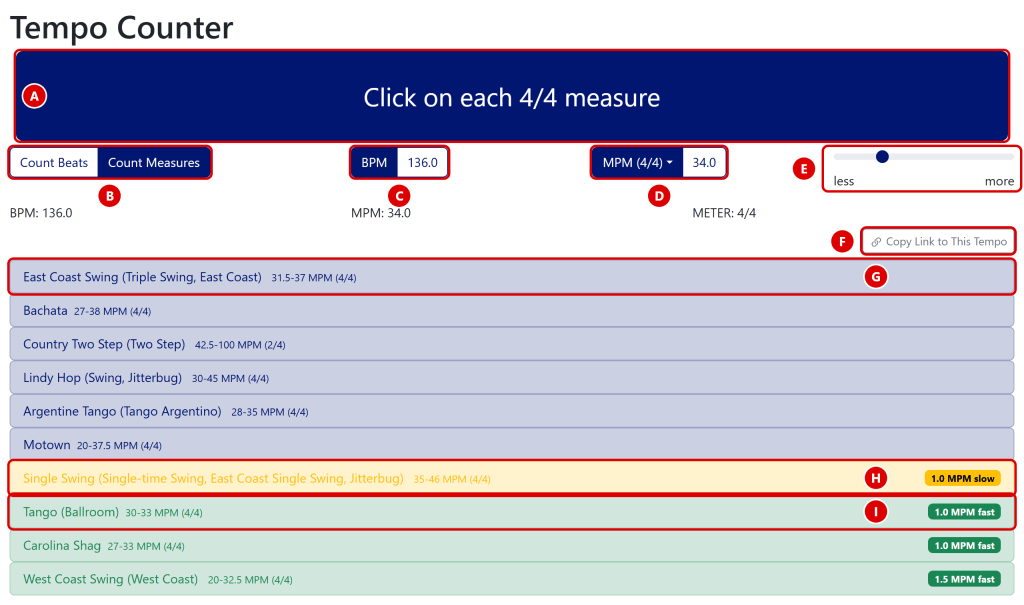
There are two ways to give the counter a tempo: tap it out with the big button (A), or type it into the BPM (C) or MPM (D) box. The line under the controls always shows the current tempo in beats per minute (BPM), measures per minute (MPM), and the meter.
Tapping out the tempo (A, B)
First, use the toggle (B) to choose whether you’ll tap once per beat (Count Beats) or once per measure (Count Measures). Use whichever is more comfortable. If you’re counting measures, set the meter with the MPM drop-down (D) first.
Then listen to the music and click the big button once per beat or measure. The button tells you what it’s waiting for, like “Click on each beat” or “Click on each 4/4 measure”, and changes to “Again” once you’ve started. The tempo boxes update with every click. If the song has a steady beat, the number should settle down after a few clicks, though it will wobble a little because nobody taps perfectly evenly. The counter averages your most recent clicks, so a stray early or late click doesn’t throw it off for long.
To start over, stop clicking for five seconds. The button goes back to its starting label, and your next click starts a new count. Switching between Count Beats and Count Measures also starts over.
Typing in a tempo (C, D)
If you already know the tempo, click the number in the BPM box (C) or the MPM box (D). A small Set Tempo box opens. Type the tempo and press Enter or click OK. The other box updates to match.
Choosing the meter (D)
The MPM drop-down (D) sets the meter: 2/4, 3/4, or 4/4. If you typed the tempo in (or opened a link), changing the meter keeps the same beats per minute and recalculates the measures per minute. For example, 120 BPM is 30 MPM in 4/4 and 40 MPM in 3/4. If you tapped out measures, it’s the other way around: your measures per minute stay put, and the beats per minute change to match the new meter.
The meter also decides which dances you see. Choosing 3/4 lists only the dances in 3/4 time, like the waltzes. Choosing 2/4 or 4/4 lists the dances in both 2/4 and 4/4, since the two feel the same on the dance floor.
The dance list (G, H, I)
Once you’ve given the counter a tempo, the list shows the dances that can be danced at that tempo, sorted so the closest match comes first. Next to each dance’s name are its other names, in parentheses, then its tempo range and meter. When you’re counting measures, the range is in measures per minute. When you’re counting beats, it’s in beats per minute.
The color of each row tells you how your tempo compares with the dance’s range:
- Blue (G): your tempo is inside the dance’s range, or less than one measure per minute outside it.
- Yellow (H): your tempo is slower than the dance’s range. The label on the right says by how much, like “1.0 MPM slow”.
- Green (I): your tempo is faster than the dance’s range, like “1.0 MPM fast”.
In 2/4 and 4/4, the list mixes dances from both meters, and each range is in measures of the dance’s own meter. A 2/4 measure is half as long as a 4/4 measure, so a 2/4 dance’s numbers are twice as big. In the image above, Country Two Step shows 42.5-100 MPM (2/4). That’s a match for 34 MPM in 4/4, which is 68 MPM in 2/4.
Click a dance to open its dance page in a new tab, with a description of the dance and the songs we have for it.
The strictness slider (E)
The slider (E) sets how close your tempo has to be to a dance’s range for the dance to show up. Slide it left, toward less, to see only the closest matches. Slide it right, toward more, to see dances that are a bit further off.
Behind the slider is a number from 0 to 20, in steps of one half. It starts at 5. The number is a percentage: a dance shows up when your tempo is within that percentage of the nearest end of the dance’s range. At 0, the far left, you see only the dances whose range includes your tempo. The slider doesn’t display the number, but you can see it in the page’s address, and in any link you copy, as epsilon (see Building a link by hand, below).
In the image above, Tango’s range is 30-33 MPM, and the tempo is 34 MPM. That’s 1 MPM, or about 3%, faster than Tango’s range. At the default of 5, Tango shows up. Slide to 3 or lower and it drops off the list. Slide all the way to 20 and the list grows from 10 dances to 20.
Copy Link to This Tempo (F)
Click Copy Link to This Tempo (F), just above the list, to copy a link to the counter exactly as it is. The link includes the tempo, the meter, whether you’re counting beats or measures, and where the strictness slider is. Paste it into an email, a text, or a post, and whoever opens it sees the same tempo and the same list of dances. That’s handy when you’ve worked out the tempo of a song and want to show a partner or a student which dances fit it.
The address in your browser’s address bar also changes as you use the counter, so bookmarking the page works just as well. Unlike the Dance Tempi page, the counter’s address always includes all four settings, even the ones you haven’t changed.
Building a link by hand
You don’t need this section to use the counter. The Copy Link button does all of it for you. But if you’re writing a web page or a handout and want to type a link straight into it, here are the parameters the counter understands.
Start with the page address, https://www.music4dance.net/home/counter, add a question mark, then any of these parameters, separated by ampersands (&). Every parameter is optional, and any you leave out get their default.
| Parameter | Values | Default | What it does |
|---|---|---|---|
| tempo | 0 to 500 | 0 | The tempo, always in beats per minute, even if you’re counting measures. |
| numerator | 2, 3, or 4 | 4 | Beats per measure, which sets the meter, the same as the MPM drop-down (D). |
| count | beats or measures | beats | Whether you’re counting beats or measures, the same as the toggle (B). |
| epsilon | 0 to 20 | 5 | Where the strictness slider (E) is. Higher numbers show more dances. |
A value the counter doesn’t understand, like a tempo of 999, a numerator of 5, or a word where a number belongs, goes back to its default. The values are lowercase, so count=Measures counts beats.
A few examples:
- 136 beats per minute in 4/4, counting measures, which is the view in the image above
- 90 beats per minute in 3/4, counting measures, which opens at 30 MPM with Slow Waltz on the list
- 104 beats per minute with the slider all the way to more, which shows every dance that’s anywhere close
Why don’t I see any dances?
- Do the BPM and MPM boxes read 0.0? Then the counter doesn’t have a tempo yet. Tap one out with the big button, or type one in.
- Otherwise, your tempo may not be close enough to any dance in the meter you’ve chosen. Slide the strictness slider further right, toward more, to see the dances just out of range. If you’re in 3/4, there are only a few dances to choose from, so also check that the music really is in 3/4.
Related help
The Dance Tempi page shows the tempo ranges for all our dances in one table, filtered by style, type, meter, and organization. If the counter doesn’t work the way you expect, or a link doesn’t open what you expected, please send us feedback.


4 thoughts on “Tempo Counter”