Category Archives: Music and Dance

Posts that are about music as it relates to dance and dance as it relates to music.

Ask music4dance: Why are the tempos that music4dance lists for Salsa wrong?

I’ve addressed questions about tempo in several different ways over the years, and I appreciate the continued feedback, as there is absolutely room for improvement in how the music4dance system handles tempo.

Algorithms are far from perfect:

The issue at hand is that many of the tempos listed for Salsa were exactly half the speed at which one would dance. There is a straightforward explanation for this. Many of the tempos listed on the site are algorithmically generated. The algorithms are decent at this point for many types of music. But with some music (and Salsa definitely falls into this category), the algorithm “hears” a double-time or half-time beat and chooses that over the “correct” tempo for the dance.

I have several mitigations for what I think of as “shadow” tempos that I’ve implemented over the years, including a new one that was prompted by the email that also convinced me to write another post on this subject.

First, the system prefers a user-entered tempo over any algorithmically generated tempo, even if the latter is more recent (the general default for conflicting information is to believe the most recent edit). I currently don’t open up editing tempos to every user, but contact me with an example of something you’d like to change for a quick check that we’re on the same page, and I’d be happy to add that permission to your account. The more people we have catching and correcting these issues, the more reliable the site will be overall.

Second, I occasionally do a pass through the database and adjust the tempo values that are obviously outside a dance’s tempo range if halving or doubling them would put them within the dance’s range. I recently ran this process for Salsa, which significantly reduced the number of songs with the issue that prompted the original complaint. I have considered generalizing this algorithm so that if a song is added without specifying a tempo and the system generates a tempo algorithmically, it would make a simple adjustment to double or halve the tempo if that puts it within the dance’s range. But I haven’t pulled the trigger on that yet. In any case, this process still left a few songs tagged as Salsa with very unsalsa-like slow tempos. I’ll dig into that shortly.

The last feature that I hope mitigates this algorithmically generated tempo issue is brand new. People need to understand that a tempo is algorithmically generated and should therefore be taken with a grain of salt1. But there was no easy way in the music4dance user experience to indicate that the system had generated a tempo algorithmically. Now, near each algorithmically generated tempo listing is a small icon of a computer chip; clicking that icon takes you to our help page with information on how tempos are generated.
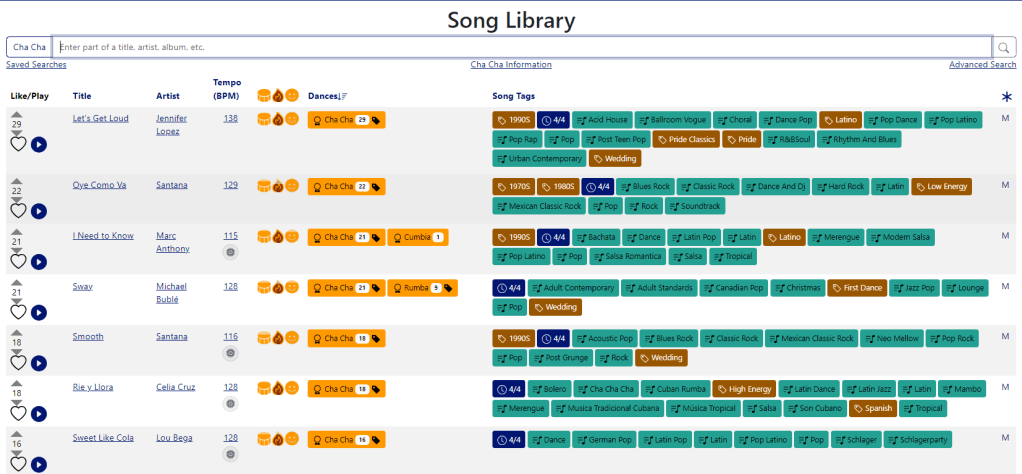
Image of the song library with algorithmic tempo icons

Different dancers can hear different beats:

But there is another, related issue. It’s not just algorithms that can “hear” a double or half-time beat. Dancers can do the same thing2. The algorithm hearing a half-time beat mentioned above is precisely the opposite problem from the one I discussed in this post, where the tempo was twice what one would dance Bolero/International Rumba to. But it was for a similar reason. Some songs have a strong enough double-time or half-time beat that it’s hard to tell which is the primary beat to count or dance to. When you are actually on the dance floor, this generally doesn’t matter, since if you’re at a salsa club and the choice is between dancing to 190BPM and 95PM, you’ll dance at 190BPM. Or conversely, if you’re in a dance studio where you’ve been studying American Rhythm, and have the same choice, you might choose to dance Bolero at 95BPM (or maybe  Mambo at 190BPM, depending on the feel of the song).

So the remaining songs in the music4dance Salsa catalog that are listed as much slower than one would dance a salsa remain because someone set that tempo based on a different dance where the slower tempo is appropriate (or because they were added with an algorithmic tempo since the last time I did a pass to clean them up). There is no easy way to solve this problem when each song has only one tempo. But I’ve been refactoring the code and the indexing service to make it easier to carry more information about the intersection between dance and song, which would allow us to list a different Salsa tempo than a Cha Cha tempo for the same song. The problem is that we would have to save a tempo field for every song/dance combination, even in the most common case where all dances to a given song are at the same tempo. I need to do some more testing to make sure that doesn’t degrade the overall search experience. The more I hear from you that this limitation is frustrating, the higher it will rise on my to-do list.

As always, please let me know if you have any thoughts about the subject of this post or the site by commenting below or using other feedback mechanisms listed here. And if you enjoy the site or the blog (or both), please consider contributing in whatever way makes sense for you.

Footnotes

  1. This strikes me as ironic, since I vibe-coded this feature using GitHub Copilot and Claude. And even though the underlying algorithmically generated tempo issue existed long before the current generative AI situation, it has a similar feel to me. ↩︎
  2. It’s also really fun to be able to dance a different dance than the rest of the room if you can make it work, but that may just be my rebel nature. ↩︎

What Happens When a Song is Danced at Different Tempos?

Sometimes, a song can be a perfectly good Bolero when heard one way but a Salsa when counting the music differently. Another example is Slow Dance (Castle Foxtrot) vs. Lindy Hop. Generally, this phenomenon is because, with some music, it’s easy to count what the musicians see as either a half note or a quarter…

Ask music4dance: Why is the tempo range you list for West Coast Swing wrong?

A West Coast Swing DJ contacted me and kindly let me know that the tempo range I had listed for West Coast Swing was “entirely wrong.” The average tempos that she plays are between 90 and 110 bpm, while I listed a tempo range of 112-128 bpm.  Before I dig further into the details, I’d…

Nine Sinatra Songs – Ballroom inspired Ballet

Pacific Northwest Ballet included Twila Tharp’s Nine Sinatra Songs as part of their Director’s Choice performance this year. I’m not in any way qualified to review a Ballet performance, but I can say that I thoroughly enjoyed it and had a great time playing with the Ballroom-inspired aspects of the dancing as I watched the show unfold. For me, the idea that the dancing was inspired by ballroom rather than in any way attempting to choreograph actual ballroom dance steps on ballet dancers is what made it work (this is the issue I sometimes have with partner dance in Broadway musicals). It was obvious in several of the nine pieces that  Ballroom dance inspired the piece, and the upper body shaping and movements felt quite ballroomesque throughout the performance.

On returning home, I hoped to find a resource that listed the dances that Tharp drew from for each of the first eight pieces (the ninth is a reprise group number), but I failed. The notes from some of the performances mention the roots of one or two dances, but it seems like, for the most part, they name the same couple of songs. So, my guess is that even a thorough search of those through the years wouldn’t yield a complete list. As an aside, it was fun to jump down the rabbit hole of the French Apache Dance that Tharp drew from for the choreography for That’s Life. If someone has such a reference, please let me know.

In the meantime, I will take this as inspiration to play a little with the possibilities of music and dance. Sinatra is already well represented in the music4dance catalog, with 166 songs listed before I started filling out the few missing entries from the ballet. But I’ve always thought of dancing Foxtrot to Sinatra or maybe Swing. In the ballet, Tango, Rumba, and Samba were definitely represented. So, I took a few minutes to see what the music4dance community has to say about dancing to this music.

If you go to the Frank Sinatra artist page, you’ll see Slow FoxtrotLindy HopRumbaCastle FoxtrotEast Coast SwingJive, Quickstep, Peabody, West Coast Swing, Single Swing, Slow WaltzBalboaBoleroBossa NovaViennese Waltz, and Blues all represented.

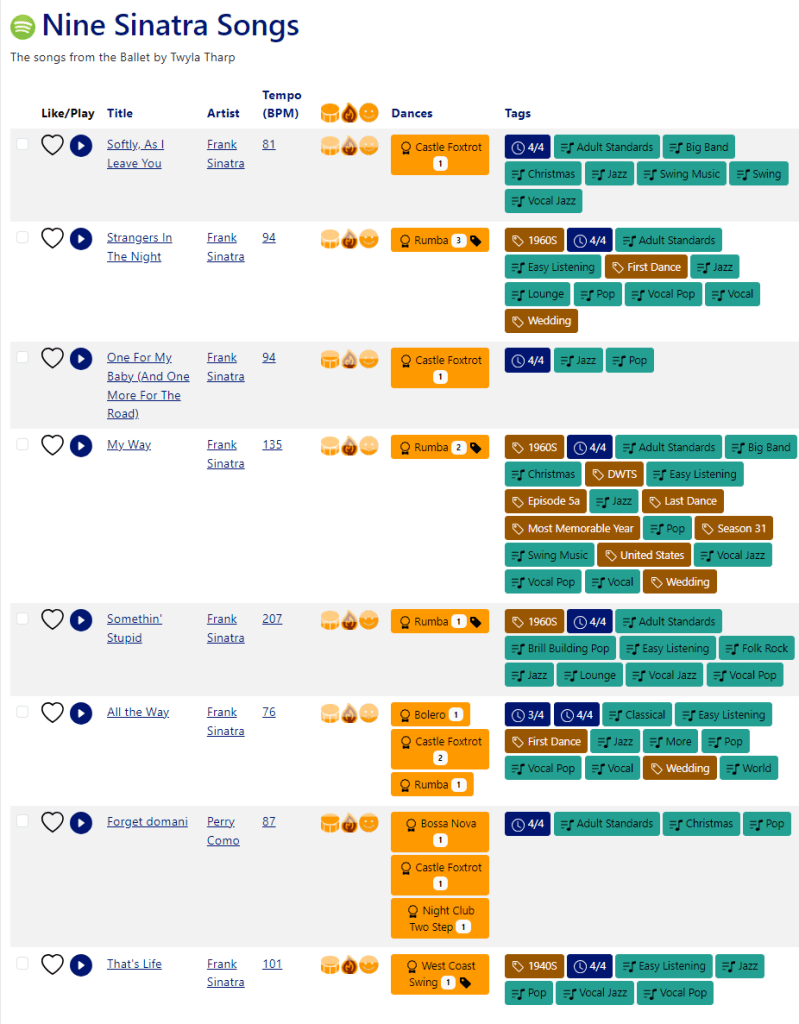
And here’s a custom music4dance playlist that includes all eight songs (although one song is the Perry Como version since the Sinatra version isn’t available on Spotify or iTunes).

A snapshot of the eight songs used in "Nine Sinatra Songs"
The eight songs used in “Nine Sinatra Songs” as shown on music4dance.

Are there other partner dances that Tharp drew from in this work that we should represent in music4dance? Are there other Ballroom-inspired ballets out there worth viewing? Do they use different music that you’d like to add to the catalog? Are there other playlists that you’d like to overlay the music4dance information on, like I did with this one? If you have ideas about this post or the site, please comment below or use other feedback mechanisms listed here. And if you enjoy the site or the blog (or both), please consider contributing in whatever way makes sense for you.

What is that dance called? Swing, East Coast Swing, Triple Swing, East Coast, or…

When I got into the business of categorizing music by dance style, I knew there would be a lot of ambiguity involved. However, some of the passion behind people’s opinions about what a dance should be called or what tempos are acceptable for the dance called X still takes me by surprise. Several times a year, I get an email from someone who is absolutely livid that I “got the tempo of West Coast Swing completely wrong” or called a dance “Lindy Hop” rather than “Swing” or some other variation on the theme.

I learn a lot from the people who send these emails, and often learn something that helps me improve the site or my general knowledge of dance. One feature I added a while back, based on some of these interactions but haven’t discussed in the blog, was the idea of having “synonyms” for dances.

The way music4dance works, I have to have an unambiguous and unique name for a dance. This leads to somewhat clunky names at times – for instance, the dance that most dances consider “Waltz,” I call “Slow Waltz” to distinguish it from “Viennese Waltz” and to allow for a catch-all category of Waltz. But I want to be able to show other names for dances so people can find the dances even if they know them by another name. This applies both to cases where the dance really is the exact same dance; it’s just named differently to disambiguate it, and in cases where the parameters for what music works are close enough that it makes sense to use the same list of music for both dances.

Cases of actual synonyms:

Cases where the dances are different, but the music is the same:

  • Castle Foxtrot = Slow Dance – I started categorizing music that was basically Slow Dance music as Castle Foxtrot, which is a legacy dance that some studios occasionally teach because Castle Foxtrot showed up in my searches as I was designing the site, and fit nicely into the tempo spectrum of Foxtrot-like dances. The practical use of this ended up being more for people looking for “Slow Dance” music in wedding contexts, so I added the Slow Dance synonym. Perhaps I should change the primary name?
  • Hustle = DiscoFox – As far as I can tell, these have evolved into different dances but are still danced to similar music. But that is based on web searching rather than personal experience, so please correct me if I’m wrong. I’m also now second-guessing myself as to whether I should add “Swing Fox,” “Disco Swing,” and “Rock Fox” as synonyms, or if one or more of these rates is its own category.

In any case, if you go to the main “Dance Style” page, you’ll see all the styles we’ve set up, along with their synonyms. As this list grows, being able to filter it is more important, so the filter control acts on both the primary name and the synonym. I also handle the synonyms when you search in the search control in the menu bar. So if you type “Slow Dance” in that search box, you’ll find a list of slow dance songs (that are actually tagged as “Castle Foxtrot”). I don’t convert the name of the tag in the results, but I could if that seems important…

I’m posting this now in part because, during my recent round of updates, I broke the showing of synonyms in the Dance Styles page and then realized I hadn’t ever asked for feedback on the feature. The only mention in this blog was the post when I added it as an afterthought to adding Single Swing to the catalog.

Are there other synonyms that I should add? Are there dances that I’ve listed as synonyms that I should break out into separate dances? If you have ideas about this post or the site, comment below or use other feedback mechanisms listed here. And if you enjoy the site or the blog (or both), please consider contributing in whatever way makes sense for you.

Western Partner Dances and Line Dances?

One of the comments on my last post asked:

A lot of our dance groups over here love to dance the partnered dance sea shells The song “Blue night” by Michael learns to Rock sings the song they dance to. Is there a list on your data base of similar songs to that one that they can also dance Sea Shells to?

This question lead me down one of those beautiful rabbit holes that dance often does.

I had never heard of this dance, but I looked it up and found a YouTube video with the choreographer demonstrating the dance. It was 32 counts (four 8-counts) danced line of dance using a vocabulary that I’m not familiar with but would guess was some flavor of country dance.

Now, when I was learning to lead as a ballroom dancer, my teacher often put together a few eight counts of choreography that I could use so that I wouldn’t have to think as much about what my next move was and concentrate instead on leading my partner and making sure I didn’t run into anyone (or step on my partner’s feet). I understand this is a common technique in the Ballroom community. I ran across similar methods when learning social dances in group classes. So my first instinct was – this is just a slightly more formalized version of that technique – and it has the advantage that your follow knows that you will be doing this same sequence, so the lead should be much easier.

Following that thread, I listened to the song more closely and counted it out. It’s about 97BPM 4/4 and had the feel of an International Rumba or Bolero to me. This gave me the first level answer to the question of what else would someone play if people wanted to dance “Sea Shells” – I went to Advanced Search and selected Bolero and Rumba, limited the tempo to 95-99 BPM (an arbitrary bracket around 97 BPM) and sorted by the most popular – that resulted in this list. I’m convinced that someone who learned “Sea Shells” could dance it to any of the top songs on the list.

But I felt like I was missing something fundamental about this type of dance, and I dug deeper. I didn’t have to do much searching to find a “Dance Step Sheet” with the specific choreography that Dan and Kelly Alboro created. In fact, there were a bunch of places that listed this dance and described the steps. Poking around the websites that hosted such sheets, I found that this is a whole thing. Please pardon my ignorance here since I’m sure many people reading this post know more about such things than I do, but the concept of choreographing a few eight counts of a partner dance and naming it was completely new to me.

My understanding from a relatively brief perusal of these sites is that there is a branch of country dancing similar to line dancing where someone choreographs a number of eight counts using a specific vocabulary, teaches it at an event, and then a whole group of people can dance the same “dance.” The most experience I’ve had with these personally is Wedding Line Dances, but it seems like a fun experience. Doing this kind of dance with a partner rather than the individual line dances I’ve seen in the past feels like a great way to become more comfortable as a partner dancer. In any case, I’ll put a bunch of links at the bottom of this post to sites written by people who know a lot more about this than I do.

Back to the original question: Another answer is that some of the “Dance Step Sheets” for “Sea Shells” list an alternate song that it can be danced to. The song they list is “jumpin’ the jetty” by Coastline. Now, this is a song that shouts Swing to me and is considerably faster (126BPM) than “Blue Night.” So that blows my original thought out of the water. Here is a search for swing songs between 124 and 128BPM. Unsurprisingly, there is no overlap between this list and the one I generated for “Blue Night.” I suspect someone who knows the choreography well can probably dance it to any reasonably consistent 4/4 music at a wide range of tempos. For those who are less expert, there is perhaps an advantage to being on the slower side and having strong phrasing. And I’m sure there are plenty of folks who only want to dance this particular dance to the music that they learned it to in the first place. But as I’ve said repeatedly, I’m way out of my depths here, so if someone who actually knows something about this kind of dancing would care to jump in and help me out, please do.

The last thing I wanted to say about this subject is that I’ve had several requests to support country and line dances on the site. I plan to enable the more traditional country partner dances once I get past some infrastructure issues that are currently blocking me from adding a bunch of new dances. I’m confident I can do that and seed the lists from reliable sources to get something up and running despite my lack of specific knowledge of those dances. Then, hopefully members of the community who know more about those dances can add more. Please let me know if you’re interested in this feature. The more people raise their hands for this feature, the faster it will move up my TODO list.

I hadn’t devised a method for handling line dances before this, partly because I assumed they were all choreographed to a single song. It didn’t seem like the system I’d built would handle that very well. But based on this experience, I’ve come up with a way to “support” line dances without adding code. I’ll throw it out there, and if anyone wants to start adding line dances to the database, I’ll document it more closely and possibly even add some code to make the experience smoother. The idea is pretty simple. Just add a comment with a quoted version of the name of the line dance to the song. Then, people can search on that and get a list of songs to line dance to. Here’s the search for “Sea Shells,” which returns the two songs I’ve discussed in this post.

I will dig myself out of the rabbit hole for now and see if I can make some progress on the infrastructure issue I mentioned above.

Please let me know if you have any thoughts about the subject of this post or the site by commenting below or using other feedback mechanisms listed here. And if you enjoy the site or the blog (or both), please consider contributing in whatever way makes sense for you.

Some interesting links related to the Western Partner dances:

Copper Knowb Stepsheets

DiceMemory Parter / Circle Dances

DiceMemory Line Dance Steps

CoutryDancingTonight – 10 Popular Partner Country Dances

Wikipedia – Partner Dance

Wikipedia – Country Western Dance

Wikipedia – Round Dance

Ask music4dance: Why is the tempo range you list for West Coast Swing wrong?

A West Coast Swing DJ contacted me and kindly let me know that the tempo range I had listed for West Coast Swing was “entirely wrong.” The average tempos that she plays are between 90 and 110 bpm, while I listed a tempo range of 112-128 bpm. 

Before I dig further into the details, I’d like to take a moment to thank this DJ and everyone who has taken the time to point out issues with the site.  Curating a site like music4dance is a big job, and mistakes will creep in. So, having the community members speak up when they see something that seems wrong is essential to keeping the site as accurate as possible.

In this particular case, I found it surprising that the information I listed was entirely wrong.  I don’t claim to be an expert on all (or even most) of the dances I cover on the site.  But West Coast Swing is one of the dances I’m most comfortable actually dancing.  My first thought was that some kind of regional difference was going on.  But one of the DJs my interlocutor referred to plays at a venue I’ve danced at within the last decade.

My second thought was that this was a difference between the Ballroom community and the “Westie” community.  That’s a bit closer to the mark. But as mentioned, I have done some social WCS dancing in the same venues where the DJs write about playing much slower tempos than I’m used to, so it couldn’t be the whole story.

The only other thing I could think of was that dances evolve over time.  This is especially true with dances like WCS, which are danced to popular music that is also changing.  In fact, that’s one of the things that I enjoy about WCS.  As primarily a ballroom dancer, WCS is the dance that I can take out to a club and just get funky with.  So, I’m pretty sure the combination of these three things brings me to a reasonable explanation of the difference that prompted the original email.

Dances evolving over time is something that both intrigues me and confounds the part of my brain that wants to be able to neatly categorize things.  And the categorizing part of my brain is fairly dominant in building a site like music4dance.

One of the reasons that it even occurred to me that I could do this kind of categorization is that competition dances tend to “lock in” the tempo somewhat, at least for competitions where the DJs are required to play music within a specific range.  That is true of Ballroom competitions but apparently not true of West Coast Swing competitions. I’ve updated my WCS social tempo to 80-130bpm, the broadest tempo range suggested by DJ Koichi Tsunoda in his post. This is the most authoritative source I could find.  It doesn’t look like World Swing Dance Council or National Associate of Swinge Dance Events publishes requirements or recommendations for WCS tempo.

Contrary to my previous point, even Ballroom dance tempos evolve.  I discovered that the Ballroom Dance organizations (NDCA and DanceSport) updated their tempo recommendations for competition dances since the last time I looked.  But there wasn’t a lot of shift.  The most significant change was that NDCA went from a complicated matrix of tempos that included different recommendations for ProAm vs Professional/Amateur and level (Bronze, Silver, Gold) to a single tempo for each dance.  I’ve updated those tempos as well.  But there wasn’t any significant shift in direction – none of the tempo recommendations for dances were much faster or slower than previously.

I’m considering adding a “Social” style to the Americana and International styles that are dictated by the Ballroom associations.  It’s certainly true that even ballroom dances can be danced to a broader range of tempos than what is dictated by competition rules, and the site should reflect that.

All of this is to lead up to a couple of specific requests for anyone who has some expertise in these areas.

  1. Please let me know if you have an issue with any of the tempos I list on the site.  I depend on the community to help keep me up-to-date and catch any errors.  While there isn’t a “right” answer unless stated by competition rules, I’d like to do my best to land on numbers that are not “entirely wrong.”
  2. Specifically, if anyone has a good source for comfortable or social ranges of tempos for the ballroom dances, I’d like a place to start.

In addition to the above specific requests, if you have comments or suggestions or stumble upon other errors, please feel free to reply to this post or contact me here. And finally, if you enjoy the site or the blog (or both), please consider contributing in whatever way makes sense for you.

Translating how dance teachers count

Something came up the other day as I was talking to a friend who just took his first social dance class. He has a musical background and is used to hearing and counting beats as a musician. So he got a little obsessed and distracted with figuring out the translation between what he was hearing…

Do Dancers Think in Eights?

I was tickled to hear Nigel Lythgoe talk a little about choreographing tap on a recent episode of So You Think You Can Dance. The commentary is at about 1:13, but please start at about 1:10 so you can see the performance that he’s referring to.  It’s a tap piece that Emma, one of the…

Translating how dance teachers count

Something came up the other day as I was talking to a friend who just took his first social dance class. He has a musical background and is used to hearing and counting beats as a musician. So he got a little obsessed and distracted with figuring out the translation between what he was hearing in the music and what he was hearing from the dance teacher. In this casual intro to partner dancing class at the local community college, he was learning Night Club Two StepSalsa, and East Coast Swing.

We dance all of those styles to music in 4/4 time. So, as someone with musical training, my friend heard the beat as 1 - 2 - 3 - 4 - 1 - 2 - 3 - 4, etc. But that’s not how the dance teacher was counting. Let’s break these down dance by dance.

Night Club Two Step

Night Club Two Step is generally counted as Slow - Quick - Quick.  For most dances that I count this way or the slight variation Quick - Quick - Slow, the Slow is two beats, and the quicks are each a single beat. The translation is straightforward: In the first case, the quicks are on 1 and 2, and the slow is on 3. In the second, the Slow is stepped on 1, and the quicks are 3 and 4.

– or –

Each box represents a quarter note in 4/4 time.

Salsa

Salsa is even easier. If it’s counted using slows and quicks, it’s Quick - Quick - Slow. Translation: quicks on beats 1 and 2 and slow on 3, holding 4. But many salsa teachers count the phrase, which is a two-measure grouping in dance. When they do that, they generally count 1 - 2 - 3 - (pause) - 5 - 6 - 7 - (pause). That’s my preferred way since it aligns with the musical counting of the beats. Occasionally, I’ve heard a Salsa teacher count 1 - 2 - 3 - (pause) - 4 - 5 - 6 - (pause). That variation drives me up the wall. It completely breaks my musician/programmer’s brain because the second measure is counted with numbers that are off by one from what’s in my head. Fortunately, my friend wasn’t exposed to that variation. 

Each box represents a quarter note in 4/4 time.

East Coast Swing 

East Coast Swing is more complicated for a couple of reasons. 

First, it is generally counted as Tri-ple-step Tri-ple-step Rock Step. Or 1 & 2 - 3 & 4 - 5 - 6. We’re dancing a 6-count basic to 4/4 music, so each basic takes a measure and a half. This timing throws a monkey wrench into counting it like a musician. If you want to be a stickler, it would be something like 1 & 2 - 3 & 4 - 1 - 2, and then the following basic would be 3 & 4 - 1 & 2 - 3 - 4, but I’ve never even tried to do that while dancing. The second is that the triple steps are syncopated, so they don’t fall precisely on the eight notes. But this also maps directly to the music, so it shouldn’t be hard for anyone who has played a bit of Jazz to get their head wrapped around.

Each box represents an eighth note in 4/4 time

Conclusions

Every dance has its nuances. Mambo and International Rumba are counted Quick - Quick - Slow, but start on the 2, Waltzes are danced to 3/4, Samba has its own form of syncopation, etc.

Let me know if you find this kind of analysis helpful and would like this kind of analysis for other dances. I’m considering doing a version of this for each dance on the dance pages, including some prettier charts, if I get some feedback that this is useful. Also, I’d be delighted to hear about other ways you count when partner dancing.

As always, I’m very interested in your feedback, so please share any thoughts and ideas about this post or the site by commenting below or using other feedback mechanisms listed here. In addition, if you enjoy the site or the blog (or both), please consider contributing in whatever way makes sense for you.

Related Posts

Do Dancers Think in Eights?

I was tickled to hear Nigel Lythgoe talk a little about choreographing tap on a recent episode of So You Think You Can Dance. The commentary is at about 1:13, but please start at about 1:10 so you can see the performance that he’s referring to.  It’s a tap piece that Emma, one of the…

Book Review: Hear the Beat, Feel the Music

As anyone who has spent any time reading my blog or interacting with my website should know by now, I’m very passionate about music, dance and the relationship between the two.  I’m also very analytical about those subjects.  And, yes, I believe passion and analysis can co-exist, don’t you? The fatal flaw with my perspective…

Ask Music4Dance: Why is a song tagged with the wrong dance style?

Variations on that question make up a significant amount of the feedback I get here at music4dance.  The first answer to these questions is that music4dance is crowd-sourced.  So someone at some point said that they could dance that style to that song.  They may or may not be right, but I think it’s worth stopping to think for a moment – is there a way they could they be right?

That’ s because of the second answer – which is that the dance world is diverse, so what people mean by naming a dance style can mean different things to different dancers.  Now, I could lock down the site and say that only songs that meet a very specific criteria of being strict tempo for American Style East Cost Swing can be marked as Swing.  There are advantages to being that strict – the biggest one is that it would make auto-generating playlists or rounds much more accurate.  But the disadvantage is that it narrows the world of dance.  Especially in these times I feel that it’s important to foster diversity even in the small ways, like what kind of music I would dance a swing to.

In any case, I bring this up now is in part because of a discussion I had with Brent T. Mills who found a song that he had produced listed on the site as a Swing rather than as a Foxtrot. He clearly intended this song to be a Foxtrot.  And aside from the (very important) fact that he has every right as the producer of that song to assert what he intended it to be danced to, he and I both come from a ballroom background and so share the same definitions of dance styles, at least at some level. Mr. Mills also wanted to make it clear that his main interest in contacting me was to help avoid confusion for dancers that aren’t experienced enough to know that many songs have a lot of crossover rather than anything negative. I very much appreciate the sentiment – and he speaks from experience – check out what he’s up to at www.MusicMills.net.

The thing that I realized as part of this discussion is that it wasn’t obvious from the page that he landed on that the dance information was crowd-sourced.  I hadn’t thought about that in exactly those term before, but as I’ve been reworking the site I’ve been trying to do a better job of re-using more common user interface elements than I did the first time around.  In the particular case of the voting mechanism for dances I think this I’m making some progress in making things like the crowd-sourced aspect of the site more clear.

In the original version (which is the current version running on the site as of mid-march 2021) I have a musical note next to a dance style that is filled up (like a thermometer) based on how many votes it’s gotten.  The only way to tell that this is a voting mechanism is to hover over the icon and read the text that says that this song has one vote. In my defense this is a little clearer when you’re on a page that lists a bunch of songs with their respective votes, but it’s still not great.

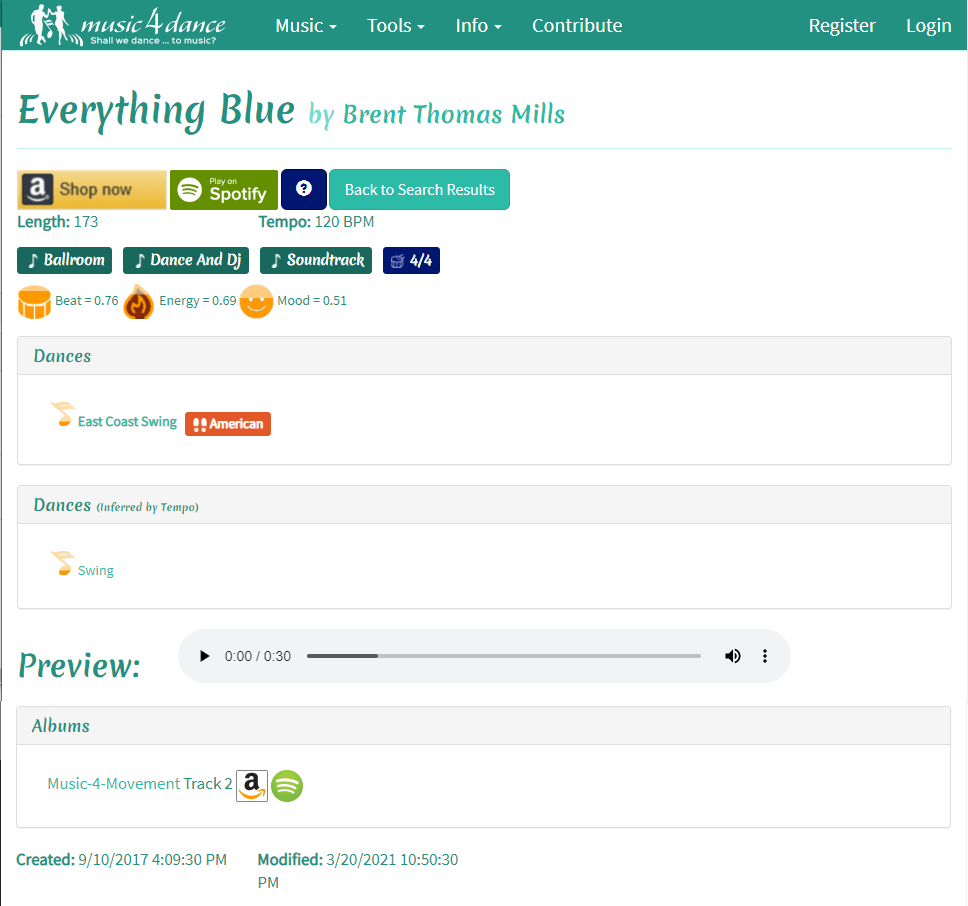
Original version of a song page on music4dance.net
An example song page from music4dance.net (current version)

In the new version (which I hope to release shortly), I use what I believe is a pretty standard mechanism to indicate voting. At least this is how the Stack Exchange family of sites that I spend an inordinate amount of time handles voting.   It’s the number of votes vertically framed by up and down arrows. Clicking on the arrows will allow you to vote (or ask you to sign in to vote).

An example song page from music4dance.net (upcoming version)

What do you think, is the new version easier to understand?  Or should I go back to the drawing board again? As always, I welcome feedback.

Quick Tip:

If you would like to vote on what dance you would dance to a song, create an account and start voting.

Ask music4dance: Why is the tempo that you’re listing for Ricky Martin’s “Casi Un Bolero” wrong?

I’ve seen a number of questions recently about why information on the site is wrong.  So I’ll start with one of the easier ones, which I’ve seen a number of variations on but is basically, “why is the tempo wrong”.  Here’s the specific question that prompted me to write this post:

There are a lot of Ricky Martin songs where the beats/minute are twice what they should be (186 for “Casi un Bolero” ?!?!).

The quick answer is that this is wrong for a dancer – listening to this music, I would dance to it at 93 beats per minute rather than 186.  And the fact that people have voted for this song to be danced as Bolero (96-104bpm) or International Rumba (100-108bpm)  indicates that others would agree.

So why was this listed incorrectly?  Unlike other things on the music4dance site like which dance you would dance to a song, tempo at least of a particular recording of a song is not subjective.  And even amongst recordings of a song, there is generally not that much variation.  Sheet music generally has some kind of tempo marking which will tell musicians the tempo at which they should perform the music.  This can range from a general marking like Presto that indicates a range of about 168-200bpm to actual metronome markings of a precise bpm tempo.  Music Theory Academy has a great explanation of reading tempo markings if you would like to dig deeper.  But my main point is that there is generally a “right answer” to what the tempo is of a piece of music.

This is a piece of music that is intended to be played ate 120 beats per minute as indicated by the quarter note = 120 marking circled in red

But if you notice the tempo that was listed for “Casi un Bolero” (186bpm) is exactly twice the tempo that we would dance to the music (93bpm).  Take a moment to listen to it (you can listen to a snippet on the “Casi Un Bolero” page on music4dance or the whole song on Spotify.com).  There are two instruments that are defining the beat – bass guitar and drum.  If we interpret this song as 4/4 at 93bpm, the bass guitar is emphasizing the first and third beats and playing occasional more complex phrases.  But you definitely hear a consistent one/three from that instrument.  on the other hand if you listen closely to the drum, it’s playing every eighth note (or 8 times each measure).  If you take the drum as the primary beat and definite that as a quarter note rather than an eighth note, you get a tempo of 186bmp.  Which is probably not what the musicians are thinking, and certainly not what a dancer is listening for.

Why is this important?  Because while many of the tempos listed on music4dance came from dancers who would hear the tempo that they can dance to a song, many other listings are generated via machine learning algorithms.  And the machine hasn’t quite figured out how to decide between listening to the bass or listening to the drums. In fact, both algorithms that I’ve used seem to prefer the drums.  So I occasionally go though and fix things up.  But with a catalog of nearly 40,000 songs and growing I’m not always keeping on top of that task.

As I rework the site, I’m hoping to get a moderation/curation function in to make it easy for others to help out with this.  So if you’re interested in helping out in that way, please let me know.  And as always I’m happy to hear from you with any kind of question, comment or feedback.

Quick Tip:

In this post I talk about the beats per minute of Bolero and International Rumba.  You can find listings of tempos for these and other dances in different forms on the tempi tool and competition ballroom page.

Playing with Dance Tempos

I just rewrote the Tempo tool for the music4dance site as part of the current effort to update the site.  In the process I went back and revisited the reasons for writing the tool in the first place. 

The main reason for this tool is to have a single place to do a bit of slicing and dicing of the relationship between the tempo of different partner dances.  It allows one to filter on the dances that you’re interested in (all Swing dances, or American Style dances) and sort by tempo to see the relationships.    This could, for instance, help find dances that one might mash up into an exhibition routine.

Another reason is just because I could.  The Tempo tool is really just a thin layer on top of the data that I use to drive the Counter tool and many other parts of the site.  I almost didn’t rewrite the tool because since I originally wrote it I added slightly less interactive but possibly more directly useful pages that lay out the different competition dances and their tempos in what I hope is an easily digestible way.

This is part of a larger rewrite of the site that I’ve been working on to get the code to a place where I can comfortably start adding more requested features.  The Counter and Tempo tools are a couple of the most isolated pages, but I’ll start digging into more core functionality soon.

As always, please send me feedback if you have ideas about the site, dancing, music, or how any or all of those subjects relate. And please consider supporting the music4dance project by sharing with your friends or any of the other ways listed here.

Quick Tip:  Many pages (like the ones mentioned above) have documentation pages that are easily accessible from the page.  Just go to the “Info” menu and choose “Help”, this will generally take you to a documentation page specifically about the feature that you were using.

Tango, Argentine Tango, Ballroom Tango, Oh My!

I just took a beginning Argentine Tango class and really enjoyed the experience.  I’ve had some experience with Ballroom Tango (American Style) and even taken a little Argentine Tango before, but this particular class really underlined the difference in the actually dance style.  Searching the web, I find plenty of evidence for this.

From the musical perspective, I found that I would be comfortable dancing Ballroom Tango to most of what the instructors played for Argentine Tango.  The character of the music seems very much the same.  The tempo was definitely slower than I would choose, but it was a beginner’s class after all.  The beat was less clear in many of the songs than I would expect in a Ballroom tango played at a school, club or competition, which was surprising.  This was a beginner’s class after all.

Now that I think about it, the Spotify EchoNest integration in music4dance could shed some light on the subject of strength of beat.  You can do an informal analysis yourself:

  1. Go to the songs library page.
  2. Choose Argentine Tango.
  3. Click on the strength of beat sort (the header icon that looks like a drum) once for ascending and twice for descending order.
  4. This will get you a list of the (currently) 578 songs that have been classified specifically as Argentine Tango sorted by the strength of beat.
  5. Or just click here to see the list.
  6. In a separate window repeat step’s 1-4 substituting Ballroom Tango for step 2 to get the 438 Ballroom Tango songs that have “strength of beat” information.
  7. Or just click here.

Now you can see the lists of Argentine Tango and Ballroom Tango both sorted by strength of beat.  At a quick glance the distribution seems pretty similar, but if anyone is at all interested let me know via a comment to this blog and I will be happy to do a slightly more formal analysis.

The other aspect of Tango music for dancers that this brought up was where to draw the line on calling something generically Tango vs. Ballroom Tango vs. Argentine Tango, etc.  I am currently calling anything a Tango that someone has tagged as any kind of Tango, which I think is fair.  Often people will just call something just Tango if they are from a particular community and I think that’s fair too.

If you are interested in stretching your reach and finding all Tangoes of whatever classification that fit a specific tempo criteria, you can use advanced search to choose generic Tango as the dance and choose a tempo range you’re interested in.  Or if you’re a Ballroom dancer you can go to the Competition Ballroom Dancing page and just click on the tempo range for the category of Ballroom Tango that you’re interested in.  I’ve set things up with the current official tempos for DanceSport and NDCA competition classes.

Speaking of official tempos.  Although I’ve found quite a number of sites that advertise and even provide rules for Argentine Tango competitions, I have yet to find anything that defines any kind of official tempo ranges for the music played at the competitions.  I suspect this is something fundamentally different about those competitions.  However, if I’m missing something and there are such official ranges, please let me know and I’ll incorporate them into the site.

And as always, please let me know what I’ve missed.  This is a very nuanced subject and I would love to hear other perspectives.  Feel free to comment on this post or send feedback directly.