Tag Archives: Dance Style

What if I want to find just Cha Chas tagged as American Style?

Or one of the many variations, such as Slow Foxtrots labeled as “Traditional,” or Boleros labeled as “fast”?

Queries like the above have always been possible, but with a very major caveat. Up until now, you could search on Cha Cha dance and “American” style. But what that did was find all songs that had a net Cha Cha vote of at least one and a tag on any dance of “American” style. So if someone voted on a song as Rumba and tagged the Rumba as American, then someone else voted for the song as Cha Cha, searching on Cha Cha and American would include that song.

This behavior was particularly troublesome if you wanted to do something like search for fast Salsas, because you’d end up with songs that are fast Rumbas or Cha Chas, but slow Salsas, which is precisely what you don’t want. Side note: the workaround for that particular issue is to search on specific tempos, but that isn’t really the same as searching for songs that someone explicitly tagged as slow or fast for a particular dance, since there is more thought put into tagging (and not every song has a tempo associated with it).

I’ve done a bunch of restructuring and added more than a bit of UI to enable the kinds of searches that I’m describing here. I’m currently busy updating the documentation to catch up, but I hope that the fundamental change is relatively intuitive.

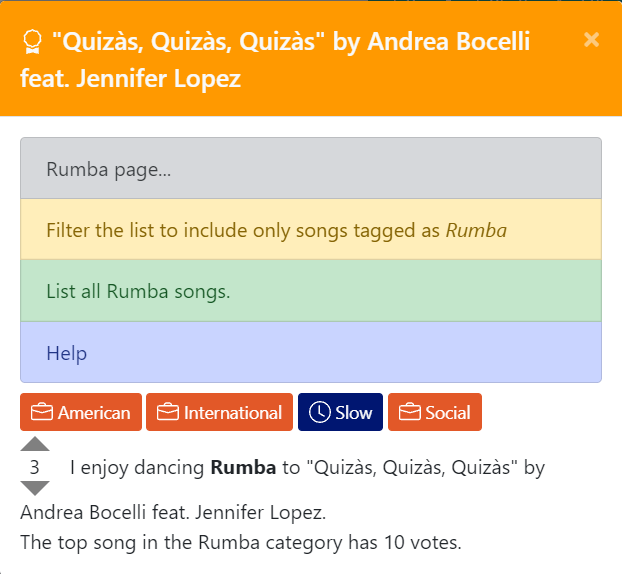
There have always been two kinds of tags: tags on songs and tags on top of a dance style for a song. I’m gravitating to calling the latter dance-specific tags, although I haven’t been 100% consistent yet. If you go to any of the dance details pages (try Slow Waltz), you’ll see two tag clouds now, labeled Dance Tags and Song Tags. Clicking on any of the tags in the Dance (specific) Tags section will give you the option to list the songs with that tag on Rumba.

Alternatively, you can navigate to the Advanced Search page, add Rumba to the list of dances, toggle the “Show Dance Details” switch, and select the option to include the American tag. In either case, you’ll end up with this result. Or we can answer the original question of All Cha Cha songs tagged as “American” style.

In any case, this is a very large new feature that includes a breaking schema change in the search index, so there are bound to be bugs. Please poke at it and let me know what you think. I’m doing my best to enable the deep scenarios that you ask for without overly complicating the core scenarios. Part of what I’m trying to do is what I alluded to in my last post, where I made a reference to making it easier to add refinements to dance searches, so that you can more accurately find all American Style Slow Foxtrots – once could theoretically do something similar with Country Cha Chas (which aren’t currently supported at all).

Please let me know if you have any thoughts about the subject of this post or the site by commenting below or using other feedback mechanisms listed here. And if you enjoy the site or the blog (or both), please consider contributing in whatever way makes sense for you.

New Feature: Searching on songs with a minimum number of dance votes

Several folks have been frustrated with the number of songs in the music4dance catalog that only have one or two votes for a particular dance style. This limitation doesn’t matter for many searches because you can sort by dance votes, and the most popular songs end up at the top. But if you want to…

New Dance: Single Swing

I’ve added Single Swing as a dance style that can be searched on and voted for in the music4dance catalog. While I think of this dance as a short-cut to use when I want to dance East Coast Swing to faster Jive or Lindy-Hop music, I’ve received enough feedback from the community that it’s considered a unique dance in its own right that…

“Search like Google” is now the default

Update (July 2024): This underlying search mechanism described in this series of posts is still in place and functions as described here, but the user interface has changed. Please see the Simple Search and Advanced Search documentation for how the current user interface works. I’ve just updated the music4dance site to make the new search engine the…
New Feature: Improved Text Searching

I’ve always been a bit dissatisfied with how I set up the Artist field in music4dance.  A free text field for the artist generally works, but it doesn’t capture everything I’d like.  But since the core functionality of music4dance is to associate songs with dance styles, keeping the rest of the system simple is a sound decision, and I stand by it.

However, something comes up every few years that makes me want to at least incrementally improve the text search part of the system.  When Prince left us, I broke down and created artist pages based on the text of the artist field.  This was a significant improvement, and I returned to that when writing my DWTS Taylor Swift/Whitney Houston post.  In that post, I listed a few things that I thought could be improved with artist search and then let things rattle around in my brain for a few months.

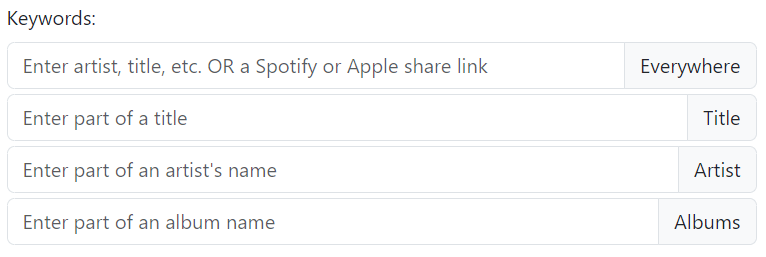
Last week, I decided to spend a little while seeing what I could do to make a worthwhile improvement in a short time.  What came out was a pair of changes.  The more visible change is an addition to the advanced search page

I’ve added some additional controls to explicitly search each of the three primary text fields in the music4dance database – Title, Artist, and Albums.  This enables a more direct way to get to all of the songs by an artist.  It also allows the inverse.  While adding the artist page let you get to all of the songs by “Prince,” it didn’t let you find all of the songs with “Prince” in the Title without also seeing the Prince and Prince Royce songs or, for that matter, songs with Prince in album names.  That is, if you can find one song with Prince as the artist you can click on the link to get to the artist page.

One side effect of this change is that if you search for Prince in the artist field, you also get Prince Royce songs, although they end up at the end of the list.  While that’s not great in the case of Prince, you now have a fast way to get to a link that will send you to the Prince artist page, which does only list Prince songs.  The good part of this quirk is that if you’re looking for songs by Benny Goodman, you’ll get a list containing not just songs with exactly “Benny Goodman” in the artist field.  You also get songs by “Benny Goodman Sextet,” “Benny Goodman Quartet,” “Benny Goodman and Charlie Christian,” “Peggy Lee and Benny Goodman,” etc.

The other more subtle improvement is that I dug into how the underlying database ranks the results of a search.  With my new understanding, I decided to weight the Title and Artist fields considerably higher than the other fields, including the Albums fields.  This helps more than one would think because I grab as many albums as I can associate with a song, and there may be a word in several of those album titles that doesn’t show up in the title or artist. Since the database uses the frequency of a word in the text as part of the weighting, those songs will show up high in the ranking, while it’s not obvious why that song showed up at all since you have to click through to the song details page to see the album names.

Give it a whirl and tell me what you think.  I will probably still do an artist index and possibly figure out a way to do some cleaning up of the database.  There are still songs where the title contains a featured artist, and that artist isn’t represented in the artist field at all, for instance.

As always, I’m very interested in your feedback, so please share any thoughts and ideas about this post or the site by commenting below or using other feedback mechanisms listed here. In addition, if you enjoy the site or the blog (or both), please consider contributing in whatever way makes sense for you.

What are your favorite Prince songs for partner dancing?

Update 2024: The content of the post is still generally accurate. There is a more recent post that outlines a new feature that adds yet another way to narrow down songs that have “Prince” in the artist’s name. New Feature: Improved Text Searching I, like many, am mourning and listening to Prince’s music. Over and…

Keep reading

Ballroom Dancing to Whitney Houston and Taylor Swift

The recent Dancing With the Stars episodes featuring Whitney Houston and Taylor Swift’s music caused a significant spike in traffic at music4dance.net, with dancers looking for music by those artists. I find this exciting for many reasons.  There’s the obvious reason that more traffic means more people showing interest in this project.  It also reinforces…

Keep reading

What is the difference between adding a song to Favorites and voting on a  Song’s Danceability?

From discussions with dancers navigating the music4dance site and observing people’s usage of the site I realize that I still haven’t made it easy to understand the nuances of a couple of important features.  I’m trying to default to simplifying the site wherever possible. But enough people are using both of these features that I don’t feel good about getting rid of either of them.  So I made some changes in terminology and behavior and I’m interested to know if this makes more sense.

Here are the two features at issue:

  1. The concept of voting on the danceability of a song to a particular dance style.  For instance – I love dancing Cha Cha to “Let’s Get Loud” by Jennifer Lopez, so I’ll vote on that.
  2. The concept of adding songs to a favorites or blocked list.  Up until this change I labelled the favorites/blocked list as like/dislike, which I now believe is part of the source of confusion.

It’s important to the music4dance community that people vote on the danceability of a song to dance styles – this is what helps build and refine the catalog that is the core of the site and the main reason that people visit it.

It’s also useful to be able to add songs to a favorites list so that you can filter on that for future searches.   And frankly, blocking a song that you are just sick of is kind of nice as well.

The two concepts are almost completely separate in how they would be used.  But they are too easily confused.  I hope that moving from the like/dislike nomenclature to favorites/blocked list will make things less confusing.

Since I feel the voting concept is more useful to the community, I’ve also done some things to make that more discoverable.  The most recent of these is that when you click on the heart (add to favorites) button in the main song lists, rather than just toggling through favorites/blocked/neutral, it will bring up a modal that will let you explicitly choose one of those options as well as quickly vote on any of the dance styles already associated with the song.

I’ve also added a voting button to dance info modal that is available by clicking on the dance voting results button.

As I noted at the beginning, this is something that I’ve been struggling with for some time (check out this post from 2016) and hope I’ve improved it a bit.  But I’m sure there are other things I can do to make this better, so please send me any of your ideas and let me know if you think the latest change works better (or worse) for you.

And, as always, I’m open to feedback about the feature discussed here as well as the site overall.


Music4dance could use your help:  Please take a look the contribute page:  This lists a bunch of ways to contribute from purchasing premium memberships to voting on songs to sharing with your friends and a bunch of things in between.

Is Simple Better?

I’m making a good deal of progress on updating the music4dance site to more modern technologies.  The main reason for doing this, as I’ve noted before, is to make it easier to add new functionality.

While I’m still in transition, it seems like a good time to get feedback on the new look.  I’m going for the simpler is better concept.  Where the old site had a different color for each section, the new pages are all themed in the same way.  I’ve also dropped back to using standard fonts and styles.  Among other things, it’s faster to do it this way (which will let me get to new features more quickly), it’s more accessible, and it is generally the direction I’m trying to go with things like simplifying search.

As of now (August of 2020), I’m about halfway through the transition.  Pretty much all of the pages except for the core pages that include song lists and the home page are converted.  So you can compare a page like the song library page (old style) to one like the ballroom page.  Or you can compare the dance style page to the help for the dances style page (which still contains an image of the old page).

So what do you think?  Old or new?  It’s not too late for me to add back in some of the customization if you think that’s a key part of what makes music4dance a place you spend time.

Oh, and while I’m at it – can I get feedback on how useful the help pages are?  I’ve not written help for all of the functionality and I haven’t bothered to convert help pages where the functionality is close to the original even if the look is different.  But if I get feedback that they are particularly useful, I’ll prioritize help higher.

As always, feedback is always welcome on any part of the site.

Quick Tip: If you’re looking for music that is within the specific tempo guidelines for NDCA or DanceSport guidelines, you can find links on the ballroom page.  Each of the tables on that page links to lists of songs listed at the correct tempo for that dance.

Check out our new Bonus Content Feature

As of this writing the publicly visible music4dance catalog contains just over twenty seven thousand songs.  But the underlying index contains well over forty six thousand songs.  So what’s the deal with the missing twenty thousand songs?  These are song listings that I’ve pulled in one way or another but aren’t complete in some way.

  1. All of the songs must have been matched to an entry in one of the publisher catalogs that we search.
  2. Each song must have been tagged with at least one dance style.

I believe that these are perfectly reasonable constraints and help to reduce confusion for a novice user. However, there is a whole lot of information indexed in our catalog that people aren’t seeing and could be of some use.

One of the things that people often do on the site is to search for ideas for songs to dance to.  They will search for an artist name or a fragment of the title of a song and see what comes up.  This works great, but of course, the more songs that can be searched the more likely that you’ll get a useful idea.  The songs that are in the bonus section have had less scrutiny, many of them probably have small typos or other inaccuracies in the title or artist that prevented them from being matched to a publisher’s catalog.  Or they might be obscure songs that just aren’t as easily available on Spotify or Amazon.  In either case, I think getting to these additional songs is useful to the expert user sleuthing for the interesting or obscure song to choreograph to or surprise their dancers with.

Another case is where someone is looking for a song of a particular tempo but doesn’t necessarily need it to be specifically for one of the dance styles that we currently catalog.  This might be because they’re looking for something to dance to in a different style that might have a specific  tempo requirement but doesn’t necessarily have some of the other requirements for partner dancing.  One case that comes to mind is tap dance music, but I’m sure there are others.  One could potentially use this for finding running or exercise music of a specific tempo.

If you’re interested in exploring this, here’s how:

As always, I’m interested in your feedback. Please let me know if this feature seems useful to you. Or even better, let me know how you use this feature so that I can add that to common use cases and blog about it in the future.

Book Review: The meaning of TANGO

The Meaning of TANGO: The Story of the Argentinian Dance by Christine Dennison

This is a fun book for Tango dancers of all types.  The book is very centered around traditional Argentine Tango and does an excellent job of conveying that perspective.  It’s also somewhat unusual in that it is predominantly about the history and philosophy of the dance but contains a section that is straight up technique with diagrams.

The book is a quick read and full of wonderful tidbits about the dance and its history.  Rather than a full-fledged review, I would like to highlight a few points that I feel gave me some useful insight into Argentine Tango.   I am someone with a ballroom background and  I believe this book helped me understand the dance in a way that I didn’t have even after taking a number of beginning Argentine Tango lessons.

Dance to the Melody

There is a section called “One Name, Many Dances” where the author talks about the relationship between Argentine Tango and ballroom dances.  In particular this quote from Freddie Camp, an early German Ballroom dancer:

In Argentina dancers prided themselves on their ability to dance the melody rather than the rhythm. Indeed, Tango orchestras almost never have a drum section. While most other dance music around the world is based on a strong, clear rhythm, generally emphasised by drums, newcomers to Tango music often complain that they find the rhythm of the music difficult to hear. This is one of the qualities that makes Argentinian Tango unique.

The idea of dancing to the melody rather than the rhythm goes a long way to explaining the thing that puzzled me about the practice music that was used in the beginning Argentine Tango lessons that I’ve taken.  I felt that the teachers were choosing music where the beat was hard to find, which I would not expect of a beginning class.  So I’m going to spend some time listening to the melody of Argentine Tango music and see if I can find myself moving to the melody.

Learning to Lead by Following

I found the description of how Argentine Tango was taught traditionally particularly enlightening.  The men would learn in prácticas which were all male and composed predominantly of expert dancers.  When learning to follow a young man would spend his formative years being led by experienced dancers.  Then he would spend additional years within the práctica leading other men before he ever went to a mix sexed milonga and lead a woman.   The fallout of this is that in the context of learning the dance, one was surrounded by experts.  Contrast this with the current practice of dance classes where there are one or two teachers and a crowd of inexperienced dancers.

In addition, from a lead’s perspective, learning to follow is invaluable.  I didn’t do this until I had years of lead experience and when I finally did spend some time learning to follow it fundamentally changed the way I lead.

The Tango Trinity

Finally, the author talks about the “Tango Trinity”: Tango, Milonga, and Vals.  From some other research and some discussion with Argentine Tango dancers, this appears to be the purist’s set of Tango dances.  I had originally categorized Neo Tango into the set of Argentine Tango dances, but that appears not to be the case.  Based on this, I almost went down the path of pulling Neo Tango from the catalog as a distinct dance and reworked it so that Neo Tango (or Tango Nuevo) would just be a style tag on top of the Tango Trinity dances.  But I’m glad I did some further research.  It looks like Neo Tango is a distinct style of dance and related to traditional Argentine tango about as closely as Ballroom Tango is.

The main thing that I got from that set of discussions is that Argentine Tango dancers are even more concerned with the tradition of the music that other styles that I’ve studied.  I got the impression that some would only consider “true tango music” to be that recorded by a specific set of artists from the golden age.  Someday, I’d like to see if I can get things sorted out so that it’s easy to distinguish these from others.

If you have thoughts on the Argentine Tango, the music4dance website or corrections to anything I’ve said about Tango and Tango music, please feel free to comment here or send me feedback.

Also, if this post sparked your interest enough to buy the book, please follow one of the affiliate links below.  And as a small aside, any of the Amazon and ITunes links on the site and blog help support the site, so if you find things of interest here, please use the links to make purchases.

The Meaning of Tango: Kindle Edition

The Meaning of Tango: Hardcover Edition

The Meaning of Tango: Paperback Edition

Finding the latest music on music4dance (take 2)

There are enough people that visit music4dance regularly that I thought it would be worth revisiting how to make it easy to find the most recently added and changed music on the site.  I did one pass at this back in November of 2016 when I had to change the default away from listing songs in order of most recently changed.

But that involved adding a link the home page and some options in the Advanced Search page and didn’t do a great job of leading people to that option if they didn’t know it was already there.

So I’ve added a “New Music” option in the “Music” menu.  This will take you directly to a page showing the songs with the most recently added first as well as an easy link to switch over to the most recently changed songs.  I hope this is a bit more discoverable than previous methods.

Once you’re on the New Music page you can use all of the usual methods of tag filtering to narrow down your search and we’ll preserve the sort order that you started with.

You can still use Advanced Search to do things like finding the most recently added Rumbas or Tangos.

We’re adding new music as we find it.  You can help in a couple of different ways.  Sign up for beta feature1 to add your own songs, mark exiting songs as danceable to a particular style, or send me lists of your favorite songs and what you dance to them – I can import any reasonably formatted list and will be happy to associate those songs with your account and set up a back-link to your site.

It’s great to see so many people use the site.  Please let me know how you use the site, I’m always delighted to hear your feedback both positive and not so positive (the latter is often what leads me down the path of new and revised features).

  1. Update: Adding songs is now out of beta – see the documentation for more info. ↩︎

Musicians for Dancers

One of the things I enjoy most about the musci4dance project is when I get feedback from people who have found the site useful.  I’m especially happy when it comes from a direction that I don’t expect.  It’s exactly that kind of feedback that I received from Mister “D” (David Simmerly) – a musician who performs for Ballroom clubs and weddings and was looking to expand his repertoire with music that would be well received in those contexts.

I asked Dave to expand a little on how he used music4dance and (paraphrasing) here are a few of the things that he came back with:

The first and second points led to an extended discussion about songs that are listed as Waltzes but are not in 3/4 time – check out my blog post on “Fake” Waltzes for more on that.

But there is a more general point that I would like to make here with respect to “correctness” of music for dance.  I’ve compiled this catalog with an eye for finding music that inspires dancers to dance.  This makes for a very loose definition of what songs “work” to dance a particular dance to.  In a setting where a dancer is choreographing to a specific piece of music, even when that choreography is a traditional ballroom dance like in Dancing With the Stars, there is quite a bit of latitude in what music will “work”.  Whereas in a social situation the dancers are more dependent on the beat and feel of the music to enjoy the experience of partnering in a specific dance style.  And then of course when one is dancing competition rounds, there are even stricter rules about tempo.

In any case, I hope that many of the songs in the music4dance catalog fall into the category (as Mr. “D” says) of “making your pants want to get up and dance.”  In the future, I hope to do a better job of tagging dances in a way that separates the strictly ballroom from the fun to choreograph to from the great songs for social dancing.  The system is at least theoretically set up to do this since I’ve enabled arbitrary tagging of songs.  It’s a big project to go through each song in an 11,000+ song catalog and make the kind of distinction I’m talking about here.  On the other hand, it is exactly the kind of thing that works well when others jump in to add their own ideas to the mix.

As always, I welcome your feedback and participation.  Thanks to David Simmerly for permission to use his name and information in this post.  If you’re in the midwest and are looking for a great solo entertainer for your Ballroom Club, Wedding Reception or another occasion, you can find him on gigsalad.com.

What is a fake Waltz?

I was recently asked why there are songs tagged as Waltz in the music4dance catalog that are in 4/4 time.  This seems almost like the dance version of an oxymoron.   In my brief description of the Waltz on the website I start with “Waltzes are dances that are danced to music in 3/4 time…”

To be honest, the main reason that there are “Waltzes” that aren’t Waltzes in the catalog is that I pull from lots of different sources and even with something this fundamental there are different schools of thought.  I intentionally error towards the inclusive in these decisions since I think that dance should be as inclusive as possible.

A substantial number of these songs come from sources that cater to people looking for wedding dances.  But there are definitely “Waltzes” in 4/4 coming from other sources as well, I’ve certainly seen some exhibition Waltzes performed to music that has almost no discernable beat,  much less a strong 3/4.

I’m not sure where I picked up this term, but these songs are what I have been calling “Fake” waltzes.  If anyone has a better term for this, I would love to hear it.

In any case, a “Fake” waltz is generally a song that is in 4/4 but has a strong downbeat and very weak rhythm otherwise, so that one can dance three steps to a measure without being too distracted by the actual rhythm of the song.   You can find all of the songs that I’ve tagged as “Fake” waltzes by following these steps:

  1. Go to the Advanced search page
  2. Under “Dance styles”, choose Waltz
  3. Under “Include tags” , Choose “Fake”
  4. Click the Submit button

Or just click here for the pre-built search.

You can use the same process, but replace step (4) with choosing “4/4” and you can find all the songs that are cataloged as both waltz and 4/4.

The more interesting variations are to use the same process to find all waltzes that are not tagged “Fake” and not tagged “4/4”.  You can do this by using “Exclude Tags” in step 3 above.

And while I’m on the subject of unusual waltzes, there is another variation on this theme. It is a song with an extremely slow primary tempo where you can fit a very fast waltz half basic (three steps) on each beat. I’ve been labeling these as “triple-time” and the list can be found here.  Although that’s an exaggeration, there is only one song on that list as of this writing – Louis Armstrong’s “What a Wonderful Life”.  Perhaps I’ll find more by the time you read this.

I’m looking into ways to make the fact that a waltz is “Fake” more obvious.  Currently, it’s a tag on the dance which can only be seen when you click on the dance tag in a song list or by going to the song details page.

In the meantime, if you have a strong objection to songs in 4/4 being labeled as Waltz, you’re welcome to sign up and start voting them down or tagging them as “Fake.”

Even more than usual, I’m interested in how other people view this, so please feel free to comment on this post or send feedback directly to me.

Search like Google Part III: Advanced Search – The Best of Both Worlds?

I’ve just updated the music4dance site with the remaining features for our search beta (see What if I just want to search for songs on music4dance like I do on Google? and Search like Google Part II: Autocomplete, Filter by Dance Style and Sorting for some background).  You should now be able to take advantage of both the new features like auto-complete and simple Google/Bing style searches with all of the dance specific features like filtering by tempo and dance style using the Advanced Search Beta.

Give both a try and let me know what you think.  I’ll leave both the beta and the legacy search capabilities up on the site for a bit so that you can compare and contrast.  Bug reports are welcome here.  And as always please submit any general feedback or suggestions here.

The Google Miniseries: