
Tag Archives: Quickstep

Please help us catalog new music

A Swing Band leader (Glenn Crytzer) reached out to me recently, asking if it would be possible to add his entire catalog to the music4dance.net database. He found a few of his songs already listed, but has a published catalog of well over a hundred songs, most of which should be danceable to partner dances (mostly Swing variations).

Glenn graciously provided me with a spreadsheet of his music, and I was able to upload it to music4dance. This was particularly nice because I could include his data on tempo and genre tags, as well as some other miscellaneous metadata from his comments that I turned into tags. But that led me to the next issue – his data didn’t include anything about which dance or dances would be particularly suitable for each of the songs. Which is entirely reasonable, he’s not actually dancing to them, and most of them would work for a generic swing night – the dancers can choose to dance Lindy, Balboa, East Coast, or something else to any particular song. Although that’s a vast over-simplification, if you’re interested in how a musician thinks about these things, Glenn’s article On Programming an Original Swing Music Album is an illuminating read.

That leaves me in a bit of a bind. I can certainly go through the 100+ songs myself and vote on which dances work for those songs, and I probably will. But I dance East and West Coast Swing and a bit of Lindy and Charleston – oh, and a bit of Slow Foxtrot, as Foxtrot and Swing music overlap – so I’m not familiar enough with some of the other dances to say whether a song would be suitable for Balboa, Jump Swing, Quickstep, etc. And more importantly, even with the dances I do know well, I’m only one opinion. Music4dance works much better when others in the community contribute by voting on dances that they are familiar with for songs in the catalog.

That line of reasoning led me down the path that I’ve considered several times before, of unlocking premium membership for free for members who vote on dances. I’ve thought and rejected several complex mechanisms to enable this. While some of them seem plausible, I don’t want to spend time writing code until I prove that there are enough members of the music4dance community willing to participate to make it worth my while.

Something about the interaction with Glenn and the thought that I’d love to get his songs showing up with associated dances sooner rather than later made me look at the problem a little differently. What if I went the low-tech/high-trust method of giving out premium memberships to anyone who committed to voting on a certain number of songs per month? I wouldn’t have to write any code at all for that, and if enough people take me up on it to make manual management of the “feature” cumbersome, I can always write the code later. That will also let me play with the parameters without building a whole dashboard of knobs and dials.

The Offer:

If you are familiar enough with at least one dance to confidently listen to an arbitrary song and say, “I would dance that dance to the song,” and are willing to spend some time each month doing that on the music4dance website, I’ll extend you a premium membership for each month that you do. Furthermore, I’ll take your word for it and give you the premium membership ahead of time. That will let you look at songs that no one has voted on yet (which is essential for things like the Glenn Crytzer catalog – at least until someone has voted on a song). To make this somewhat measurable on my end, let’s set the number of votes at 50 per month to keep your premium membership going. I’ll reserve the right to change the parameters at any time, including cancelling the program, since this is an experiment. But at minimum, if you contact me to try this out, you’ll get the first month of premium free, and I won’t turn that off before the end of the first month unless I detect you doing something malicious.

Why should you care about a premium account? In this case, it allows you access to more songs, including songs that no one has voted on yet and songs that I’ve pulled in from someone’s list of danceable songs but haven’t matched to a music catalog. With a premium account, ad content is turned off, and you can export results of your searches to Spotify – see details here.

Musicians (a quick aside):

Before I get into the nitty-gritty details of how to take me up on this offer, let me take a moment to reach out to other musicians who would perform music suitable for partner dancers. If you are interested in having me bulk upload your catalog to music4dance, please contact me, and I’d be happy to do that.

Here’s how to go about taking me up on my offer:

  • Create an account on music4dance.net here if you don’t have one already. (Account management help)
  • Email me at info@music4dance.net from the email you used to create your music4dance account and include “I’d like to Help Cataloging Music” in the title. Feel free to include any other details you’d like to share or questions about the offer in the email. I read everything that I get.
  • I expect to be able to upgrade your account and respond to your email within forty-eight hours (but this is an intention, not a commitment – read the notes above about this being an experiment) – if you haven’t heard from me in that timeframe, please try again.
  • Read the information about Dance Tags to understand how to vote.
  • Start voting!

This offer is for voting on dances, not for clicking the like button on songs. The latter is a feature that helps you organize your use of the music4dance catalog, but doesn’t do much for other users, so I’d like to focus on the core music-to-dance relationship of the voting mechanism for this offer.

Useful links:

What if you want to support music4dance but don’t have either the time or the experience to catalog songs by dance? There are plenty of other ways to contribute, as described on our “Contribute” page.
Nine Sinatra Songs – Ballroom inspired Ballet

Pacific Northwest Ballet included Twila Tharp’s Nine Sinatra Songs as part of their Director’s Choice performance this year. I’m not in any way qualified to review a Ballet performance, but I can say that I thoroughly enjoyed it and had a great time playing with the Ballroom-inspired aspects of the dancing as I watched the show unfold. For me, the idea that the dancing was inspired by ballroom rather than in any way attempting to choreograph actual ballroom dance steps on ballet dancers is what made it work (this is the issue I sometimes have with partner dance in Broadway musicals). It was obvious in several of the nine pieces that  Ballroom dance inspired the piece, and the upper body shaping and movements felt quite ballroomesque throughout the performance.

On returning home, I hoped to find a resource that listed the dances that Tharp drew from for each of the first eight pieces (the ninth is a reprise group number), but I failed. The notes from some of the performances mention the roots of one or two dances, but it seems like, for the most part, they name the same couple of songs. So, my guess is that even a thorough search of those through the years wouldn’t yield a complete list. As an aside, it was fun to jump down the rabbit hole of the French Apache Dance that Tharp drew from for the choreography for That’s Life. If someone has such a reference, please let me know.

In the meantime, I will take this as inspiration to play a little with the possibilities of music and dance. Sinatra is already well represented in the music4dance catalog, with 166 songs listed before I started filling out the few missing entries from the ballet. But I’ve always thought of dancing Foxtrot to Sinatra or maybe Swing. In the ballet, Tango, Rumba, and Samba were definitely represented. So, I took a few minutes to see what the music4dance community has to say about dancing to this music.

If you go to the Frank Sinatra artist page, you’ll see Slow FoxtrotLindy HopRumbaCastle FoxtrotEast Coast SwingJive, Quickstep, Peabody, West Coast Swing, Single Swing, Slow WaltzBalboaBoleroBossa NovaViennese Waltz, and Blues all represented.

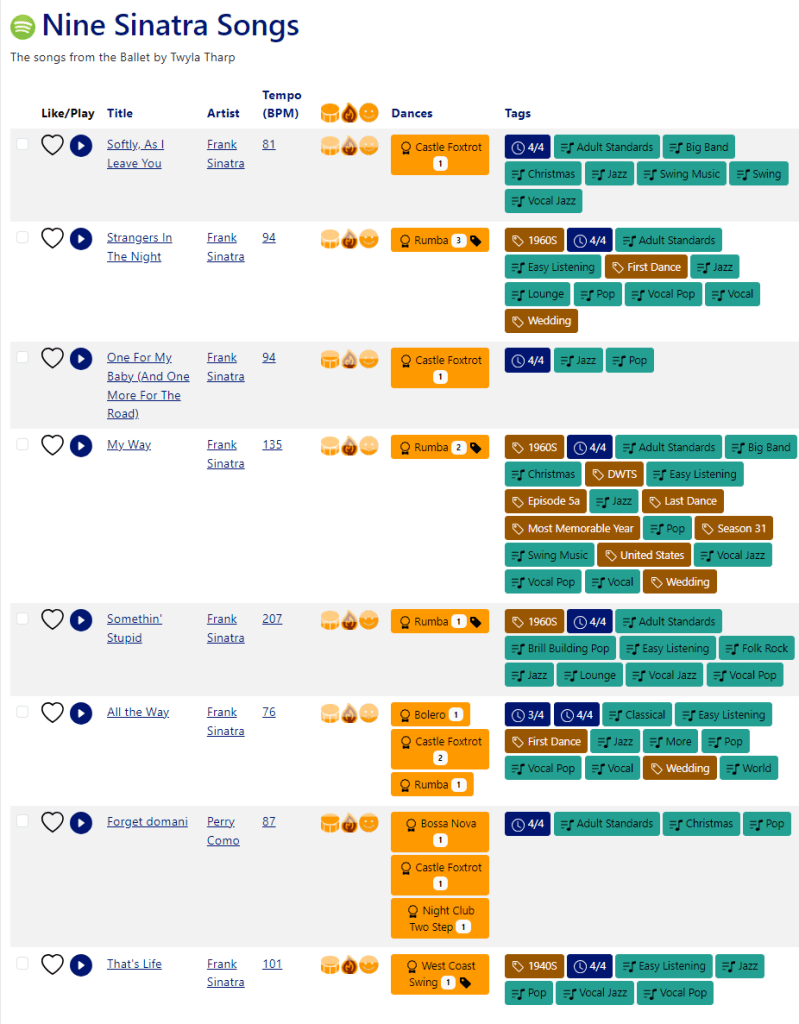
And here’s a custom music4dance playlist that includes all eight songs (although one song is the Perry Como version since the Sinatra version isn’t available on Spotify or iTunes).

A snapshot of the eight songs used in "Nine Sinatra Songs"
The eight songs used in “Nine Sinatra Songs” as shown on music4dance.

Are there other partner dances that Tharp drew from in this work that we should represent in music4dance? Are there other Ballroom-inspired ballets out there worth viewing? Do they use different music that you’d like to add to the catalog? Are there other playlists that you’d like to overlay the music4dance information on, like I did with this one? If you have ideas about this post or the site, please comment below or use other feedback mechanisms listed here. And if you enjoy the site or the blog (or both), please consider contributing in whatever way makes sense for you.

Holiday Music for Partner Dancing (Take 2)

It’s that time of year again – people are searching for holiday music for showcases and holiday party dances.   So I decided to take another round at what I could do to improve that experience on the music4dance website.  Take a quick look at my post from last year since that is still 100% applicable.  Don’t worry, I’ll wait…

You’re back?  Great!  As you can see, I took some pretty big shortcuts to get the Holiday Music page up before Christmas last year.  This year I spent a little while to improve the page.

First, I made the pages work like the other song search pages so that you get 25 songs at a time and can scale up to much longer searches.  There are only 261 songs on the main Holiday Music page as of this writing, but I hope to get that number up to the point where loading them all on one page is prohibitive.

Second, I added the functionality to list all of the Holiday Music for an individual dance style.  So if you are choreographing a routine for Quickstep or Rumba, you can now list just the Holiday Quickstep or the Holiday Rumba songs.

Over the course of this holiday season, I hope to add more music.  If you are interested in helping, here are a couple of things you can try:

  • Sign up for our add song beta and add holiday songs yourself.
  • Browse our music catalog and tag songs as Holiday when you find them.
  • If you have a list of holiday songs categorized by dance style that you are willing to share, please send us an email at info@music4dance.net or contact us through our feedback form.

I’ll also get things set up to push these lists out to Spotify soon.

As always if you have comments or suggestions please feel free to reply to this post or contact me here.

What are your favorite Prince songs for partner dancing?

I, like many, am mourning and listening to Prince‘s music. Over and over again.

Since I’ve been thinking a lot about music and partner dancing recently, this lead me to think about what I would dance to each song.  Especially when Leader of the Band popped up in my playlist and screamed Cha-Cha at me.  Of course a lot of his seminal work has more of a blues feel that I would associate with West Coast Swing (or possibly even more directly blues dancing).  But there are certainly some things in his catalog that one might Quickstep to (Let’s Go Crazy) or dance a Slow Foxtrot (Strollin‘) to.

Here’s a link to the list of Price songs currently in the music4dance catalog.  If you’ve got other favorites (along with what you would dance to them) let me know by responding to this post or sending feedback and I’d be happy to add them.  Or sign in and vote on what style you would dance to the songs already in the catalog.

The Prince Feature

One of the things that I noticed as I was looking for Prince music in the music4dance catalog was that I hadn’t implemented an artist page of any kind.  You could search for Prince but you would both get everything I had catalog by Prince and everything by Prince Royce songs with Prince in the title.  So I did a quick fix – if you click an artist’s name you’ll be taken to a page with a list of the first 100 songs I’ve catalog by that artist.  Since I’m only tracking artist by the full name this has a couple of implications, one of which is that Leader of the Band won’t show up under Prince since the artist is actually “Sheila E. featuring Prince and The E Family.”

You can, of course, still search for Prince and manually go through the songs to find the ones that actually involve Prince, but that’s obviously not the perfect solution.  How much does this matter to you?  Is it important to have a more specific idea of artist when you’re sorting through songs to dance to?

As always, please send me feedback or just respond to this post with any issues or ideas.

I am learning the Foxtrot, where can I find some music?

The quick answer is to just click this link where you will find a list of over a thousand songs that have been labeled as Foxtrot.

But that’s definitely not the full answer.  In that list you will find songs that are too fast or too slow for you to dance to because the Foxtrot is not just one dance style but a family of dances each of which can be danced to a different range of tempos.

When I first started dancing  my teachers were from a background that was influenced by American Smooth style of Ballroom dance.  So there was a very specific dance that I first learned as “The Foxtrot”.   This is what is more precisely known as American Style Foxtrot and the was danced in the range of 30 measures per minute plus or minus a bit depending on competition rules.

In order to answer the more precise question of what kind of music will work for the dance that you are learning, it helps to get a bit of a historical perspective.  The Foxtrot follows a pretty common pattern in how partner dances evolve.  A style is first danced socially and pulls in moves from multiple traditions.  Often something resembling the social dance is performed on stage by exhibition dancers as well.  As the style becomes established, teachers take it and formalize it and possibly simplify it for their students. Then social dancers start pulling in things from different traditions and the dance evolves.  Sometimes it gets renamed, and sometimes the dance with the same name is just danced differently depending on where and when a dancer learned the style.   And never forget the influence of the music that is evolving alongside the dances, perhaps speeding up or slowing down or changing in character in a way that influences how dancers dance to it.

In the case of the Foxtrot, two of the early influences were Peabody and the Tango.  The Peabody was a very fast “one step” dance, and the Tango was imported from Argentina via Paris.  Harry Fox is the exhibition dancer who lent the Foxtrot his name.  Vernon and Irene Castle are the teachers who first formalized the Foxtrot as well as using it in their performances.

Arthur Murray standardized the particular version of the Foxtrot that I learned.  He also revived the Peabody as a competition dance to occupy the fast end of the Foxtrot style dances, as he felt that it was more reasonable for students to learn than the slightly slower but more complicated Quickstep.

At some point Charleston influences crept in as a style dance-able to faster music developed, called appropriately, the Quickstep.

To round out this family of dance styles I’ve adopted the name Castle Foxtrot to represent the slowest variations.   Much of the music that I’ve cataloged as Castle Foxtrot has been labeled by others as Slow Dance, especially when it relates to Wedding Dances.  Many of the moves that are used in Foxtrot can be slowed down and made to stay in place  (or on spot) to create something that is much more elegant than the side to side swaying that I first “learned” as a slow dance.

Here is a snapshot of the Foxtrot filter of the music4dance Tempi Tool, as a jumping off point to help you find music in an appropriate tempo for your style of Foxtrot.  Just click on any of the tempo ranges to get Foxtrot music in that range.

NameMeterMPMBPMTypeStyle(s)
Castle Foxtrot4/415-2560-100FoxtrotSocial
Slow Foxtrot4/428-34112-136FoxtrotAmerican Smooth, International Standard
QuickStep4/448-52192-208FoxtrotInternational Standard
Peabody4/460-62240-248FoxtrotAmerican Smooth

With the full tool on the music4dance site you can dig further into the relationship between dances and tempos.

Foxtrot was further complicated by the fact that it co-evolved very closely with swing and was often danced to the same music, or at least music played by the same bands.   I’ll take at look at what I’ve been categorizing as the Swing family of dances next.

Does this categorization help you at all in how you think about dancing and how it relates to music.  Is there a different way that you would slice and dice these dances?

One thing that I completely over-simplified in my description was the influence of regional traditions.  Would anyone from around the world care to shed some light on your regional influences to the Foxtrot?

Useful Links: