Tag Archives: Rumba

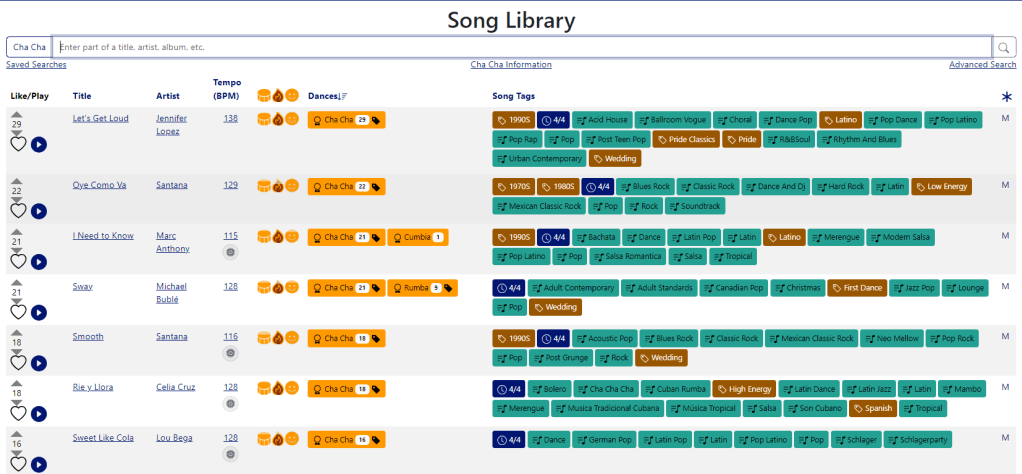
What if I want to find just Cha Chas tagged as American Style?

Or one of the many variations, such as Slow Foxtrots labeled as “Traditional,” or Boleros labeled as “fast”?

Queries like the above have always been possible, but with a very major caveat. Up until now, you could search on Cha Cha dance and “American” style. But what that did was find all songs that had a net Cha Cha vote of at least one and a tag on any dance of “American” style. So if someone voted on a song as Rumba and tagged the Rumba as American, then someone else voted for the song as Cha Cha, searching on Cha Cha and American would include that song.

This behavior was particularly troublesome if you wanted to do something like search for fast Salsas, because you’d end up with songs that are fast Rumbas or Cha Chas, but slow Salsas, which is precisely what you don’t want. Side note: the workaround for that particular issue is to search on specific tempos, but that isn’t really the same as searching for songs that someone explicitly tagged as slow or fast for a particular dance, since there is more thought put into tagging (and not every song has a tempo associated with it).

I’ve done a bunch of restructuring and added more than a bit of UI to enable the kinds of searches that I’m describing here. I’m currently busy updating the documentation to catch up, but I hope that the fundamental change is relatively intuitive.

There have always been two kinds of tags: tags on songs and tags on top of a dance style for a song. I’m gravitating to calling the latter dance-specific tags, although I haven’t been 100% consistent yet. If you go to any of the dance details pages (try Slow Waltz), you’ll see two tag clouds now, labeled Dance Tags and Song Tags. Clicking on any of the tags in the Dance (specific) Tags section will give you the option to list the songs with that tag on Rumba.

Alternatively, you can navigate to the Advanced Search page, add Rumba to the list of dances, toggle the “Show Dance Details” switch, and select the option to include the American tag. In either case, you’ll end up with this result. Or we can answer the original question of All Cha Cha songs tagged as “American” style.

In any case, this is a very large new feature that includes a breaking schema change in the search index, so there are bound to be bugs. Please poke at it and let me know what you think. I’m doing my best to enable the deep scenarios that you ask for without overly complicating the core scenarios. Part of what I’m trying to do is what I alluded to in my last post, where I made a reference to making it easier to add refinements to dance searches, so that you can more accurately find all American Style Slow Foxtrots – once could theoretically do something similar with Country Cha Chas (which aren’t currently supported at all).

Please let me know if you have any thoughts about the subject of this post or the site by commenting below or using other feedback mechanisms listed here. And if you enjoy the site or the blog (or both), please consider contributing in whatever way makes sense for you.

New Feature: Searching on songs with a minimum number of dance votes

Several folks have been frustrated with the number of songs in the music4dance catalog that only have one or two votes for a particular dance style. This limitation doesn’t matter for many searches because you can sort by dance votes, and the most popular songs end up at the top. But if you want to…

New Dance: Single Swing

I’ve added Single Swing as a dance style that can be searched on and voted for in the music4dance catalog. While I think of this dance as a short-cut to use when I want to dance East Coast Swing to faster Jive or Lindy-Hop music, I’ve received enough feedback from the community that it’s considered a unique dance in its own right that…

“Search like Google” is now the default

Update (July 2024): This underlying search mechanism described in this series of posts is still in place and functions as described here, but the user interface has changed. Please see the Simple Search and Advanced Search documentation for how the current user interface works. I’ve just updated the music4dance site to make the new search engine the…

Nine Sinatra Songs – Ballroom inspired Ballet

Pacific Northwest Ballet included Twila Tharp’s Nine Sinatra Songs as part of their Director’s Choice performance this year. I’m not in any way qualified to review a Ballet performance, but I can say that I thoroughly enjoyed it and had a great time playing with the Ballroom-inspired aspects of the dancing as I watched the show unfold. For me, the idea that the dancing was inspired by ballroom rather than in any way attempting to choreograph actual ballroom dance steps on ballet dancers is what made it work (this is the issue I sometimes have with partner dance in Broadway musicals). It was obvious in several of the nine pieces that  Ballroom dance inspired the piece, and the upper body shaping and movements felt quite ballroomesque throughout the performance.

On returning home, I hoped to find a resource that listed the dances that Tharp drew from for each of the first eight pieces (the ninth is a reprise group number), but I failed. The notes from some of the performances mention the roots of one or two dances, but it seems like, for the most part, they name the same couple of songs. So, my guess is that even a thorough search of those through the years wouldn’t yield a complete list. As an aside, it was fun to jump down the rabbit hole of the French Apache Dance that Tharp drew from for the choreography for That’s Life. If someone has such a reference, please let me know.

In the meantime, I will take this as inspiration to play a little with the possibilities of music and dance. Sinatra is already well represented in the music4dance catalog, with 166 songs listed before I started filling out the few missing entries from the ballet. But I’ve always thought of dancing Foxtrot to Sinatra or maybe Swing. In the ballet, Tango, Rumba, and Samba were definitely represented. So, I took a few minutes to see what the music4dance community has to say about dancing to this music.

If you go to the Frank Sinatra artist page, you’ll see Slow FoxtrotLindy HopRumbaCastle FoxtrotEast Coast SwingJive, Quickstep, Peabody, West Coast Swing, Single Swing, Slow WaltzBalboaBoleroBossa NovaViennese Waltz, and Blues all represented.

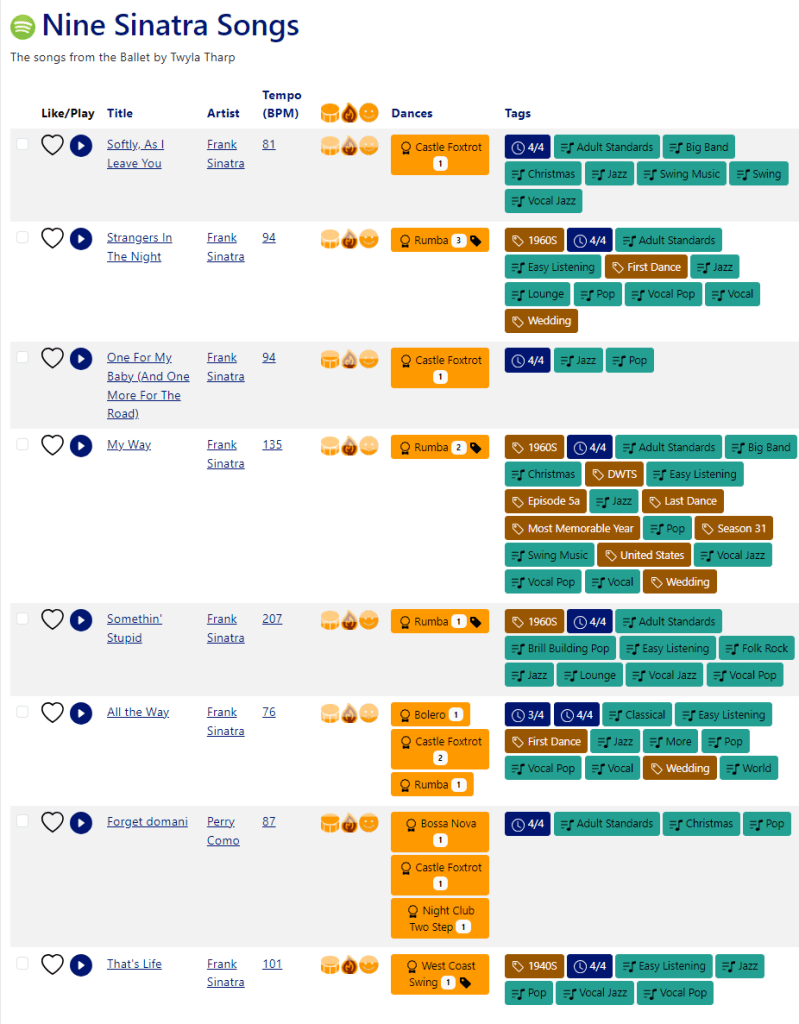
And here’s a custom music4dance playlist that includes all eight songs (although one song is the Perry Como version since the Sinatra version isn’t available on Spotify or iTunes).

A snapshot of the eight songs used in "Nine Sinatra Songs"
The eight songs used in “Nine Sinatra Songs” as shown on music4dance.

Are there other partner dances that Tharp drew from in this work that we should represent in music4dance? Are there other Ballroom-inspired ballets out there worth viewing? Do they use different music that you’d like to add to the catalog? Are there other playlists that you’d like to overlay the music4dance information on, like I did with this one? If you have ideas about this post or the site, please comment below or use other feedback mechanisms listed here. And if you enjoy the site or the blog (or both), please consider contributing in whatever way makes sense for you.

Western Partner Dances and Line Dances?

One of the comments on my last post asked:

A lot of our dance groups over here love to dance the partnered dance sea shells The song “Blue night” by Michael learns to Rock sings the song they dance to. Is there a list on your data base of similar songs to that one that they can also dance Sea Shells to?

This question lead me down one of those beautiful rabbit holes that dance often does.

I had never heard of this dance, but I looked it up and found a YouTube video with the choreographer demonstrating the dance. It was 32 counts (four 8-counts) danced line of dance using a vocabulary that I’m not familiar with but would guess was some flavor of country dance.

Now, when I was learning to lead as a ballroom dancer, my teacher often put together a few eight counts of choreography that I could use so that I wouldn’t have to think as much about what my next move was and concentrate instead on leading my partner and making sure I didn’t run into anyone (or step on my partner’s feet). I understand this is a common technique in the Ballroom community. I ran across similar methods when learning social dances in group classes. So my first instinct was – this is just a slightly more formalized version of that technique – and it has the advantage that your follow knows that you will be doing this same sequence, so the lead should be much easier.

Following that thread, I listened to the song more closely and counted it out. It’s about 97BPM 4/4 and had the feel of an International Rumba or Bolero to me. This gave me the first level answer to the question of what else would someone play if people wanted to dance “Sea Shells” – I went to Advanced Search and selected Bolero and Rumba, limited the tempo to 95-99 BPM (an arbitrary bracket around 97 BPM) and sorted by the most popular – that resulted in this list. I’m convinced that someone who learned “Sea Shells” could dance it to any of the top songs on the list.

But I felt like I was missing something fundamental about this type of dance, and I dug deeper. I didn’t have to do much searching to find a “Dance Step Sheet” with the specific choreography that Dan and Kelly Alboro created. In fact, there were a bunch of places that listed this dance and described the steps. Poking around the websites that hosted such sheets, I found that this is a whole thing. Please pardon my ignorance here since I’m sure many people reading this post know more about such things than I do, but the concept of choreographing a few eight counts of a partner dance and naming it was completely new to me.

My understanding from a relatively brief perusal of these sites is that there is a branch of country dancing similar to line dancing where someone choreographs a number of eight counts using a specific vocabulary, teaches it at an event, and then a whole group of people can dance the same “dance.” The most experience I’ve had with these personally is Wedding Line Dances, but it seems like a fun experience. Doing this kind of dance with a partner rather than the individual line dances I’ve seen in the past feels like a great way to become more comfortable as a partner dancer. In any case, I’ll put a bunch of links at the bottom of this post to sites written by people who know a lot more about this than I do.

Back to the original question: Another answer is that some of the “Dance Step Sheets” for “Sea Shells” list an alternate song that it can be danced to. The song they list is “jumpin’ the jetty” by Coastline. Now, this is a song that shouts Swing to me and is considerably faster (126BPM) than “Blue Night.” So that blows my original thought out of the water. Here is a search for swing songs between 124 and 128BPM. Unsurprisingly, there is no overlap between this list and the one I generated for “Blue Night.” I suspect someone who knows the choreography well can probably dance it to any reasonably consistent 4/4 music at a wide range of tempos. For those who are less expert, there is perhaps an advantage to being on the slower side and having strong phrasing. And I’m sure there are plenty of folks who only want to dance this particular dance to the music that they learned it to in the first place. But as I’ve said repeatedly, I’m way out of my depths here, so if someone who actually knows something about this kind of dancing would care to jump in and help me out, please do.

The last thing I wanted to say about this subject is that I’ve had several requests to support country and line dances on the site. I plan to enable the more traditional country partner dances once I get past some infrastructure issues that are currently blocking me from adding a bunch of new dances. I’m confident I can do that and seed the lists from reliable sources to get something up and running despite my lack of specific knowledge of those dances. Then, hopefully members of the community who know more about those dances can add more. Please let me know if you’re interested in this feature. The more people raise their hands for this feature, the faster it will move up my TODO list.

I hadn’t devised a method for handling line dances before this, partly because I assumed they were all choreographed to a single song. It didn’t seem like the system I’d built would handle that very well. But based on this experience, I’ve come up with a way to “support” line dances without adding code. I’ll throw it out there, and if anyone wants to start adding line dances to the database, I’ll document it more closely and possibly even add some code to make the experience smoother. The idea is pretty simple. Just add a comment with a quoted version of the name of the line dance to the song. Then, people can search on that and get a list of songs to line dance to. Here’s the search for “Sea Shells,” which returns the two songs I’ve discussed in this post.

I will dig myself out of the rabbit hole for now and see if I can make some progress on the infrastructure issue I mentioned above.

Please let me know if you have any thoughts about the subject of this post or the site by commenting below or using other feedback mechanisms listed here. And if you enjoy the site or the blog (or both), please consider contributing in whatever way makes sense for you.

Some interesting links related to the Western Partner dances:

Copper Knowb Stepsheets

DiceMemory Parter / Circle Dances

DiceMemory Line Dance Steps

CoutryDancingTonight – 10 Popular Partner Country Dances

Wikipedia – Partner Dance

Wikipedia – Country Western Dance

Wikipedia – Round Dance

How to find the most popular songs to dance to

The core mission of music4dance.net is to help you find music to dance to, whether you’re a ballroom dancer, social dancer, or really any kind of dancer. Sometimes I look at the site and say, “This could be better.” Or “Here’s a place that I’ve wanted to improve for a while but couldn’t figure out how; maybe I should try something different.” I had an “aha” moment when I was going through the site for my annual Holiday Music post. I’ve been frustrated that many of the lists of songs on music4dance.net default to some nearly random order that tended to put songs on top that only one or two people had voted for. In the Holiday Music catalog, if you choose a specific dance (like Foxtrot), the list is sorted by the number of votes for that dance. But that wasn’t true of the main list, and there wasn’t an obvious way to sort that list by dance votes.

So I took a step back to think about the general problem of getting the songs with the most dance votes to the top of lists and search results and started digging into the corner cases, which is generally where I get stuck on this kind of problem. For song sorting, I was particularly worried about an issue that a customer brought up when I first implemented the general search like google feature that enabled full-text search. In that case, I was sorting by most recent by default, and when the customer tried to do a full-text search, the song he was looking for ended up on the second page of results because there were a bunch of songs that matched his search less well but had been added more recently.

After thinking about this for a while and looking through search history, I concluded that there are two main ways people search for songs to dance to on music4dance.net. The most common search is for a specific song or artist, in which case you want the song you’re searching for to end up as close to the top of the list as possible, whether or not it is highly rated. The other way is to build lists to browse or create playlists from. In these cases, having the most popular songs at the top makes sense (unless you’ve specified something else like tempo).

Given the above, I’m more explicitly handling the case where you don’t specify a sort order as a special “default” case. If you search for specific text, I assume that’s the most important part of your search, and I sort by most relevant to the text part of the search. This part should take care of the customer I  mentioned above and folks doing that kind of search. In all other cases, I’ll sort by dance votes. You can, of course, always use the Advanced Search page to specify a sort order to override the default.

One of the reasons that I didn’t do this a long time ago is that there are some other corner cases. The biggest one is that there is no way in the underlying search engine to sort on the sum of the votes for different dances. So I can sort on votes for Rumba or even votes on Rumba, then votes for Cha Cha, but I can’t sort by the sum of the votes for Rumba and Cha Cha or even on the most total votes. I still haven’t fully solved this problem, but I have reduced it to a corner case that I believe is a better compromise than the random sort I started with.

I added a new sortable field in the database representing the sum of all dance votes on each song. With the new field, when looking at the default song list you see when you go to the Song Library, you’ll see the most popular songs on the first page. That also helps pages like the main Holiday Dance Music page, where you’ll also see the most popular songs first. The dance-specific pages were already sorted by dance votes for the Holiday, Broadway, and Halloween pages but not for the main dance lists (e.g., East Coast Swing Songs). That’s now fixed.

Unfortunately, in cases where you search for multiple dance styles, I can’t sort by the sum of the votes of those styles. Instead, I sort by each dance style vote in the order you specified them. So, if you search for all songs with Rumba, Bolero, and Cha Cha votes, you’ll get a list starting with the songs with the most votes for Rumba, then Bolero, and finally by Cha Cha votes. It’s not a perfect solution, but I think it’s still an improvement over the previous random ordering in these cases. What do you think?

Following the line of reasoning that started this post, I’m sure there are things that aren’t quite working for many of you when searching on music4dance. Please let me know. Sometimes, I just need to see the problem to come up with a fix. That’s especially true if you’re using the site in a way I didn’t expect, so even if everything is working smoothly, I’d love to hear how it’s helping you.

In addition to the specific ask above, I’m always happy to hear ideas about this post or the site by commenting below or using other feedback mechanisms listed here. And if you enjoy the site or the blog (or both), please consider contributing in whatever way makes sense for you.

Translating how dance teachers count

Something came up the other day as I was talking to a friend who just took his first social dance class. He has a musical background and is used to hearing and counting beats as a musician. So he got a little obsessed and distracted with figuring out the translation between what he was hearing in the music and what he was hearing from the dance teacher. In this casual intro to partner dancing class at the local community college, he was learning Night Club Two StepSalsa, and East Coast Swing.

We dance all of those styles to music in 4/4 time. So, as someone with musical training, my friend heard the beat as 1 - 2 - 3 - 4 - 1 - 2 - 3 - 4, etc. But that’s not how the dance teacher was counting. Let’s break these down dance by dance.

Night Club Two Step

Night Club Two Step is generally counted as Slow - Quick - Quick.  For most dances that I count this way or the slight variation Quick - Quick - Slow, the Slow is two beats, and the quicks are each a single beat. The translation is straightforward: In the first case, the quicks are on 1 and 2, and the slow is on 3. In the second, the Slow is stepped on 1, and the quicks are 3 and 4.

– or –

Each box represents a quarter note in 4/4 time.

Salsa

Salsa is even easier. If it’s counted using slows and quicks, it’s Quick - Quick - Slow. Translation: quicks on beats 1 and 2 and slow on 3, holding 4. But many salsa teachers count the phrase, which is a two-measure grouping in dance. When they do that, they generally count 1 - 2 - 3 - (pause) - 5 - 6 - 7 - (pause). That’s my preferred way since it aligns with the musical counting of the beats. Occasionally, I’ve heard a Salsa teacher count 1 - 2 - 3 - (pause) - 4 - 5 - 6 - (pause). That variation drives me up the wall. It completely breaks my musician/programmer’s brain because the second measure is counted with numbers that are off by one from what’s in my head. Fortunately, my friend wasn’t exposed to that variation. 

Each box represents a quarter note in 4/4 time.

East Coast Swing 

East Coast Swing is more complicated for a couple of reasons. 

First, it is generally counted as Tri-ple-step Tri-ple-step Rock Step. Or 1 & 2 - 3 & 4 - 5 - 6. We’re dancing a 6-count basic to 4/4 music, so each basic takes a measure and a half. This timing throws a monkey wrench into counting it like a musician. If you want to be a stickler, it would be something like 1 & 2 - 3 & 4 - 1 - 2, and then the following basic would be 3 & 4 - 1 & 2 - 3 - 4, but I’ve never even tried to do that while dancing. The second is that the triple steps are syncopated, so they don’t fall precisely on the eight notes. But this also maps directly to the music, so it shouldn’t be hard for anyone who has played a bit of Jazz to get their head wrapped around.

Each box represents an eighth note in 4/4 time

Conclusions

Every dance has its nuances. Mambo and International Rumba are counted Quick - Quick - Slow, but start on the 2, Waltzes are danced to 3/4, Samba has its own form of syncopation, etc.

Let me know if you find this kind of analysis helpful and would like this kind of analysis for other dances. I’m considering doing a version of this for each dance on the dance pages, including some prettier charts, if I get some feedback that this is useful. Also, I’d be delighted to hear about other ways you count when partner dancing.

As always, I’m very interested in your feedback, so please share any thoughts and ideas about this post or the site by commenting below or using other feedback mechanisms listed here. In addition, if you enjoy the site or the blog (or both), please consider contributing in whatever way makes sense for you.

Related Posts

Do Dancers Think in Eights?

I was tickled to hear Nigel Lythgoe talk a little about choreographing tap on a recent episode of So You Think You Can Dance. The commentary is at about 1:13, but please start at about 1:10 so you can see the performance that he’s referring to.  It’s a tap piece that Emma, one of the…

Book Review: Hear the Beat, Feel the Music

As anyone who has spent any time reading my blog or interacting with my website should know by now, I’m very passionate about music, dance and the relationship between the two.  I’m also very analytical about those subjects.  And, yes, I believe passion and analysis can co-exist, don’t you? The fatal flaw with my perspective…

We’d like to dance a “real” partner dance as the first dance at our wedding (Part I: We already chose our song)

Wedding season is upon us, and one of the things that come with weddings is receptions with first dancesfather/daughter dancesmother/son dancesmother/daughter dances, and any other variation you can think of. I think it’s extra special when those dances are recognizably partner dances like FoxtrotRumba, or Swing. Of course, I have a bit of a bias.

If you want to find a dance that fits the song you love, here are some things that can help. In my next post, I’ll cover the other direction – finding a song to fit your dance.

First, consider visiting your local dance studio and asking a professional. The other professional that could help is your wedding DJ; sometimes, they are also dance teachers or at least know a dance teacher to connect you with.

In tandem with going to a professional, some features of music4dance.net can help. The first is to try searching for your song – you can type the title into the search box in the menu bar or on the Song Library page. If it’s a particularly popular song, you might also include the artist to see if you can get to the specific version of the song. But oftentimes, variations on a song by different artists still maintain enough of the same characteristics to be danced to the same dance. So be creative in your search and see what you come up with.

For example, try typing “Fly me to the moon” into the search bar – including the quotes to get songs with that full title rather than all the songs with those keywords. And we’re probably most interested in the Frank Sinatra version, so scroll down to that or add Sinatra (outside of the quotes) to the search.

You can already see which dances folks in the music4dance community have voted on to dance to this song. There is quite a spectrum. If you click on the song title, you will get more details. Among other things that will show you that Slow Foxtrot is the most-voted dance for this song, some folks have voted for East Coast Swing and Jive but have noted that it’s slow for those dances. That’s not necessarily bad; you could speed up the song a bit (modern technology is fantastic) and get it to something still slow for ECS but not crazy slow – which might be just the right tempo for a first dance.

But what if you can’t find the song in the music4dance catalog? There is another tool that can provide some help. Try looking at the tempo counter tool (and its help page). Counting out the song’s tempo in this tool will show you which dances can technically be danced to the song. The tempo counter result doesn’t tell you anything about if the style of the song fits the dance. But this is also pretty interesting because if you’re going to go all the way and choreograph a first dance, sometimes doing something that’s a little out of a stylistic mismatch can be pretty effective. Choreographing a dance to a song that doesn’t quite fit is frequently done with showcase dances like those you see on Dancing with the Stars and can be very effective in creating a memorable wedding dance.

I hope this helped and that you really enjoy your first dance, not to mention the rest of your wedding and reception.

If you used the second method I mentioned or the help of a professional to find a song/dance combination for any of your wedding dances, please consider becoming part of the music4dance community and adding your wedding songs to the catalog.

As always, I’m very interested in your feedback, so please share any thoughts and ideas about this post or the site by commenting below or using other feedback mechanisms listed here. In addition, if you enjoy the site or the blog (or both), please consider contributing in whatever way makes sense for you.

P.S. This is a reboot of a very early blog post I wrote in 2015. Since the site has been through a couple of significant over-hauls since I wrote the first pair of wedding music posts, I think it’s worthwhile revisiting them. I may end up doing a more systematic rewrite. In that case, I’ll try to figure out a better way to index the posts to remove duplicates and/or make the fresher content pop up ahead of the old content.

Ask music4dance: Why is the tempo that you’re listing for Ricky Martin’s “Casi Un Bolero” wrong?

I’ve seen a number of questions recently about why information on the site is wrong.  So I’ll start with one of the easier ones, which I’ve seen a number of variations on but is basically, “why is the tempo wrong”.  Here’s the specific question that prompted me to write this post:

There are a lot of Ricky Martin songs where the beats/minute are twice what they should be (186 for “Casi un Bolero” ?!?!).

The quick answer is that this is wrong for a dancer – listening to this music, I would dance to it at 93 beats per minute rather than 186.  And the fact that people have voted for this song to be danced as Bolero (96-104bpm) or International Rumba (100-108bpm)  indicates that others would agree.

So why was this listed incorrectly?  Unlike other things on the music4dance site like which dance you would dance to a song, tempo at least of a particular recording of a song is not subjective.  And even amongst recordings of a song, there is generally not that much variation.  Sheet music generally has some kind of tempo marking which will tell musicians the tempo at which they should perform the music.  This can range from a general marking like Presto that indicates a range of about 168-200bpm to actual metronome markings of a precise bpm tempo.  Music Theory Academy has a great explanation of reading tempo markings if you would like to dig deeper.  But my main point is that there is generally a “right answer” to what the tempo is of a piece of music.

This is a piece of music that is intended to be played ate 120 beats per minute as indicated by the quarter note = 120 marking circled in red

But if you notice the tempo that was listed for “Casi un Bolero” (186bpm) is exactly twice the tempo that we would dance to the music (93bpm).  Take a moment to listen to it (you can listen to a snippet on the “Casi Un Bolero” page on music4dance or the whole song on Spotify.com).  There are two instruments that are defining the beat – bass guitar and drum.  If we interpret this song as 4/4 at 93bpm, the bass guitar is emphasizing the first and third beats and playing occasional more complex phrases.  But you definitely hear a consistent one/three from that instrument.  on the other hand if you listen closely to the drum, it’s playing every eighth note (or 8 times each measure).  If you take the drum as the primary beat and definite that as a quarter note rather than an eighth note, you get a tempo of 186bmp.  Which is probably not what the musicians are thinking, and certainly not what a dancer is listening for.

Why is this important?  Because while many of the tempos listed on music4dance came from dancers who would hear the tempo that they can dance to a song, many other listings are generated via machine learning algorithms.  And the machine hasn’t quite figured out how to decide between listening to the bass or listening to the drums. In fact, both algorithms that I’ve used seem to prefer the drums.  So I occasionally go though and fix things up.  But with a catalog of nearly 40,000 songs and growing I’m not always keeping on top of that task.

As I rework the site, I’m hoping to get a moderation/curation function in to make it easy for others to help out with this.  So if you’re interested in helping out in that way, please let me know.  And as always I’m happy to hear from you with any kind of question, comment or feedback.

Quick Tip:

In this post I talk about the beats per minute of Bolero and International Rumba.  You can find listings of tempos for these and other dances in different forms on the tempi tool and competition ballroom page.

How do you like to see lists of music to dance to?

One of the core features of music4dance is to be able to list songs for dancing in a bunch of different ways.  As I noted a little while ago, I’m at the point in the process of the site upgrade where I’m reworking that core functionality.  In a world of infinite (or even abundant) resources , I’d get the new functionality up and running and give you the opportunity to switch back and forth between the new and the old for some period of time and give me your feedback.  While that’s a bit out of my reach, it occurred to me that it’s pretty easy to just roll out what I’ve got on some of the pages and leave the old stuff in place on others. That will give you the opportunity to see them both and compare and give feedback.

As of this writing (November 15th, 2020) I’ve got an initial version working and rolled out to some of the pages.  You can see the new song lists on  the Holiday Music page including the specific holiday dance variants like Holiday Cha Cha and Holiday Foxtrot, the New Music page and the dance pages including both the dance group pages like the Swing page and specific dance pages like the Rumba page.  The old version is still live in the basic song library and as the results of advanced searches as well as any of the links from other places on the site that bring up a song list.

Please take a look and let me know what you think.  I’m particularly interested in anything that I left out in the new version that you used in the old version.  But I’m also always open to feedback and ideas for what I could do to make this content more helpful for you.

As always, thank you for supporting music4dance and please feel to provide feedback on the subject of this post or anything else relating to music4dance.

Music for Dance Through the Decades

One of the ways that I like to search for music is by era.  At least as far as twentieth century American music goes, this tends to be categorized by decade.

Early on, I tried some experiments around pulling publication date for a song to help with this kind of search.  But the sources I had generally listed release date as whatever the most recent release of the song was, which was often on a compilation album and had nothing to do with when the song was first published.  Even more importantly, when we think of music associated with a particular decade it’s a very loose definition and involves a judgement call about style as much as any technicality around original the release date.

But since I’ve been grabbing information from a bunch of different places and a few of them have been tagging music by decade, I’ve got a decent catalog of songs that have decade tags.  You can take a look by going to the tags page and clicking on any of the decades like the 1970s  or 2000s

If you’re interested in finding songs for a particular dance style from a specific decade, that’s exactly what the Advanced Search functionality is for.  You can go to the form, choose Rumba from the “dance style” chooser and go to the “Other” tags under “Include Tags”  (the brown pencil).  Choose 1980s from the list of tags and click include.  Then click search, and you will get a list of songs from the 80’s that you should be able to dance a Rumba to.  If you’ve got particular tempo needs, for instance, if you’re looking for a slower or faster Rumba, you can always restrict the tempo in the advanced search form as well. If you don’t have a good handle on dance tempi for dances, check out our tempi tool.

Speaking of searching for specific tempos.  One of the features that we’ve recently added is the ability to find songs by tempo even if we haven’t identified a specific partner dance for the song.  As of this writing, we are trying this out as a premium feature.  If you have purchased a premium subscription, you can check the box on the Advanced Search page to include the “Not categorized by dance” bonus content, specify your tempo range and get a larger list of songs that meet those criteria.  (Check out more details on my bonus content blog post.) This should be useful for people that are looking for music of a specific tempo for dances that we haven’t categorized yet or for exercise that isn’t dancing.

As always, I’m interested in your feedback. Let me know how you use this feature, or what would make it better.

Holiday Music for Partner Dancing (Take 2)

It’s that time of year again – people are searching for holiday music for showcases and holiday party dances.   So I decided to take another round at what I could do to improve that experience on the music4dance website.  Take a quick look at my post from last year since that is still 100% applicable.  Don’t worry, I’ll wait…

You’re back?  Great!  As you can see, I took some pretty big shortcuts to get the Holiday Music page up before Christmas last year.  This year I spent a little while to improve the page.

First, I made the pages work like the other song search pages so that you get 25 songs at a time and can scale up to much longer searches.  There are only 261 songs on the main Holiday Music page as of this writing, but I hope to get that number up to the point where loading them all on one page is prohibitive.

Second, I added the functionality to list all of the Holiday Music for an individual dance style.  So if you are choreographing a routine for Quickstep or Rumba, you can now list just the Holiday Quickstep or the Holiday Rumba songs.

Over the course of this holiday season, I hope to add more music.  If you are interested in helping, here are a couple of things you can try:

  • Sign up for our add song beta and add holiday songs yourself.
  • Browse our music catalog and tag songs as Holiday when you find them.
  • If you have a list of holiday songs categorized by dance style that you are willing to share, please send us an email at info@music4dance.net or contact us through our feedback form.

I’ll also get things set up to push these lists out to Spotify soon.

As always if you have comments or suggestions please feel free to reply to this post or contact me here.