
Tag Archives: West Coast Swing

Ask music4dance: How do I find a song that people can dance West Coast Swing and Foxtrot to, or Cha Cha and Rumba, or…

Some of the most vocal members of the music4dance community are folks who either DJ for their studio’s dances or help build the playlists for their community dances, or some variation of the two. The common thread is that they’re using music4dance at various points in their processes and have been kind enough to share the details with me. This has resulted in a number of features that I am sure help more members of the community than my original interlocutor. Thanks again to everyone who has taken the time to share their experiences with music4dance.

The topic at hand is a recent email expressing appreciation for the ability to use the advanced search feature to find songs that can be danced to two or more different dance styles. I realize that I last blogged about this feature in 2015, before I moved the advanced search features to their own page. I missed this post in the review I went through last year to try to update some of the most out-of-date posts and archive the old ones. So I appreciate the reminder.

A little bit of personal history:

When I was first learning to dance, my teacher tried to get me up and able to social dance quickly, including several smooth dances and several rhythm dances. That was totally and completely beyond my capacity, and I spent the better part of a year taking lessons, occasionally showing up to Friday night dances and stumbling through a song or two, but not feeling very good about it. And stepping on too many toes. I clicked in with dancing when a different teacher took me on and convinced me to enter the in-studio competition with an East Coast Swing “solo” piece (what I would now call an exhibition piece – she choreographed the dance to a specific song. We put on costumes and acted out a little scene as part of the dance – pretty close to what most of the performances on Dancing With the Stars are.

With that experience, I graduated to a comfort level with East Coast Swing that I could show up to a dance and dance that one style for the one in 10ish songs that the DJ played. But wait – there is some overlap between East Coast Swing tempo and Slow Foxtrot, at least for social dancing. And the music is of a similar style, since these dances “grew up together” in the Swing Era. And even better – the people dancing Foxtrot were following line of dance around the edge of the dance floor, so we could tear up the middle of the floor with a swing and not disturb the “official” dance. Now I could be up on the floor for one in 5ish songs, and things were starting to feel better. And the rest is history.

How can music4dance help?

But back to the topic at hand. There is a strong motivation when picking songs for a social dance where many styles are represented (which is often true in a traditional ballroom setting) to cater to music that lets newbies dance what they know.  Music4dance makes this easy. If you want to find songs that fall in the overlap between East Coast Swing and Slow Foxtrot, just go to the Advanced Search page and choose each of those dances in the Dances section and click on All (you want the intersection, not the union). Or click here. Then you might want to whittle down that list to the fast end of the Slow Foxtrot and the slow end of the East Coast range – say 128 to 132 BPM, and you get a manageable list of songs to browse through. You can listen to snippets of most songs directly in music4dance. Or, if you’re a premium subscriber, you can export the list to a Spotify playlist and listen to the full songs.

There are a lot of combinations of dances this technique works for, including the dances from the title of this post – West Coast Swing and Slow Foxtrot or Cha Cha and American Rumba are just a couple. Take it for a spin and let me know what you think. And let me know if you use this alongside other features. Or just drop me a line with how you use music4dance. I always read and respond to feedback.

As always, please let me know if you have any thoughts about the subject of this post or the site by commenting below or using other feedback mechanisms listed here. And if you enjoy the site or the blog (or both), please consider contributing in whatever way makes sense for you.

Create a Spotify Playlist

One of my initial goals with music4dance was to be able to create playlists to dance to.  I can finally say that I’ve got this working in a way that is close to my original vision at least for Spotify. The idea is, for instance, that I’d like to build a playlist of Foxtrot songs…

New Feature: Filter by Song Length

If you’re trying to get a playlist together for a social dance, it would be nice for the songs to be a reasonable length for your audience.  I realize that DJ tools will let you manage this in multiple ways, but sometimes it’s just easier to start with songs in the length range you’d like. There are…

Add to a Spotify Playlist Directly from music4dance

A number of people have told me over the years that they create custom Spotify playlists by browsing the music4dance catalog and selecting individual songs. I’ve had ambitions to do all kinds of things to create and manipulate playlists. But it occurred to me, based on a recent conversation, that just the ability to easily…
music4dance Goes Country (part I)

One of the most common requests I’ve received is to support Country Western dances. That request has come in many forms, but I don’t have personal experience with Country Western dancing (well, that’s not 100% true, I learned to West Coast Swing at a Country bar in downtown Seattle that my ballroom dancer friends would hang out at after rehearsing). I’m nearly certain that in adapting music4dance to support more country music, I’ll stick my foot in something stinky and get some negative feedback. I’m all right with that – all feedback will make the site better in the long run, just please try to be gentle 🙂 I’ve also stepped on plenty of toes with Ballroom dance which I know quite a bit about, Argentine Tango, which I know a little about and some of the social dances that fall in between on my personal knowledge spectrum.

And music4dance is pretty complicated to begin with, so adding another dimension may make it harder to use. But I’m hoping that, with your help and some iteration on the idea, we can get things to work even better in the long run.

My initial approach to adding Country Western Dance support is to review the organizations that publish competition rules, including tempo information, and see if I can work those dances into the music4dance system in a way similar to how I’ve set up the competition ballroom dances. This turned out to be easier than I expected. All three organizations that I found online (United Country Western Dance Council, World Country Dance Federation, and American Country Dance Association) list eight competition dances. Triple Two, Polka, Night Club Two Step, Cha Cha, Waltz, Two Step, Swing, and West Coast Swing. Only one of those dances wasn’t already in the database (Triple Two). Polka and Country Two Step were random additions early in the site’s evolution because a couple of DJ friends and lists published by ballroom dance studios included enough songs of those styles to make it worth my while to include them.

My biggest question was, should I create new dances for all of the dances that overlapped? After all, the Cha Cha danced in Country Western competitions is certainly not the Cha Cha I learned competing in American Rhythm (heck, the cha cha that the International Latin dancers were learning in the next room wasn’t the same dance either). I decided to follow the pattern that I’ve already established for Ballroom dances with the same name, even if they are pretty different. Rumba is probably the strongest example in the ballroom catalog of two dances with the same name that are not the same dance. But the characteristics of the music that a dancer cares most about are similar – this is true even of Rumba, where the tempo is significantly different.

Not coincidentally, I recently finished a significant project that allowed me to use the core database to easily and accurately search specifically for American Rumba vs. International Rumba. While there are a few drawbacks to grouping America, International, and Country Cha Cha together, there are a lot of advantages both in terms of how the system works internally and in making it easier to find new music for everyone (I’ve always been a proponent of genre-bending in fiction and cross-over choreography in dance).

So, there is now an active “Country Western Competition Dancing” page, and all of the individual dance pages for dances that include Country styles include the competition info for those dances. I’ll continue to tweak some of this information as I get feedback and do more research.

I realized as I was writing this post that I hadn’t addressed the fact that this change also complicated the voting mechanism. I want to encourage folks to vote on a song being a good Cha Cha, but also make it easy for them to specify Country, International, or American. I made some quick tweaks, but this is definitely a feature still under development.

Please let me know what you think (even – possibly especially – if you think I got it completely wrong). I’m interested in whether there are other Country Western dances that I should include, even if they’re not part of the core competition dances. There was a reference to Country Smooth and Country Rhythm rounds in one of the organizations rules, should I be supporting that? I’ve also used the composite tempos from the rules, combining the different levels to give the broadest range. Should I just be using the most advanced category?  What else have I missed?

And as always, if you enjoy the site or the blog (or both), please consider contributing in whatever way makes sense for you.

Please help us catalog new music

A Swing Band leader (Glenn Crytzer) reached out to me recently, asking if it would be possible to add his entire catalog to the music4dance.net database. He found a few of his songs already listed, but has a published catalog of well over a hundred songs, most of which should be danceable to partner dances (mostly Swing variations).

Glenn graciously provided me with a spreadsheet of his music, and I was able to upload it to music4dance. This was particularly nice because I could include his data on tempo and genre tags, as well as some other miscellaneous metadata from his comments that I turned into tags. But that led me to the next issue – his data didn’t include anything about which dance or dances would be particularly suitable for each of the songs. Which is entirely reasonable, he’s not actually dancing to them, and most of them would work for a generic swing night – the dancers can choose to dance Lindy, Balboa, East Coast, or something else to any particular song. Although that’s a vast over-simplification, if you’re interested in how a musician thinks about these things, Glenn’s article On Programming an Original Swing Music Album is an illuminating read.

That leaves me in a bit of a bind. I can certainly go through the 100+ songs myself and vote on which dances work for those songs, and I probably will. But I dance East and West Coast Swing and a bit of Lindy and Charleston – oh, and a bit of Slow Foxtrot, as Foxtrot and Swing music overlap – so I’m not familiar enough with some of the other dances to say whether a song would be suitable for Balboa, Jump Swing, Quickstep, etc. And more importantly, even with the dances I do know well, I’m only one opinion. Music4dance works much better when others in the community contribute by voting on dances that they are familiar with for songs in the catalog.

That line of reasoning led me down the path that I’ve considered several times before, of unlocking premium membership for free for members who vote on dances. I’ve thought and rejected several complex mechanisms to enable this. While some of them seem plausible, I don’t want to spend time writing code until I prove that there are enough members of the music4dance community willing to participate to make it worth my while.

Something about the interaction with Glenn and the thought that I’d love to get his songs showing up with associated dances sooner rather than later made me look at the problem a little differently. What if I went the low-tech/high-trust method of giving out premium memberships to anyone who committed to voting on a certain number of songs per month? I wouldn’t have to write any code at all for that, and if enough people take me up on it to make manual management of the “feature” cumbersome, I can always write the code later. That will also let me play with the parameters without building a whole dashboard of knobs and dials.

The Offer:

If you are familiar enough with at least one dance to confidently listen to an arbitrary song and say, “I would dance that dance to the song,” and are willing to spend some time each month doing that on the music4dance website, I’ll extend you a premium membership for each month that you do. Furthermore, I’ll take your word for it and give you the premium membership ahead of time. That will let you look at songs that no one has voted on yet (which is essential for things like the Glenn Crytzer catalog – at least until someone has voted on a song). To make this somewhat measurable on my end, let’s set the number of votes at 50 per month to keep your premium membership going. I’ll reserve the right to change the parameters at any time, including cancelling the program, since this is an experiment. But at minimum, if you contact me to try this out, you’ll get the first month of premium free, and I won’t turn that off before the end of the first month unless I detect you doing something malicious.

Why should you care about a premium account? In this case, it allows you access to more songs, including songs that no one has voted on yet and songs that I’ve pulled in from someone’s list of danceable songs but haven’t matched to a music catalog. With a premium account, ad content is turned off, and you can export results of your searches to Spotify – see details here.

Musicians (a quick aside):

Before I get into the nitty-gritty details of how to take me up on this offer, let me take a moment to reach out to other musicians who would perform music suitable for partner dancers. If you are interested in having me bulk upload your catalog to music4dance, please contact me, and I’d be happy to do that.

Here’s how to go about taking me up on my offer:

  • Create an account on music4dance.net here if you don’t have one already. (Account management help)
  • Email me at info@music4dance.net from the email you used to create your music4dance account and include “I’d like to Help Cataloging Music” in the title. Feel free to include any other details you’d like to share or questions about the offer in the email. I read everything that I get.
  • I expect to be able to upgrade your account and respond to your email within forty-eight hours (but this is an intention, not a commitment – read the notes above about this being an experiment) – if you haven’t heard from me in that timeframe, please try again.
  • Read the information about Dance Tags to understand how to vote.
  • Start voting!

This offer is for voting on dances, not for clicking the like button on songs. The latter is a feature that helps you organize your use of the music4dance catalog, but doesn’t do much for other users, so I’d like to focus on the core music-to-dance relationship of the voting mechanism for this offer.

Useful links:

What if you want to support music4dance but don’t have either the time or the experience to catalog songs by dance? There are plenty of other ways to contribute, as described on our “Contribute” page.

Nine Sinatra Songs – Ballroom inspired Ballet

Pacific Northwest Ballet included Twila Tharp’s Nine Sinatra Songs as part of their Director’s Choice performance this year. I’m not in any way qualified to review a Ballet performance, but I can say that I thoroughly enjoyed it and had a great time playing with the Ballroom-inspired aspects of the dancing as I watched the show unfold. For me, the idea that the dancing was inspired by ballroom rather than in any way attempting to choreograph actual ballroom dance steps on ballet dancers is what made it work (this is the issue I sometimes have with partner dance in Broadway musicals). It was obvious in several of the nine pieces that  Ballroom dance inspired the piece, and the upper body shaping and movements felt quite ballroomesque throughout the performance.

On returning home, I hoped to find a resource that listed the dances that Tharp drew from for each of the first eight pieces (the ninth is a reprise group number), but I failed. The notes from some of the performances mention the roots of one or two dances, but it seems like, for the most part, they name the same couple of songs. So, my guess is that even a thorough search of those through the years wouldn’t yield a complete list. As an aside, it was fun to jump down the rabbit hole of the French Apache Dance that Tharp drew from for the choreography for That’s Life. If someone has such a reference, please let me know.

In the meantime, I will take this as inspiration to play a little with the possibilities of music and dance. Sinatra is already well represented in the music4dance catalog, with 166 songs listed before I started filling out the few missing entries from the ballet. But I’ve always thought of dancing Foxtrot to Sinatra or maybe Swing. In the ballet, Tango, Rumba, and Samba were definitely represented. So, I took a few minutes to see what the music4dance community has to say about dancing to this music.

If you go to the Frank Sinatra artist page, you’ll see Slow FoxtrotLindy HopRumbaCastle FoxtrotEast Coast SwingJive, Quickstep, Peabody, West Coast Swing, Single Swing, Slow WaltzBalboaBoleroBossa NovaViennese Waltz, and Blues all represented.

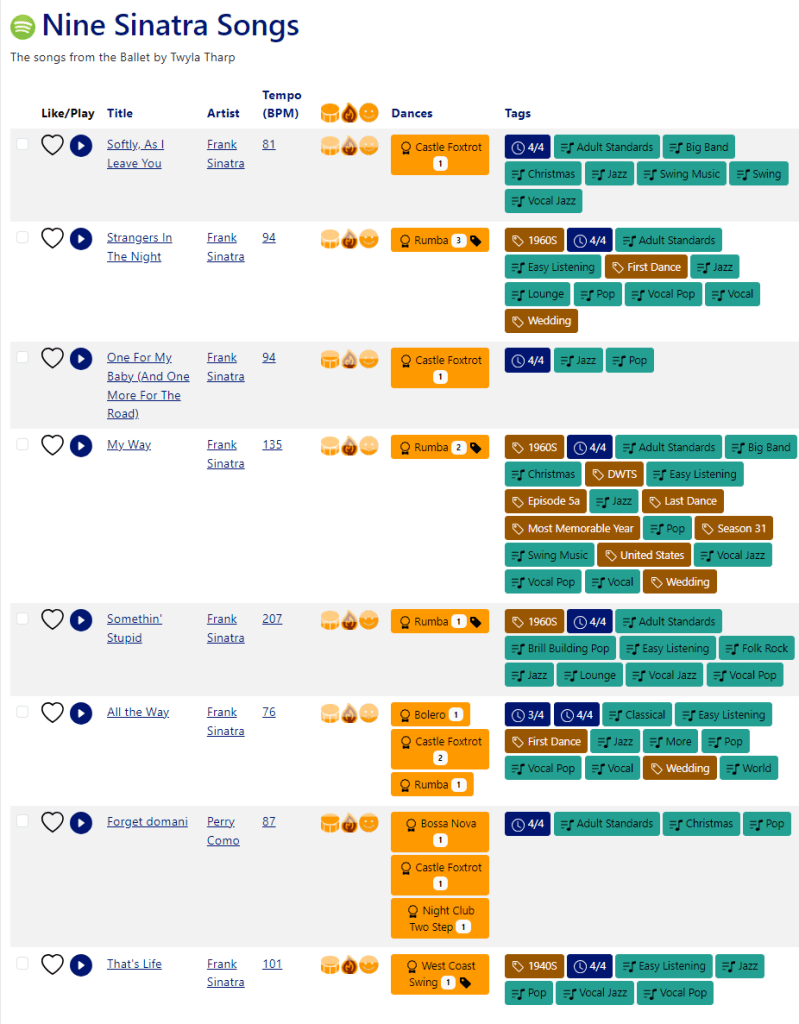
And here’s a custom music4dance playlist that includes all eight songs (although one song is the Perry Como version since the Sinatra version isn’t available on Spotify or iTunes).

A snapshot of the eight songs used in "Nine Sinatra Songs"
The eight songs used in “Nine Sinatra Songs” as shown on music4dance.

Are there other partner dances that Tharp drew from in this work that we should represent in music4dance? Are there other Ballroom-inspired ballets out there worth viewing? Do they use different music that you’d like to add to the catalog? Are there other playlists that you’d like to overlay the music4dance information on, like I did with this one? If you have ideas about this post or the site, please comment below or use other feedback mechanisms listed here. And if you enjoy the site or the blog (or both), please consider contributing in whatever way makes sense for you.

What is that dance called? Swing, East Coast Swing, Triple Swing, East Coast, or…

When I got into the business of categorizing music by dance style, I knew there would be a lot of ambiguity involved. However, some of the passion behind people’s opinions about what a dance should be called or what tempos are acceptable for the dance called X still takes me by surprise. Several times a year, I get an email from someone who is absolutely livid that I “got the tempo of West Coast Swing completely wrong” or called a dance “Lindy Hop” rather than “Swing” or some other variation on the theme.

I learn a lot from the people who send these emails, and often learn something that helps me improve the site or my general knowledge of dance. One feature I added a while back, based on some of these interactions but haven’t discussed in the blog, was the idea of having “synonyms” for dances.

The way music4dance works, I have to have an unambiguous and unique name for a dance. This leads to somewhat clunky names at times – for instance, the dance that most dances consider “Waltz,” I call “Slow Waltz” to distinguish it from “Viennese Waltz” and to allow for a catch-all category of Waltz. But I want to be able to show other names for dances so people can find the dances even if they know them by another name. This applies both to cases where the dance really is the exact same dance; it’s just named differently to disambiguate it, and in cases where the parameters for what music works are close enough that it makes sense to use the same list of music for both dances.

Cases of actual synonyms:

Cases where the dances are different, but the music is the same:

  • Castle Foxtrot = Slow Dance – I started categorizing music that was basically Slow Dance music as Castle Foxtrot, which is a legacy dance that some studios occasionally teach because Castle Foxtrot showed up in my searches as I was designing the site, and fit nicely into the tempo spectrum of Foxtrot-like dances. The practical use of this ended up being more for people looking for “Slow Dance” music in wedding contexts, so I added the Slow Dance synonym. Perhaps I should change the primary name?
  • Hustle = DiscoFox – As far as I can tell, these have evolved into different dances but are still danced to similar music. But that is based on web searching rather than personal experience, so please correct me if I’m wrong. I’m also now second-guessing myself as to whether I should add “Swing Fox,” “Disco Swing,” and “Rock Fox” as synonyms, or if one or more of these rates is its own category.

In any case, if you go to the main “Dance Style” page, you’ll see all the styles we’ve set up, along with their synonyms. As this list grows, being able to filter it is more important, so the filter control acts on both the primary name and the synonym. I also handle the synonyms when you search in the search control in the menu bar. So if you type “Slow Dance” in that search box, you’ll find a list of slow dance songs (that are actually tagged as “Castle Foxtrot”). I don’t convert the name of the tag in the results, but I could if that seems important…

I’m posting this now in part because, during my recent round of updates, I broke the showing of synonyms in the Dance Styles page and then realized I hadn’t ever asked for feedback on the feature. The only mention in this blog was the post when I added it as an afterthought to adding Single Swing to the catalog.

Are there other synonyms that I should add? Are there dances that I’ve listed as synonyms that I should break out into separate dances? If you have ideas about this post or the site, comment below or use other feedback mechanisms listed here. And if you enjoy the site or the blog (or both), please consider contributing in whatever way makes sense for you.

New Feature: More Spotify Exports

One of the more active members of the music4dance.net community filed a bug report recently, noting that he tried to create a Spotify Playlist, but it came up empty. The playlist was All West Coast Swing (with at least 3 votes) songs having tempo between 100 and 120 beats per minute including songs edited by sabrinaskandy sorted by Dance Rating from most popular to least popular. Staring on page 4. It never occurred to me that someone would want to export a playlist starting from a page other than one. There was a very good reason in this case. He was interested in trying new music, and the top songs in this search were those with which he was generally already familiar.

On a separate track, I’ve been contemplating ways to distinguish the different tiers of the premium subscription. While I want to keep the core functionality of music4dance open to everyone, and I contend that the main reason to pay for a premium subscription is to support the project, I’d like to start building a few things that are nice bonuses for people who provide more financial support.

So, I’ve fixed the bug and now allow folks with a Silver subscription to export from pages other than the first one. While I was at it, I’ve increased the number of songs you can export to a thousand for anyone with a Bronze subscription. Details are available on the subscriptions page.

While I’m here, please let me know if you want to download song and dance information to a file. I have a beta-level feature in place, but I haven’t seen enough interest in the feature to clean it up and get it fully in projection. It’s not a giant lift, so even a few people expressing interest will tip the scales.

In case you’re wondering, the bug turned out to be that I was paging by 100 rather than 25 during export, so the query in question, which only returned 101 songs, produced nothing when starting from the (4-1)*100 = 300th song.

One other nice side effect of the combination of having the total number of dance votes per song indexed and the ability to export larger playlists is that I can now produce a playlist with the Top 1000 songs, based on the total number of dance votes. I don’t know how practical that playlist is, but I find it fun.

In addition to the specific asks above, I’m always happy to hear ideas about this post or the site by commenting below or using other feedback mechanisms listed here. And if you enjoy the site or the blog (or both), please consider contributing in whatever way makes sense for you.

Ask music4dance: Why is the tempo range you list for West Coast Swing wrong?

A West Coast Swing DJ contacted me and kindly let me know that the tempo range I had listed for West Coast Swing was “entirely wrong.” The average tempos that she plays are between 90 and 110 bpm, while I listed a tempo range of 112-128 bpm. 

Before I dig further into the details, I’d like to take a moment to thank this DJ and everyone who has taken the time to point out issues with the site.  Curating a site like music4dance is a big job, and mistakes will creep in. So, having the community members speak up when they see something that seems wrong is essential to keeping the site as accurate as possible.

In this particular case, I found it surprising that the information I listed was entirely wrong.  I don’t claim to be an expert on all (or even most) of the dances I cover on the site.  But West Coast Swing is one of the dances I’m most comfortable actually dancing.  My first thought was that some kind of regional difference was going on.  But one of the DJs my interlocutor referred to plays at a venue I’ve danced at within the last decade.

My second thought was that this was a difference between the Ballroom community and the “Westie” community.  That’s a bit closer to the mark. But as mentioned, I have done some social WCS dancing in the same venues where the DJs write about playing much slower tempos than I’m used to, so it couldn’t be the whole story.

The only other thing I could think of was that dances evolve over time.  This is especially true with dances like WCS, which are danced to popular music that is also changing.  In fact, that’s one of the things that I enjoy about WCS.  As primarily a ballroom dancer, WCS is the dance that I can take out to a club and just get funky with.  So, I’m pretty sure the combination of these three things brings me to a reasonable explanation of the difference that prompted the original email.

Dances evolving over time is something that both intrigues me and confounds the part of my brain that wants to be able to neatly categorize things.  And the categorizing part of my brain is fairly dominant in building a site like music4dance.

One of the reasons that it even occurred to me that I could do this kind of categorization is that competition dances tend to “lock in” the tempo somewhat, at least for competitions where the DJs are required to play music within a specific range.  That is true of Ballroom competitions but apparently not true of West Coast Swing competitions. I’ve updated my WCS social tempo to 80-130bpm, the broadest tempo range suggested by DJ Koichi Tsunoda in his post. This is the most authoritative source I could find.  It doesn’t look like World Swing Dance Council or National Associate of Swinge Dance Events publishes requirements or recommendations for WCS tempo.

Contrary to my previous point, even Ballroom dance tempos evolve.  I discovered that the Ballroom Dance organizations (NDCA and DanceSport) updated their tempo recommendations for competition dances since the last time I looked.  But there wasn’t a lot of shift.  The most significant change was that NDCA went from a complicated matrix of tempos that included different recommendations for ProAm vs Professional/Amateur and level (Bronze, Silver, Gold) to a single tempo for each dance.  I’ve updated those tempos as well.  But there wasn’t any significant shift in direction – none of the tempo recommendations for dances were much faster or slower than previously.

I’m considering adding a “Social” style to the Americana and International styles that are dictated by the Ballroom associations.  It’s certainly true that even ballroom dances can be danced to a broader range of tempos than what is dictated by competition rules, and the site should reflect that.

All of this is to lead up to a couple of specific requests for anyone who has some expertise in these areas.

  1. Please let me know if you have an issue with any of the tempos I list on the site.  I depend on the community to help keep me up-to-date and catch any errors.  While there isn’t a “right” answer unless stated by competition rules, I’d like to do my best to land on numbers that are not “entirely wrong.”
  2. Specifically, if anyone has a good source for comfortable or social ranges of tempos for the ballroom dances, I’d like a place to start.

In addition to the above specific requests, if you have comments or suggestions or stumble upon other errors, please feel free to reply to this post or contact me here. And finally, if you enjoy the site or the blog (or both), please consider contributing in whatever way makes sense for you.

Translating how dance teachers count

Something came up the other day as I was talking to a friend who just took his first social dance class. He has a musical background and is used to hearing and counting beats as a musician. So he got a little obsessed and distracted with figuring out the translation between what he was hearing…

Do Dancers Think in Eights?

I was tickled to hear Nigel Lythgoe talk a little about choreographing tap on a recent episode of So You Think You Can Dance. The commentary is at about 1:13, but please start at about 1:10 so you can see the performance that he’s referring to.  It’s a tap piece that Emma, one of the…

Book Review: How to Read Music in 30 Days

While dancers definitely don’t need to be able to read music, it is helpful to be able to dig up sheet music for a song and understand the meter and tempo markings. This can act as a sanity check against what you hear, tap out in a tempo counter, or find by just stepping out the dance.

The catch is that the simple idea that 3/4 meter is a waltz and 4/4 is everything else only gets you so far. What is 12/8 or 2/2? Can you even dance to music that is marked in those ways and others? How to Read Music in 30 Days describes simple and compound meters and tempo markings in enough detail to get your head wrapped around these markings and translate them back to something meaningful to a dancer.

Last year, I wrote a blog post about how musicians and dancers might think of tempo differently. In that case, it was a simple matter of the written music and the musician thinking about the pulse or underlying beat as being twice the tempo as the dancer does.

In the case that prompted this post, I was asked about “Like I’m Gonna Lose You,” by Meghan Trainor featuring John Legend which is marked as 12/8 with a dotted quarter note = 72 beats per minute.

12/8 meter

This could be translated to a 3/4 meter at 72 measures per minute or 216 beats per minute. That would be a very fast Viennese Waltz, which is what 6 people have voted for. Alternatively, one could translate this to 4/4 time 72 beats per minute or 18 measures per minute, which would make a good Slow Dance, Blues Dance, or a very slow West Coast Swing, all of which have votes. See the book for how to do these translations; it’s explained better there than I can manage.

Since I can only have one tempo listed per song, I’m a little stuck on being able to get the “dancer’s tempo” correct for songs that can be danced to different interpretations of the beat. I’m starting to think about reworking music4dance so we can override the tempo on a per-dance style basis. That’s a pretty significant lift for a small number of songs. But this keeps coming up, so let me know what you think. If I get enough people asking for this, I’ll figure out how to make it work.

This is a topic that I’ve touched on quite a bit, so here are some other posts and resources that might be of interest:

As always, I’m very interested in your feedback, so please share any thoughts and ideas about this post or the site by commenting below or using other feedback mechanisms listed here. In addition, if you enjoy the site or the blog (or both), please consider contributing in whatever way that makes sense for you.


How to Read Music in 30 Days: Paperback

How to Read Music in 30 Days: Hardcover

How to Read Music in 30 Days: Spiral Bound

Note: If you found this book through this blog, please be kind and click on one of the links above to purchase it. This helps support the blog. If you’re feeling especially generous (or just like the blog a lot), clicking on the Amazon links in the blog or on the music4dance site and then doing your regular, unrelated shopping, which also helps support the site as a very small fraction of those proceeds will be directed to musci4dance.

Where did all the Collegiate Shag music go?

When I first started publishing lists of swing music on the music4dance site, I grouped all of the swing style dances together and then used tempo ranges to guess at specific dance styles.  This method works reasonably well for some of the core swing dances such as Lindy Hop, East Coast Swing, and Jive.

But a helpful Carolina Shag DJ contacted me to let me know that this method did not work at all for Carolina Shag since the dance ancestor might be swing, but the music that one typically dances to doesn’t even have a swing rhythm.  And of course, both Hustle and West Coast Swing are very much part of the swing family of dances but don’t require a swing rhythm to dance to.  So I went back and made the default searches only return songs that someone had explicitly tagged as a type of swing rather than inferring anything from general category and tempo.

Since the only exposure I had to Collegiate Shag was a reference that it was a swing style dance to music between 180-200 beats per minute when I turned off the “infer by tempo” feature,  I stopped listing any Collegiate Shag songs.  Well, that seemed wrong, so I did some digging around the web and found a few lists of Collegiate Shag songs and incorporated them into the music4dance catalog.

Do you dance or DJ Collegiate Shag?  Please, let me know if there are other songs that I should add to this list.

What are your favorite Prince songs for partner dancing?

I, like many, am mourning and listening to Prince‘s music. Over and over again.

Since I’ve been thinking a lot about music and partner dancing recently, this lead me to think about what I would dance to each song.  Especially when Leader of the Band popped up in my playlist and screamed Cha-Cha at me.  Of course a lot of his seminal work has more of a blues feel that I would associate with West Coast Swing (or possibly even more directly blues dancing).  But there are certainly some things in his catalog that one might Quickstep to (Let’s Go Crazy) or dance a Slow Foxtrot (Strollin‘) to.

Here’s a link to the list of Price songs currently in the music4dance catalog.  If you’ve got other favorites (along with what you would dance to them) let me know by responding to this post or sending feedback and I’d be happy to add them.  Or sign in and vote on what style you would dance to the songs already in the catalog.

The Prince Feature

One of the things that I noticed as I was looking for Prince music in the music4dance catalog was that I hadn’t implemented an artist page of any kind.  You could search for Prince but you would both get everything I had catalog by Prince and everything by Prince Royce songs with Prince in the title.  So I did a quick fix – if you click an artist’s name you’ll be taken to a page with a list of the first 100 songs I’ve catalog by that artist.  Since I’m only tracking artist by the full name this has a couple of implications, one of which is that Leader of the Band won’t show up under Prince since the artist is actually “Sheila E. featuring Prince and The E Family.”

You can, of course, still search for Prince and manually go through the songs to find the ones that actually involve Prince, but that’s obviously not the perfect solution.  How much does this matter to you?  Is it important to have a more specific idea of artist when you’re sorting through songs to dance to?

As always, please send me feedback or just respond to this post with any issues or ideas.