Tag Archives: AI-drafted

New Feature: Copy Link to This View, or how to share a tempo table

In my post about automatic tempo correction, I asked for help with the tempo thresholds, and I included a link that opened the tempos page with just the Meter, BPM, and Range columns showing. I promised to explain “that little trick in a future post.” This is that post, but the trick has changed since I wrote that.

In August, the only way to get a link like that was to know the parameter names and type them into the address bar, which is what I did. Now I don’t have to. The Dance Tempi page and the Tempo Counter each have a new button that copies a link to exactly what you’re looking at.

The easy way: Copy Link to This View
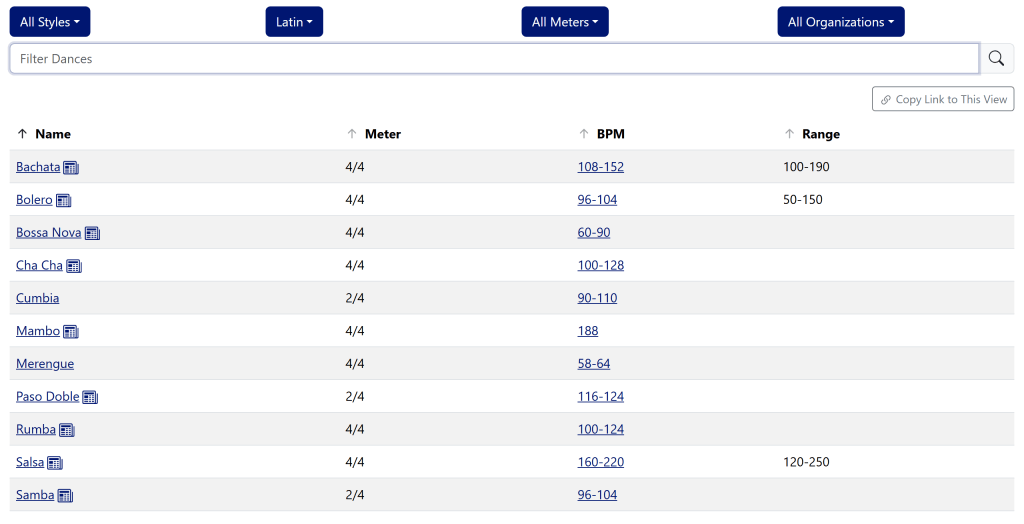
The Dance Tempi page with the Type dropdown set to Latin and the other filters at All. Below the filter box is a Copy Link to This View button, then a table of eleven Latin dances, from Bachata to Samba, with Name, Meter, BPM, and Range columns. Only Bachata, Bolero, and Salsa show a range.
The Dance Tempi page, filtered to the Latin dances with the Range column showing. The Copy Link to This View button sits just above the table.

Set up the Dance Tempi page however you like: pick styles, types, meters, and organizations from the dropdowns, and choose which columns to show. Then click Copy Link to This View, just above the table. The link goes to your clipboard, ready to paste into an email, a text, or a post on your studio’s Facebook page. Whoever opens it sees the same table you did. The image above is this link.

The address bar also updates as you change things, so bookmarking the page does the same job as copying the link. If you leave everything at the default, there’s nothing to add, and the link is just the plain page address.
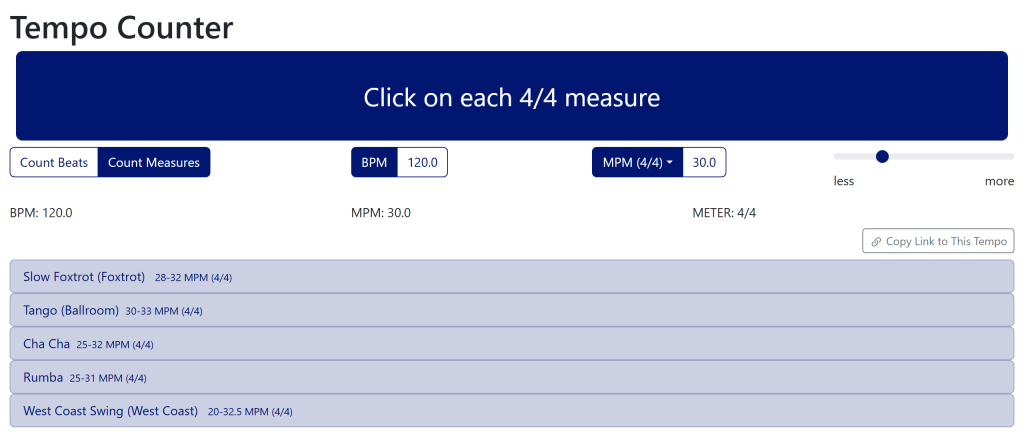
The Tempo Counter set to Count Measures, showing 120.0 BPM and 30.0 MPM in 4/4. A Copy Link to This Tempo button sits above a list of matching dances: Slow Foxtrot, Tango, Cha Cha, Rumba, and West Coast Swing, each with its range in measures per minute followed by (4/4).
The Tempo Counter at 30 measures per minute in 4/4, with the Copy Link to This Tempo button above the list of matching dances.

The Tempo Counter works the same way, with a button labeled Copy Link to This Tempo just above the list of dances. Once you’ve tapped out or typed a tempo, the link captures the tempo, the meter, whether you’re counting beats or measures, and where the strictness slider is set. That’s handy if you’ve worked out the tempo of a song and want to show a partner or a student which dances fit it. The image above is this link.

The same idea is also on the song search pages: search results and the advanced search form now have a Copy Link to This Search button.

Building a link by hand

You don’t need any of this to use the buttons. But if you’re writing a web page or a handout and want to type a link straight into it, both pages take a handful of parameters:

  • The Dance Tempi page takes styles, types, meters, organizations, and columns, which match its four filters and its column chooser.
  • The Tempo Counter takes tempo (always in beats per minute), numerator (the beats per measure), count (beats or measures), and epsilon (where the strictness slider is set).

Every parameter is optional, and anything a page doesn’t recognize is quietly skipped rather than producing an error page. The full lists of values and defaults, with examples, are in the “Building a link by hand” sections of the Dance Tempi and Tempo Counter help pages, which I rewrote for this feature.

For the record, the link from the August post was https://www.music4dance.net/Home/Tempi?columns=meter&columns=bpm&columns=validationRange. The columns parameter lists every column to show, and validationRange is the Range column, which is hidden by default.

Two fixes to the Tempo Counter

Rewriting the Tempo Counter help page meant actually trying everything it describes, and that turned up two bugs:

  • With the strictness slider all the way to the left, toward less, the list was always empty, even when your tempo was squarely inside a dance’s range. The far left now shows exactly the dances whose range includes your tempo.
  • The dances in the list had lost their meter. That matters because in 4/4 the counter also lists the 2/4 dances, and their ranges are in 2/4 measures, which run twice as fast. Without the “(2/4)” after the range, Samba at 48-52 MPM looked like a terrible match for 24 MPM in 4/4, when it’s actually spot on. The meter is back.

What it doesn’t do

This is the incremental version, so there are a couple of gaps. The Filter Dances search box on the Dance Tempi page isn’t part of the link, and neither is the column you sorted by, so a shared table always opens sorted by name. If you run into a view you can’t link to, or a link that doesn’t open what you expected, please let me know.

Step of the Month

The  “Step of the Month” for October is to help out with the Halloween catalog. There are several ways to do this: you can add the Halloween Tag to songs that don’t have it and should, you can remove the Halloween Tag from songs that do have it and shouldn’t, or you can add new Halloween songs (I will also accept lists of songs if that’s easier – in that case, please reach out for details on accepted format).


AI disclosure: I used AI to write the first draft of this post, then edited it and take responsibility for what it says. How AI is used on music4dance.

New Feature: Automatic Tempo Correction by Dance

One of the cool things about maintaining a database of songs cataloged by dance is that I can use that information to correct the most common mistake made by algorithmic tempo matching: the double-time/halftime issue. I’ve done this on an ad hoc basis for years, but now I have everything lined up so the system…

New Feature: An Artist Index, or what else has Kenny Rogers done?

In my last post, while working through the ways music4dance does and doesn’t handle artists, I wrote that I was “pretty sure I’ll implement an Artist Index of some kind in the foreseeable future.” It turns out that the foreseeable future was about ten days. The artist index is live, under Music → Artists.

Browsing

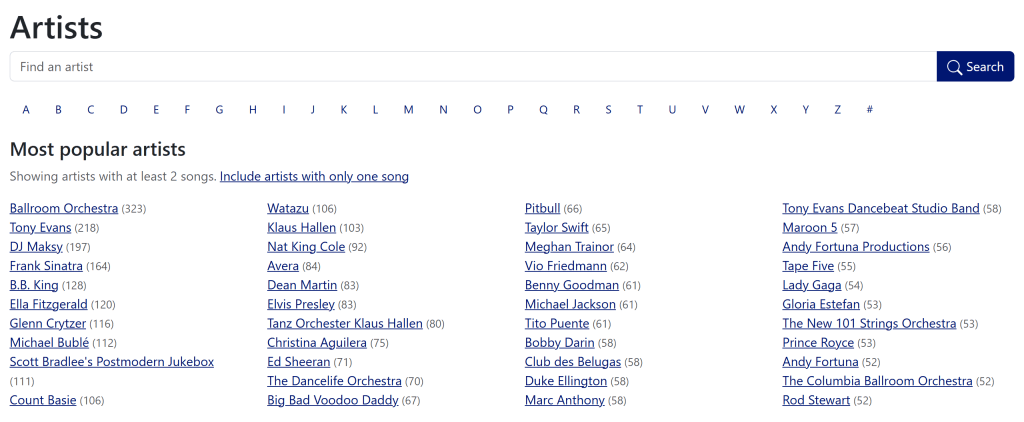
The music4dance artist index page: a search box, an A-to-Z letter navigation row, and four columns of artist names, each followed by its song count.
The artist index, opened to the artists with the most songs in the catalog.

The page starts with the hundred artists who have the most songs, which is interesting in its own right — the top of that list is as much practice/ballroom orchestras as it is the names you’d expect. From there you can type any part of a name into the search box or click a letter to browse. As of this writing, there are 15,093 artists in the index; the 5,986 of them with more than one song are the ones you see by default, and there’s a link to include the rest.

Artists rather than credits

The part of this feature that I think matters more is what happened to the artist pages themselves.

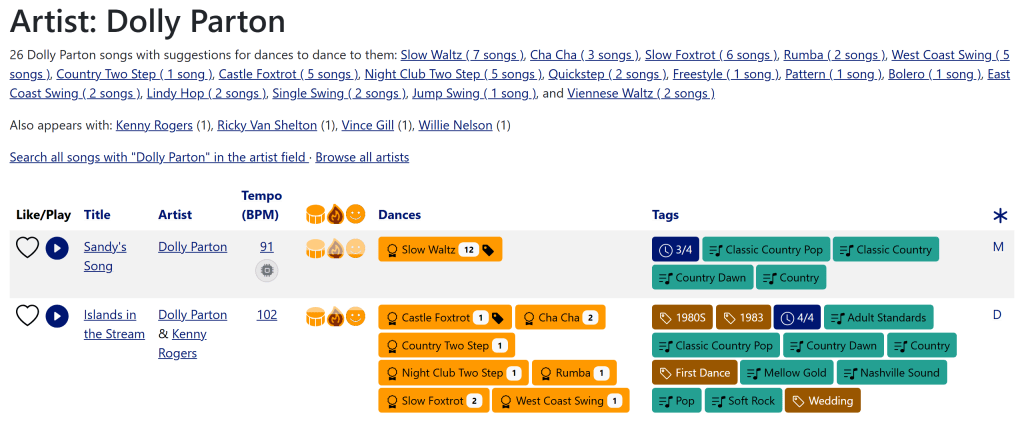
Until now, an artist page matched the whole artist field as a phrase, so the Dolly Parton page listed the songs credited to exactly “Dolly Parton” and nothing else. That’s why, in the last post, the best I could offer for “Islands in the Stream” was a link to an advanced search. Now the system reads each credit and pulls the individual artists out of it, so that song sits on Dolly Parton’s page and on Kenny Rogers’ page, and both halves of the credit are links wherever it appears.

Image of the Dolly Parton artist page

Her page picked up four songs it didn’t have before, plus an “Also appears with” line pointing at Kenny Rogers, Ricky Van Shelton, Vince Gill, and Willie Nelson. The credit itself is never rewritten — the song details page still shows exactly what the source said.

This also cleans up the case I’ve been frustrated with since 2016. The Prince pate is now 28 songs, including the ones credited to Prince & The New Power Generation, and Prince Royce is a separate entry in the index with 53 songs of his own, rather than something I have to apologize for in the middle of a search.

Where it falls short

Unsurprisingly, a free-text artist field doesn’t give up its contents easily. I only split a credit where there’s real evidence for it — a “feat.” or a slash, or a name that already carries songs of its own — because the failure I least wanted was a band name torn in half.

The bigger limit isn’t the splitting, though. When I measured our credits against a sample of Spotify’s structured ones, about 28% of the credits in the catalog turn out to involve more than one artist — but 80% of those credit strings contain no separator at all. Spotify knows a song is by two people; our copy of the credit just says the first one. No amount of cleverness gets a name out of a string it isn’t in, so this picks up roughly a fifth of the collaborations that are really out there. Closing the rest of that gap means going back to the services for better data, which is a project for another day.

A couple of smaller things: spelling variants are still separate artists, so P!nk and Pink each have a page, and the index itself rebuilds every few hours, so a brand-new song can take a little while to turn up there (the artist pages are current immediately). And the larger caveat from last time still stands — the artist field is still text, not a proper relational thing with artists as first-class objects. This is the incremental version. It just turns out the incremental version covers most of what I actually wanted.

If you’d like to help

The Artists help page has the full details, including how to correct an artist list on a song. If you land on a page with songs that don’t belong there, or find a credit that clearly should have been split and wasn’t, please let me know. And if you’d enjoy doing some of that cleanup yourself, send me your music4dance username and I’ll turn on editing for your account.

Step of the Month

The  “Step of the Month” for September is still the ask from the last post: which Dolly Parton songs are your favorites to dance to, and what style of dance? I’m particularly interested in hearing from Country Western dancers. Feel free to respond to this post, use the general feedback page, or add the songs and vote on existing songs directly. Her page is a better place to start than it was two weeks ago.


AI disclosure: I used AI to write the first draft of this post, then edited it and take responsibility for what it says. How AI is used on music4dance.

Artists

Every song in the music4dance library carries an artist credit exactly as its source song wrote it — Pitbull feat. Ne-Yo, Duke Ellington and His Orchestra, Dolly Parton & Kenny Rogers. That’s the right thing to display, but it’s an awkward thing to browse. If you wanted to know what else Kenny Rogers had recorded,…

What Are Your Favorite Dolly Parton Songs for Partner Dancing?

Like many, I’m mourning and listening to Dolly Parton’s music. I haven’t written a post related to an artist’s death since Prince left us in 2016. I’m not sure what my internal algorithm is for this, but besides Dolly being such a unifying cultural icon, there is the small detail that I noticed a significant…

What are your favorite Prince songs for partner dancing?

Update 2024: The content of the post is still generally accurate. There is a more recent post that outlines a new feature that adds yet another way to narrow down songs that have “Prince” in the artist’s name. New Feature: Improved Text Searching I, like many, am mourning and listening to Prince’s music. Over and…