Tag Archives: Tempo

music4dance Goes Country (part I)

One of the most common requests I’ve received is to support Country Western dances. That request has come in many forms, but I don’t have personal experience with Country Western dancing (well, that’s not 100% true, I learned to West Coast Swing at a Country bar in downtown Seattle that my ballroom dancer friends would hang out at after rehearsing). I’m nearly certain that in adapting music4dance to support more country music, I’ll stick my foot in something stinky and get some negative feedback. I’m all right with that – all feedback will make the site better in the long run, just please try to be gentle 🙂 I’ve also stepped on plenty of toes with Ballroom dance which I know quite a bit about, Argentine Tango, which I know a little about and some of the social dances that fall in between on my personal knowledge spectrum.

And music4dance is pretty complicated to begin with, so adding another dimension may make it harder to use. But I’m hoping that, with your help and some iteration on the idea, we can get things to work even better in the long run.

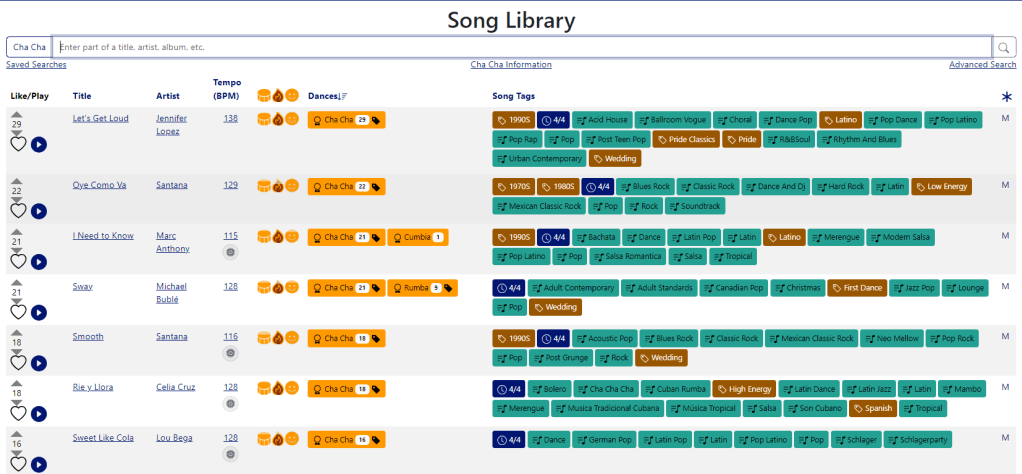
My initial approach to adding Country Western Dance support is to review the organizations that publish competition rules, including tempo information, and see if I can work those dances into the music4dance system in a way similar to how I’ve set up the competition ballroom dances. This turned out to be easier than I expected. All three organizations that I found online (United Country Western Dance Council, World Country Dance Federation, and American Country Dance Association) list eight competition dances. Triple Two, Polka, Night Club Two Step, Cha Cha, Waltz, Two Step, Swing, and West Coast Swing. Only one of those dances wasn’t already in the database (Triple Two). Polka and Country Two Step were random additions early in the site’s evolution because a couple of DJ friends and lists published by ballroom dance studios included enough songs of those styles to make it worth my while to include them.

My biggest question was, should I create new dances for all of the dances that overlapped? After all, the Cha Cha danced in Country Western competitions is certainly not the Cha Cha I learned competing in American Rhythm (heck, the cha cha that the International Latin dancers were learning in the next room wasn’t the same dance either). I decided to follow the pattern that I’ve already established for Ballroom dances with the same name, even if they are pretty different. Rumba is probably the strongest example in the ballroom catalog of two dances with the same name that are not the same dance. But the characteristics of the music that a dancer cares most about are similar – this is true even of Rumba, where the tempo is significantly different.

Not coincidentally, I recently finished a significant project that allowed me to use the core database to easily and accurately search specifically for American Rumba vs. International Rumba. While there are a few drawbacks to grouping America, International, and Country Cha Cha together, there are a lot of advantages both in terms of how the system works internally and in making it easier to find new music for everyone (I’ve always been a proponent of genre-bending in fiction and cross-over choreography in dance).

So, there is now an active “Country Western Competition Dancing” page, and all of the individual dance pages for dances that include Country styles include the competition info for those dances. I’ll continue to tweak some of this information as I get feedback and do more research.

I realized as I was writing this post that I hadn’t addressed the fact that this change also complicated the voting mechanism. I want to encourage folks to vote on a song being a good Cha Cha, but also make it easy for them to specify Country, International, or American. I made some quick tweaks, but this is definitely a feature still under development.

Please let me know what you think (even – possibly especially – if you think I got it completely wrong). I’m interested in whether there are other Country Western dances that I should include, even if they’re not part of the core competition dances. There was a reference to Country Smooth and Country Rhythm rounds in one of the organizations rules, should I be supporting that? I’ve also used the composite tempos from the rules, combining the different levels to give the broadest range. Should I just be using the most advanced category?  What else have I missed?

And as always, if you enjoy the site or the blog (or both), please consider contributing in whatever way makes sense for you.

What Happens When a Song is Danced at Different Tempos?

Sometimes, a song can be a perfectly good Bolero when heard one way but a Salsa when counting the music differently. Another example is Slow Dance (Castle Foxtrot) vs. Lindy Hop.

Generally, this phenomenon is because, with some music, it’s easy to count what the musicians see as either a half note or a quarter note as a beat. Quarter note vs. eight note is another common variation. At one point, I tried to tag dances as half-time or double-time when I saw songs with this property. But honestly, I can tie my head up in knots when I look back at this. Am I dancing double-time to the music (e.g., stepping twice as fast), or is the music half-time to my dance? And, that ‘solution’ also has the limitation that there is no way to sort or filter on tempo and include those songs correctly without doing two searches (maybe 3) and then weaving the results together ‘manually.’

And that doesn’t even take into account Waltzes, where you can get into other fun variations that I talked about in my fake waltz post.

A more robust solution to this problem is to have a separate tempo field for each dance. This would only be filled in if the dance had a positive number of votes. Then, if you search on Foxtrot and sort by tempo, the Foxtrot tempo field will be used. If you search on multiple dances or didn’t include a dance in a search and sort on tempo, I’d have to default to some master tempo field. If I went down this path, I’d have to populate the ‘dance’ tempo fields off of the master tempo fields by default and do some manual searching for the exceptions (and depend on others to update them as they see them).

What do you think? Would this be a significant improvement in how you use music4dance? Or is it a corner-enough case that you’ve never noticed and would prefer I spend my time on improvements in other areas?

Please share any thoughts and ideas about this post or the site by commenting below or using other feedback mechanisms listed here. In addition, if you enjoy the site or the blog (or both), please consider contributing in whatever way makes sense for you.

I’m a ballroom dancer. Can I find practice songs that are at competition tempo? (Revisited)

This is an update to a post I wrote in 2015Music4Dance has come a long way since then, so the answer to the title question is completely different than it was nearly a decade ago.  In fact, the top-level answer is so simple I was tempted to just put a note at the top of the old post, but I had a few other things to say, so I went this route instead.

So here it is: Go to the Ballroom page and check it out.  The page is accessible from the “Music” menu.

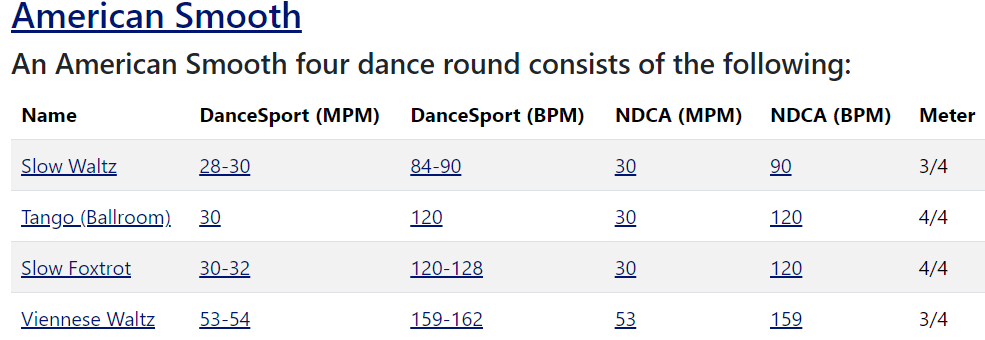
A table showing the tempi of American Smooth dances

Clicking on the round title takes you to a page with more information about that style.  For the American styles, that includes other dances that aren’t part of a round.

The Competition Ballroom page has sections for American SmoothAmerican RhythmInternational Standard, and International Latin. Each section contains basic information about the dances, including tempo in measures per minute and beats per minute1 for both of the major organizations that run Ballroom Dance Competitions.

Clicking on any tempo listings will take you to a list of songs tagged with that dance style and set to within that tempo range.  Note that I’m not currently also filtering on the American or International tag on the dance. This is for two reasons. First, the underlying database, which has a lot of excellent qualities, won’t let me do that particular search.  Second, because many of my sources don’t routinely specify the style, we’d be leaving out many great songs if we filtered that tightly.

And that’s it!


Here are some additional things that you might want to try that are adjacent to the simple answer:

If you disagree with the tempo listings and believe they’re wrong, please let me know, and if possible, cite your sources.  Tempo recommendations change occasionally, and I’m not always on top of the changes – the NDCA made some substantial changes a couple of years ago, and it took me over a year to notice.

If you want to find songs that are slower or faster than the listed tempos (e.g., if you want a slow set and a fast set), you can go through the process above and then click “change search” on the results. This will take you to the advanced search page, where you can change the tempo range without changing anything else and re-run the search.

If you have a premium subscription you can export the results of any of the above searches to Spotify.

If you would like to have this kind of support for other styles of dance, let me know where I can find reliable tempo information, and I’ll look into adding them. Some similar functionality is available on all of the dances we list, but the full tables only make sense if we have the kind of information that the ballroom dance organizations give for their competitions.

As always, I’m very interested in your feedback, so please share any thoughts and ideas about this post or the site by commenting below or using other feedback mechanisms listed here. In addition, if you enjoy the site or the blog (or both), please consider contributing in whatever way makes sense for you.


  1. Before you ask, I’m leading with “Measures Per Minute” rather than “Beats Per Minute,” as that’s how NDCA and DanceSport list tempo in their rules. If anyone in the ballroom world knows why that is, please let me know. ↩︎

Translating how dance teachers count

Something came up the other day as I was talking to a friend who just took his first social dance class. He has a musical background and is used to hearing and counting beats as a musician. So he got a little obsessed and distracted with figuring out the translation between what he was hearing in the music and what he was hearing from the dance teacher. In this casual intro to partner dancing class at the local community college, he was learning Night Club Two StepSalsa, and East Coast Swing.

We dance all of those styles to music in 4/4 time. So, as someone with musical training, my friend heard the beat as 1 - 2 - 3 - 4 - 1 - 2 - 3 - 4, etc. But that’s not how the dance teacher was counting. Let’s break these down dance by dance.

Night Club Two Step

Night Club Two Step is generally counted as Slow - Quick - Quick.  For most dances that I count this way or the slight variation Quick - Quick - Slow, the Slow is two beats, and the quicks are each a single beat. The translation is straightforward: In the first case, the quicks are on 1 and 2, and the slow is on 3. In the second, the Slow is stepped on 1, and the quicks are 3 and 4.

– or –

Each box represents a quarter note in 4/4 time.

Salsa

Salsa is even easier. If it’s counted using slows and quicks, it’s Quick - Quick - Slow. Translation: quicks on beats 1 and 2 and slow on 3, holding 4. But many salsa teachers count the phrase, which is a two-measure grouping in dance. When they do that, they generally count 1 - 2 - 3 - (pause) - 5 - 6 - 7 - (pause). That’s my preferred way since it aligns with the musical counting of the beats. Occasionally, I’ve heard a Salsa teacher count 1 - 2 - 3 - (pause) - 4 - 5 - 6 - (pause). That variation drives me up the wall. It completely breaks my musician/programmer’s brain because the second measure is counted with numbers that are off by one from what’s in my head. Fortunately, my friend wasn’t exposed to that variation. 

Each box represents a quarter note in 4/4 time.

East Coast Swing 

East Coast Swing is more complicated for a couple of reasons. 

First, it is generally counted as Tri-ple-step Tri-ple-step Rock Step. Or 1 & 2 - 3 & 4 - 5 - 6. We’re dancing a 6-count basic to 4/4 music, so each basic takes a measure and a half. This timing throws a monkey wrench into counting it like a musician. If you want to be a stickler, it would be something like 1 & 2 - 3 & 4 - 1 - 2, and then the following basic would be 3 & 4 - 1 & 2 - 3 - 4, but I’ve never even tried to do that while dancing. The second is that the triple steps are syncopated, so they don’t fall precisely on the eight notes. But this also maps directly to the music, so it shouldn’t be hard for anyone who has played a bit of Jazz to get their head wrapped around.

Each box represents an eighth note in 4/4 time

Conclusions

Every dance has its nuances. Mambo and International Rumba are counted Quick - Quick - Slow, but start on the 2, Waltzes are danced to 3/4, Samba has its own form of syncopation, etc.

Let me know if you find this kind of analysis helpful and would like this kind of analysis for other dances. I’m considering doing a version of this for each dance on the dance pages, including some prettier charts, if I get some feedback that this is useful. Also, I’d be delighted to hear about other ways you count when partner dancing.

As always, I’m very interested in your feedback, so please share any thoughts and ideas about this post or the site by commenting below or using other feedback mechanisms listed here. In addition, if you enjoy the site or the blog (or both), please consider contributing in whatever way makes sense for you.

Related Posts

Do Dancers Think in Eights?

I was tickled to hear Nigel Lythgoe talk a little about choreographing tap on a recent episode of So You Think You Can Dance. The commentary is at about 1:13, but please start at about 1:10 so you can see the performance that he’s referring to.  It’s a tap piece that Emma, one of the…

Book Review: Hear the Beat, Feel the Music

As anyone who has spent any time reading my blog or interacting with my website should know by now, I’m very passionate about music, dance and the relationship between the two.  I’m also very analytical about those subjects.  And, yes, I believe passion and analysis can co-exist, don’t you? The fatal flaw with my perspective…

We’d like to dance a “real” partner dance as the first dance at our wedding (Part I: We already chose our song)

Wedding season is upon us, and one of the things that come with weddings is receptions with first dancesfather/daughter dancesmother/son dancesmother/daughter dances, and any other variation you can think of. I think it’s extra special when those dances are recognizably partner dances like FoxtrotRumba, or Swing. Of course, I have a bit of a bias.

If you want to find a dance that fits the song you love, here are some things that can help. In my next post, I’ll cover the other direction – finding a song to fit your dance.

First, consider visiting your local dance studio and asking a professional. The other professional that could help is your wedding DJ; sometimes, they are also dance teachers or at least know a dance teacher to connect you with.

In tandem with going to a professional, some features of music4dance.net can help. The first is to try searching for your song – you can type the title into the search box in the menu bar or on the Song Library page. If it’s a particularly popular song, you might also include the artist to see if you can get to the specific version of the song. But oftentimes, variations on a song by different artists still maintain enough of the same characteristics to be danced to the same dance. So be creative in your search and see what you come up with.

For example, try typing “Fly me to the moon” into the search bar – including the quotes to get songs with that full title rather than all the songs with those keywords. And we’re probably most interested in the Frank Sinatra version, so scroll down to that or add Sinatra (outside of the quotes) to the search.

You can already see which dances folks in the music4dance community have voted on to dance to this song. There is quite a spectrum. If you click on the song title, you will get more details. Among other things that will show you that Slow Foxtrot is the most-voted dance for this song, some folks have voted for East Coast Swing and Jive but have noted that it’s slow for those dances. That’s not necessarily bad; you could speed up the song a bit (modern technology is fantastic) and get it to something still slow for ECS but not crazy slow – which might be just the right tempo for a first dance.

But what if you can’t find the song in the music4dance catalog? There is another tool that can provide some help. Try looking at the tempo counter tool (and its help page). Counting out the song’s tempo in this tool will show you which dances can technically be danced to the song. The tempo counter result doesn’t tell you anything about if the style of the song fits the dance. But this is also pretty interesting because if you’re going to go all the way and choreograph a first dance, sometimes doing something that’s a little out of a stylistic mismatch can be pretty effective. Choreographing a dance to a song that doesn’t quite fit is frequently done with showcase dances like those you see on Dancing with the Stars and can be very effective in creating a memorable wedding dance.

I hope this helped and that you really enjoy your first dance, not to mention the rest of your wedding and reception.

If you used the second method I mentioned or the help of a professional to find a song/dance combination for any of your wedding dances, please consider becoming part of the music4dance community and adding your wedding songs to the catalog.

As always, I’m very interested in your feedback, so please share any thoughts and ideas about this post or the site by commenting below or using other feedback mechanisms listed here. In addition, if you enjoy the site or the blog (or both), please consider contributing in whatever way makes sense for you.

P.S. This is a reboot of a very early blog post I wrote in 2015. Since the site has been through a couple of significant over-hauls since I wrote the first pair of wedding music posts, I think it’s worthwhile revisiting them. I may end up doing a more systematic rewrite. In that case, I’ll try to figure out a better way to index the posts to remove duplicates and/or make the fresher content pop up ahead of the old content.

Would you like more content on music4dance.net? If so, what kind?

Brad’s comment on my Single Swing post made me realize that I’ve done a bunch of research on dancing and dance music that I haven’t effectively conveyed on the site or the blog. He pointed me to a site that listed tempo values for Single Swing that I already had in my notes and used when doing some of my earlier set-up of dances. But I didn’t credit that site or put a reference to it anywhere on music4dance.

So I started down the path of sorting out my notes with the intent of adding a whole bunch of new references to source material throughout the music4dance site. Since much of my initial research is over a decade old, can you guess what I discovered? I won’t keep you in suspense. A working majority, more than 75%, of the links that I used to research music4dance were dead. Most of those were sites that completely disappeared, a few were reworked and dropped the pages I was interested in, and a very few still had the content but at a different location.

Now, that lead me down the path of how many dead links I have on the site. As a programmer, I took a few hours off my content investigation to write a link checker. I was relieved to see that of the external content links I have on the site, less than a dozen were stale. On the other hand, the total number of those links is less than a hundred, so it was still about a ten percent failure rate. (I’m excluding links to songs, I know there is a significant amazon link issue that I need to deal with at some point).

The conclusion: I’m less excited about spending a bunch of time beefing out reference sections for dances and other content. But now that I’ve got the link checker in place, I could do that in a reasonably maintainable way.

This brings me to the main point of this post. I’ve been neglecting content again while spending time keeping code updated and adding features. So, I want to ask you what you’d like to see on the site. To start the conversation off, here are a few things that I’ve heard:

  • More references to information about dances
  • More detailed descriptions of dances
  • Additional dances (Kizomba and Country dances have been the biggest asks other than Single Swing, which is what kicked this all off)
  • More information about dance tempos, where they come from, what they mean, etc.

I’m sure you have many other ideas, so please let me know. I will kick this off by asking folks to add to the comments section of this post (or, if you prefer, you can message me privately). If I get enough interest, I’ll also set up a survey.

And while you’re at it, please let me know if there are other sites relevant enough to music4dance that it would make sense to add links.

As always, if you enjoy the site or the blog (or both), please consider helping by contributing in whatever other way makes sense for you.

New Dance: Single Swing

I’ve added Single Swing as a dance style that can be searched on and voted for in the music4dance catalog. While I think of this dance as a short-cut to use when I want to dance East Coast Swing to faster Jive or Lindy-Hop music, I’ve received enough feedback from the community that it’s considered a unique dance in its own right that I am happy to add it. From some light searching on this dance, it has gone by several names in different regions and times. Some of the names I saw were “Sing-time Swing,” “Single rhythm swing,” and “East Coast Single Swing.” It’s also one of several dances that have been called the Jitterbug at some point in the twentieth century.

I set the initial tempo to 140-184 beats per minute (35-46 measures per minute), which I found listed in several places. Since, as far as I can tell, this isn’t a competition dance, I haven’t found an “official” tempo range and am happy to adjust if someone with more expertise in this particular dance would provide feedback. I also seeded this list of songs with publicly available lists that sounded reasonable. Please feel free to go through to vote up other swing songs that you think are good fits for this dance. You can do this by adding songs or by searching for Swing songs in the Single Swing tempo range and voting up the ones that sound like good Single Swings. I’m also happy to bulk upload lists if you’ve got a CSV file or Spotify playlist of single swings that you’d like me to include.

Over the past several years, I’ve been moving the site in a direction where I hope to be able to handle more different dance styles and add them more easily. I’m getting closer to being able to add dances quickly. However, to add a lot of different dances, I’ll have to replace the underlying search engine (or wait for it to add some new features – it will be interesting to see which comes first). Some of the things I’ve done are to make lists of dances somewhat flatter and allowing search by name in most places where dances are listed. I’ve loosened the tie between types of dances (e.g., Sing, Waltz, Latin) and dance style, so that dance styles don’t have to be as strictly categorized as before. I’ve also added synonyms to dance styles, so in most places where you see the name of a dance style, other names of the dance are shown in parenthesis.

In any case, I’m always interested in what you think would be most helpful. I’m sure there are plenty of dance styles I’m not cataloging that fit into the broad category of partner dances that are danced to a specific tempo range or style of music. If you have a dance style suggestion or other comments, please feel free to reply to this post or contact me here. In addition, if you enjoy the site or the blog (or both), please consider helping by adding to the Single Swing catalog or contributing in whatever other way makes sense for you.

Book Review: How to Read Music in 30 Days

While dancers definitely don’t need to be able to read music, it is helpful to be able to dig up sheet music for a song and understand the meter and tempo markings. This can act as a sanity check against what you hear, tap out in a tempo counter, or find by just stepping out the dance.

The catch is that the simple idea that 3/4 meter is a waltz and 4/4 is everything else only gets you so far. What is 12/8 or 2/2? Can you even dance to music that is marked in those ways and others? How to Read Music in 30 Days describes simple and compound meters and tempo markings in enough detail to get your head wrapped around these markings and translate them back to something meaningful to a dancer.

Last year, I wrote a blog post about how musicians and dancers might think of tempo differently. In that case, it was a simple matter of the written music and the musician thinking about the pulse or underlying beat as being twice the tempo as the dancer does.

In the case that prompted this post, I was asked about “Like I’m Gonna Lose You,” by Meghan Trainor featuring John Legend which is marked as 12/8 with a dotted quarter note = 72 beats per minute.

12/8 meter

This could be translated to a 3/4 meter at 72 measures per minute or 216 beats per minute. That would be a very fast Viennese Waltz, which is what 6 people have voted for. Alternatively, one could translate this to 4/4 time 72 beats per minute or 18 measures per minute, which would make a good Slow Dance, Blues Dance, or a very slow West Coast Swing, all of which have votes. See the book for how to do these translations; it’s explained better there than I can manage.

Since I can only have one tempo listed per song, I’m a little stuck on being able to get the “dancer’s tempo” correct for songs that can be danced to different interpretations of the beat. I’m starting to think about reworking music4dance so we can override the tempo on a per-dance style basis. That’s a pretty significant lift for a small number of songs. But this keeps coming up, so let me know what you think. If I get enough people asking for this, I’ll figure out how to make it work.

This is a topic that I’ve touched on quite a bit, so here are some other posts and resources that might be of interest:

As always, I’m very interested in your feedback, so please share any thoughts and ideas about this post or the site by commenting below or using other feedback mechanisms listed here. In addition, if you enjoy the site or the blog (or both), please consider contributing in whatever way that makes sense for you.


How to Read Music in 30 Days: Paperback

How to Read Music in 30 Days: Hardcover

How to Read Music in 30 Days: Spiral Bound

Note: If you found this book through this blog, please be kind and click on one of the links above to purchase it. This helps support the blog. If you’re feeling especially generous (or just like the blog a lot), clicking on the Amazon links in the blog or on the music4dance site and then doing your regular, unrelated shopping, which also helps support the site as a very small fraction of those proceeds will be directed to musci4dance.

New Feature: Filter by Song Length

If you’re trying to get a playlist together for a social dance, it would be nice for the songs to be a reasonable length for your audience. 

I realize that DJ tools will let you manage this in multiple ways, but sometimes it’s just easier to start with songs in the length range you’d like. There are probably other good reasons to be able to filter on the duration of a song; let me know if you think of any.

Again at Arne’s prompting, I implemented the ability to filter on song length using the advanced search page. My quick and dirty implementation is to filter on a range of seconds. This implementation will let you do things like get all the Salsa songs in the catalog between 90 and 180 seconds between 150-180 beats per minute. Or any other variations that you come up with.

I already store the duration values for songs, so this wasn’t a heavy lift. But I did take some shortcuts to get this feature out quickly. I’d prefer a slicker control to choose the length, and it would be awfully nice if when you searched or sorted on the length that the length showed up in the results. Neither of these would be particularly hard to do. Still, I’d like to hear if others are using this feature and how they’re using it before I invest more into it.

As always, I’m very interested in your feedback, so please share any thoughts and ideas you have about this post or the site by commenting below or using other feedback mechanisms listed here. In addition, if you enjoy the site or the blog (or both), please consider contributing in whatever way that makes sense for you.

Ask music4dance: Why is the tempo that you’re listing for Ricky Martin’s “Casi Un Bolero” wrong?

I’ve seen a number of questions recently about why information on the site is wrong.  So I’ll start with one of the easier ones, which I’ve seen a number of variations on but is basically, “why is the tempo wrong”.  Here’s the specific question that prompted me to write this post:

There are a lot of Ricky Martin songs where the beats/minute are twice what they should be (186 for “Casi un Bolero” ?!?!).

The quick answer is that this is wrong for a dancer – listening to this music, I would dance to it at 93 beats per minute rather than 186.  And the fact that people have voted for this song to be danced as Bolero (96-104bpm) or International Rumba (100-108bpm)  indicates that others would agree.

So why was this listed incorrectly?  Unlike other things on the music4dance site like which dance you would dance to a song, tempo at least of a particular recording of a song is not subjective.  And even amongst recordings of a song, there is generally not that much variation.  Sheet music generally has some kind of tempo marking which will tell musicians the tempo at which they should perform the music.  This can range from a general marking like Presto that indicates a range of about 168-200bpm to actual metronome markings of a precise bpm tempo.  Music Theory Academy has a great explanation of reading tempo markings if you would like to dig deeper.  But my main point is that there is generally a “right answer” to what the tempo is of a piece of music.

This is a piece of music that is intended to be played ate 120 beats per minute as indicated by the quarter note = 120 marking circled in red

But if you notice the tempo that was listed for “Casi un Bolero” (186bpm) is exactly twice the tempo that we would dance to the music (93bpm).  Take a moment to listen to it (you can listen to a snippet on the “Casi Un Bolero” page on music4dance or the whole song on Spotify.com).  There are two instruments that are defining the beat – bass guitar and drum.  If we interpret this song as 4/4 at 93bpm, the bass guitar is emphasizing the first and third beats and playing occasional more complex phrases.  But you definitely hear a consistent one/three from that instrument.  on the other hand if you listen closely to the drum, it’s playing every eighth note (or 8 times each measure).  If you take the drum as the primary beat and definite that as a quarter note rather than an eighth note, you get a tempo of 186bmp.  Which is probably not what the musicians are thinking, and certainly not what a dancer is listening for.

Why is this important?  Because while many of the tempos listed on music4dance came from dancers who would hear the tempo that they can dance to a song, many other listings are generated via machine learning algorithms.  And the machine hasn’t quite figured out how to decide between listening to the bass or listening to the drums. In fact, both algorithms that I’ve used seem to prefer the drums.  So I occasionally go though and fix things up.  But with a catalog of nearly 40,000 songs and growing I’m not always keeping on top of that task.

As I rework the site, I’m hoping to get a moderation/curation function in to make it easy for others to help out with this.  So if you’re interested in helping out in that way, please let me know.  And as always I’m happy to hear from you with any kind of question, comment or feedback.

Quick Tip:

In this post I talk about the beats per minute of Bolero and International Rumba.  You can find listings of tempos for these and other dances in different forms on the tempi tool and competition ballroom page.