
Tag Archives: Slow Foxtrot

Ask music4dance: When was this song added to the catalog?

Someone recently asked me to add a feature that shows when a song was added to the music4dance catalog. It turns out this feature already exists, but the fact that this person didn’t realize it means it isn’t as obvious as it should be. This is especially true, given that the questioner demonstrated she was a fairly sophisticated user of the site through other questions and comments in the same thread.

I have some ideas for how to expose this functionality, but I’d like your feedback before I dive in. I’d also like to get a sense of how interested you are in this information and how you’d like to use it.

What I have:

I’ll start by mapping out what I’m keeping in the database. In my internal format, I keep a record of every time a song is changed, including who made the change and (of course) what the changes are. It is too expensive to index all this information, so it is available on the song’s detail page, but only a few things can be quickly looked up for filtering and sorting the song list. These are as follows:

  1. The date that a song is originally added to the database
  2. The most recent date on which the song was modified (including by the system)
  3. The most recent date on which a song was edited by a user
  4. The most recent date that someone took the time to enter a written comment on the song

What you can do with it:

The easiest way to use this information (other than looking at the change log on the song’s details page), is to go to the New Music page. This will let you see the most recent songs based on when they were added, changed, or commented on. I find this useful as a quick check to see whether people (and bots) are successfully adding and making changes to songs. If the things at the top of the changed list are more than about a day old, it’s a good indication that I broke something. I also think this is good for users who are looking for new music to see what’s up – but now that I’m looking at that page with fresh eyes, I feel like it could benefit from filtering by dance style, like the Holiday Music and other similar pages.
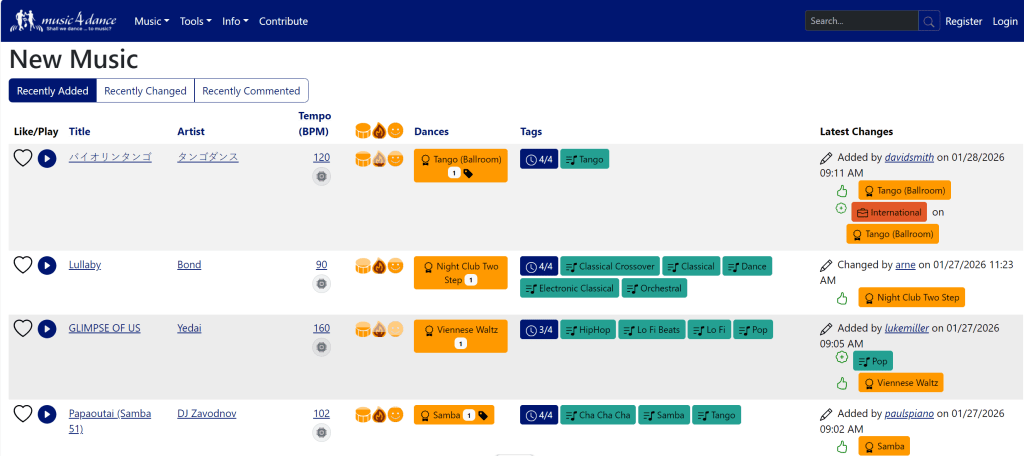
Image of the new music page

To go to the next level, you can open the Advanced Search page and search/filter a song list any way you like, including by dance style, and then sort it by “When Added”, “When Modified”, “When Edited”, or “Comments.” Modified and Edited are subtle variations on Changed, which I’m not going to dive into here, but feel free to play with those and let me know if you think I’m just adding complexity for no reason.

In general, the last column in the desktop version shows information about the date you’re sorting on. The only indication I’m giving on smaller screens is the order in which the list is presented.

Where to go from here:

Between the original question and writing this post, I have had a number of thoughts about what I would improve. But please pause for a moment before you read on, as I’d like your ideas unpolluted by my ramblings.

  • Add some indication of the sort-ordered date on mobile.
  • Make the information that is shown about songs in the search results list configurable – possibly separately for mobile and desktop (this one would be part of a larger project).
  • Add dance filtering to the New Music page. And/Or add an “advanced search” button to those pages that pre-populates the advanced search form.
  • Distinguish between Modified and Edited on the New Music page.
  • Provide the option to view the full edit history on the song details page.
  • Add the ability to filter between two dates for any of the indexed date types (e.g., I want to see all cha-chas that were added before 2015)

Publication date of a song:

When I first read the message that prompted this post, I thought I was being asked to show the date the song was published. That’s a question that I’ve been asked quite a bit, and the answer is that it’s harder than it seems. In general, people are asking for the date the song was first released as a single or on the first album it appeared on. But since the data I have access to is often a “Best Of” or “Ballroom Mix” album, and the date I can see is the album’s, not the song’s, I haven’t figured out a way to reliably get the information we want. This may be a matter of hooking up to another music database like MusicBrainz, but that’s a pretty big lift, so it’s not part of my immediate plans.

However, I have used various sources to tag songs with the decades they’re associated with; this is more of a fuzzy style idea than anything to do with the song’s release date, but that’s often what I want: 70’s Cha Cha or 50’s Slow Foxtrot.


As always, please let me know if you have any thoughts about the subject of this post or the site by commenting below or using other feedback mechanisms listed here. And if you enjoy the site or the blog (or both), please consider contributing in whatever way makes sense for you.

Song Details

The music4dance song details page contains all of the information that we have gathered about a song, including tags and dances that you have may have added. Below is a snapshot of a song details page for “(I’ve Had) The Time of My Life” as seen by a user “Charlie” while he is editing it.…

Advanced Search

The advanced search form can be found by clicking on the “Advanced Search” item in the “Music” menu or by clicking on the “Advanced Search” link on the song list page. Text Searching If you want to search specifically in certain fields, you can click the “more” button in the keywords section and get some…
What if I want to find just Cha Chas tagged as American Style?

Or one of the many variations, such as Slow Foxtrots labeled as “Traditional,” or Boleros labeled as “fast”?

Queries like the above have always been possible, but with a very major caveat. Up until now, you could search on Cha Cha dance and “American” style. But what that did was find all songs that had a net Cha Cha vote of at least one and a tag on any dance of “American” style. So if someone voted on a song as Rumba and tagged the Rumba as American, then someone else voted for the song as Cha Cha, searching on Cha Cha and American would include that song.

This behavior was particularly troublesome if you wanted to do something like search for fast Salsas, because you’d end up with songs that are fast Rumbas or Cha Chas, but slow Salsas, which is precisely what you don’t want. Side note: the workaround for that particular issue is to search on specific tempos, but that isn’t really the same as searching for songs that someone explicitly tagged as slow or fast for a particular dance, since there is more thought put into tagging (and not every song has a tempo associated with it).

I’ve done a bunch of restructuring and added more than a bit of UI to enable the kinds of searches that I’m describing here. I’m currently busy updating the documentation to catch up, but I hope that the fundamental change is relatively intuitive.

There have always been two kinds of tags: tags on songs and tags on top of a dance style for a song. I’m gravitating to calling the latter dance-specific tags, although I haven’t been 100% consistent yet. If you go to any of the dance details pages (try Slow Waltz), you’ll see two tag clouds now, labeled Dance Tags and Song Tags. Clicking on any of the tags in the Dance (specific) Tags section will give you the option to list the songs with that tag on Rumba.

Alternatively, you can navigate to the Advanced Search page, add Rumba to the list of dances, toggle the “Show Dance Details” switch, and select the option to include the American tag. In either case, you’ll end up with this result. Or we can answer the original question of All Cha Cha songs tagged as “American” style.

In any case, this is a very large new feature that includes a breaking schema change in the search index, so there are bound to be bugs. Please poke at it and let me know what you think. I’m doing my best to enable the deep scenarios that you ask for without overly complicating the core scenarios. Part of what I’m trying to do is what I alluded to in my last post, where I made a reference to making it easier to add refinements to dance searches, so that you can more accurately find all American Style Slow Foxtrots – once could theoretically do something similar with Country Cha Chas (which aren’t currently supported at all).

Please let me know if you have any thoughts about the subject of this post or the site by commenting below or using other feedback mechanisms listed here. And if you enjoy the site or the blog (or both), please consider contributing in whatever way makes sense for you.

New Feature: Searching on songs with a minimum number of dance votes

Several folks have been frustrated with the number of songs in the music4dance catalog that only have one or two votes for a particular dance style. This limitation doesn’t matter for many searches because you can sort by dance votes, and the most popular songs end up at the top. But if you want to…

New Dance: Single Swing

I’ve added Single Swing as a dance style that can be searched on and voted for in the music4dance catalog. While I think of this dance as a short-cut to use when I want to dance East Coast Swing to faster Jive or Lindy-Hop music, I’ve received enough feedback from the community that it’s considered a unique dance in its own right that…

“Search like Google” is now the default

Update (July 2024): This underlying search mechanism described in this series of posts is still in place and functions as described here, but the user interface has changed. Please see the Simple Search and Advanced Search documentation for how the current user interface works. I’ve just updated the music4dance site to make the new search engine the…

Please help us catalog new music

A Swing Band leader (Glenn Crytzer) reached out to me recently, asking if it would be possible to add his entire catalog to the music4dance.net database. He found a few of his songs already listed, but has a published catalog of well over a hundred songs, most of which should be danceable to partner dances (mostly Swing variations).

Glenn graciously provided me with a spreadsheet of his music, and I was able to upload it to music4dance. This was particularly nice because I could include his data on tempo and genre tags, as well as some other miscellaneous metadata from his comments that I turned into tags. But that led me to the next issue – his data didn’t include anything about which dance or dances would be particularly suitable for each of the songs. Which is entirely reasonable, he’s not actually dancing to them, and most of them would work for a generic swing night – the dancers can choose to dance Lindy, Balboa, East Coast, or something else to any particular song. Although that’s a vast over-simplification, if you’re interested in how a musician thinks about these things, Glenn’s article On Programming an Original Swing Music Album is an illuminating read.

That leaves me in a bit of a bind. I can certainly go through the 100+ songs myself and vote on which dances work for those songs, and I probably will. But I dance East and West Coast Swing and a bit of Lindy and Charleston – oh, and a bit of Slow Foxtrot, as Foxtrot and Swing music overlap – so I’m not familiar enough with some of the other dances to say whether a song would be suitable for Balboa, Jump Swing, Quickstep, etc. And more importantly, even with the dances I do know well, I’m only one opinion. Music4dance works much better when others in the community contribute by voting on dances that they are familiar with for songs in the catalog.

That line of reasoning led me down the path that I’ve considered several times before, of unlocking premium membership for free for members who vote on dances. I’ve thought and rejected several complex mechanisms to enable this. While some of them seem plausible, I don’t want to spend time writing code until I prove that there are enough members of the music4dance community willing to participate to make it worth my while.

Something about the interaction with Glenn and the thought that I’d love to get his songs showing up with associated dances sooner rather than later made me look at the problem a little differently. What if I went the low-tech/high-trust method of giving out premium memberships to anyone who committed to voting on a certain number of songs per month? I wouldn’t have to write any code at all for that, and if enough people take me up on it to make manual management of the “feature” cumbersome, I can always write the code later. That will also let me play with the parameters without building a whole dashboard of knobs and dials.

The Offer:

If you are familiar enough with at least one dance to confidently listen to an arbitrary song and say, “I would dance that dance to the song,” and are willing to spend some time each month doing that on the music4dance website, I’ll extend you a premium membership for each month that you do. Furthermore, I’ll take your word for it and give you the premium membership ahead of time. That will let you look at songs that no one has voted on yet (which is essential for things like the Glenn Crytzer catalog – at least until someone has voted on a song). To make this somewhat measurable on my end, let’s set the number of votes at 50 per month to keep your premium membership going. I’ll reserve the right to change the parameters at any time, including cancelling the program, since this is an experiment. But at minimum, if you contact me to try this out, you’ll get the first month of premium free, and I won’t turn that off before the end of the first month unless I detect you doing something malicious.

Why should you care about a premium account? In this case, it allows you access to more songs, including songs that no one has voted on yet and songs that I’ve pulled in from someone’s list of danceable songs but haven’t matched to a music catalog. With a premium account, ad content is turned off, and you can export results of your searches to Spotify – see details here.

Musicians (a quick aside):

Before I get into the nitty-gritty details of how to take me up on this offer, let me take a moment to reach out to other musicians who would perform music suitable for partner dancers. If you are interested in having me bulk upload your catalog to music4dance, please contact me, and I’d be happy to do that.

Here’s how to go about taking me up on my offer:

  • Create an account on music4dance.net here if you don’t have one already. (Account management help)
  • Email me at info@music4dance.net from the email you used to create your music4dance account and include “I’d like to Help Cataloging Music” in the title. Feel free to include any other details you’d like to share or questions about the offer in the email. I read everything that I get.
  • I expect to be able to upgrade your account and respond to your email within forty-eight hours (but this is an intention, not a commitment – read the notes above about this being an experiment) – if you haven’t heard from me in that timeframe, please try again.
  • Read the information about Dance Tags to understand how to vote.
  • Start voting!

This offer is for voting on dances, not for clicking the like button on songs. The latter is a feature that helps you organize your use of the music4dance catalog, but doesn’t do much for other users, so I’d like to focus on the core music-to-dance relationship of the voting mechanism for this offer.

Useful links:

What if you want to support music4dance but don’t have either the time or the experience to catalog songs by dance? There are plenty of other ways to contribute, as described on our “Contribute” page.

Nine Sinatra Songs – Ballroom inspired Ballet

Pacific Northwest Ballet included Twila Tharp’s Nine Sinatra Songs as part of their Director’s Choice performance this year. I’m not in any way qualified to review a Ballet performance, but I can say that I thoroughly enjoyed it and had a great time playing with the Ballroom-inspired aspects of the dancing as I watched the show unfold. For me, the idea that the dancing was inspired by ballroom rather than in any way attempting to choreograph actual ballroom dance steps on ballet dancers is what made it work (this is the issue I sometimes have with partner dance in Broadway musicals). It was obvious in several of the nine pieces that  Ballroom dance inspired the piece, and the upper body shaping and movements felt quite ballroomesque throughout the performance.

On returning home, I hoped to find a resource that listed the dances that Tharp drew from for each of the first eight pieces (the ninth is a reprise group number), but I failed. The notes from some of the performances mention the roots of one or two dances, but it seems like, for the most part, they name the same couple of songs. So, my guess is that even a thorough search of those through the years wouldn’t yield a complete list. As an aside, it was fun to jump down the rabbit hole of the French Apache Dance that Tharp drew from for the choreography for That’s Life. If someone has such a reference, please let me know.

In the meantime, I will take this as inspiration to play a little with the possibilities of music and dance. Sinatra is already well represented in the music4dance catalog, with 166 songs listed before I started filling out the few missing entries from the ballet. But I’ve always thought of dancing Foxtrot to Sinatra or maybe Swing. In the ballet, Tango, Rumba, and Samba were definitely represented. So, I took a few minutes to see what the music4dance community has to say about dancing to this music.

If you go to the Frank Sinatra artist page, you’ll see Slow FoxtrotLindy HopRumbaCastle FoxtrotEast Coast SwingJive, Quickstep, Peabody, West Coast Swing, Single Swing, Slow WaltzBalboaBoleroBossa NovaViennese Waltz, and Blues all represented.

And here’s a custom music4dance playlist that includes all eight songs (although one song is the Perry Como version since the Sinatra version isn’t available on Spotify or iTunes).

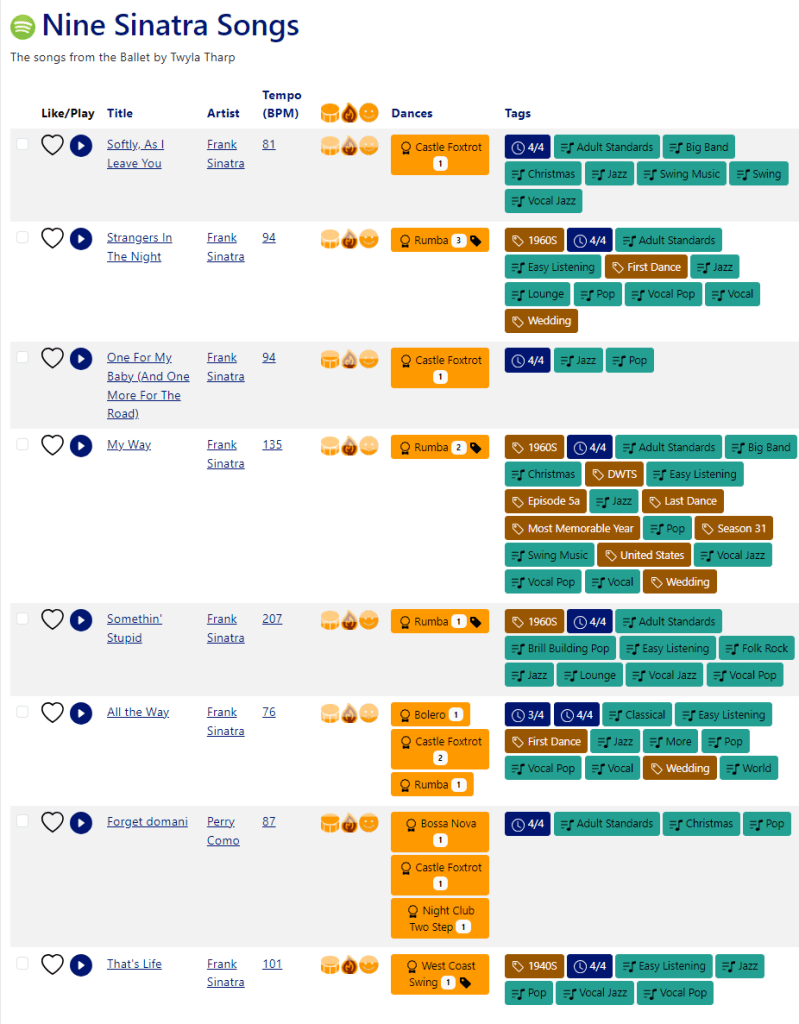
A snapshot of the eight songs used in "Nine Sinatra Songs"
The eight songs used in “Nine Sinatra Songs” as shown on music4dance.

Are there other partner dances that Tharp drew from in this work that we should represent in music4dance? Are there other Ballroom-inspired ballets out there worth viewing? Do they use different music that you’d like to add to the catalog? Are there other playlists that you’d like to overlay the music4dance information on, like I did with this one? If you have ideas about this post or the site, please comment below or use other feedback mechanisms listed here. And if you enjoy the site or the blog (or both), please consider contributing in whatever way makes sense for you.

What is that dance called? Swing, East Coast Swing, Triple Swing, East Coast, or…

When I got into the business of categorizing music by dance style, I knew there would be a lot of ambiguity involved. However, some of the passion behind people’s opinions about what a dance should be called or what tempos are acceptable for the dance called X still takes me by surprise. Several times a year, I get an email from someone who is absolutely livid that I “got the tempo of West Coast Swing completely wrong” or called a dance “Lindy Hop” rather than “Swing” or some other variation on the theme.

I learn a lot from the people who send these emails, and often learn something that helps me improve the site or my general knowledge of dance. One feature I added a while back, based on some of these interactions but haven’t discussed in the blog, was the idea of having “synonyms” for dances.

The way music4dance works, I have to have an unambiguous and unique name for a dance. This leads to somewhat clunky names at times – for instance, the dance that most dances consider “Waltz,” I call “Slow Waltz” to distinguish it from “Viennese Waltz” and to allow for a catch-all category of Waltz. But I want to be able to show other names for dances so people can find the dances even if they know them by another name. This applies both to cases where the dance really is the exact same dance; it’s just named differently to disambiguate it, and in cases where the parameters for what music works are close enough that it makes sense to use the same list of music for both dances.

Cases of actual synonyms:

Cases where the dances are different, but the music is the same:

  • Castle Foxtrot = Slow Dance – I started categorizing music that was basically Slow Dance music as Castle Foxtrot, which is a legacy dance that some studios occasionally teach because Castle Foxtrot showed up in my searches as I was designing the site, and fit nicely into the tempo spectrum of Foxtrot-like dances. The practical use of this ended up being more for people looking for “Slow Dance” music in wedding contexts, so I added the Slow Dance synonym. Perhaps I should change the primary name?
  • Hustle = DiscoFox – As far as I can tell, these have evolved into different dances but are still danced to similar music. But that is based on web searching rather than personal experience, so please correct me if I’m wrong. I’m also now second-guessing myself as to whether I should add “Swing Fox,” “Disco Swing,” and “Rock Fox” as synonyms, or if one or more of these rates is its own category.

In any case, if you go to the main “Dance Style” page, you’ll see all the styles we’ve set up, along with their synonyms. As this list grows, being able to filter it is more important, so the filter control acts on both the primary name and the synonym. I also handle the synonyms when you search in the search control in the menu bar. So if you type “Slow Dance” in that search box, you’ll find a list of slow dance songs (that are actually tagged as “Castle Foxtrot”). I don’t convert the name of the tag in the results, but I could if that seems important…

I’m posting this now in part because, during my recent round of updates, I broke the showing of synonyms in the Dance Styles page and then realized I hadn’t ever asked for feedback on the feature. The only mention in this blog was the post when I added it as an afterthought to adding Single Swing to the catalog.

Are there other synonyms that I should add? Are there dances that I’ve listed as synonyms that I should break out into separate dances? If you have ideas about this post or the site, comment below or use other feedback mechanisms listed here. And if you enjoy the site or the blog (or both), please consider contributing in whatever way makes sense for you.

Are you ready for your Halloween Dance?

Whether you’re a DJ getting your playlist together or a performer looking for that perfect song to craft a routine to, our Halloween collection is a great place to start. I’ve recently spent some time expanding the catalog. As of this writing, there are 222 songs tagged as Halloween with at least one vote for some kind of partner dance like Foxtrot, Cha-Cha, or Salsa.

Several years ago, I made an initial pass at taking generic Halloween playlists and cross-referencing them with the music4dance catalog of songs tagged by dance style. At the time, I did the simplest possible thing: I imported the songs from some Halloween catalogs and then put a link in the songs menu that went to that query. At the time, 80 songs were tagged as Halloween and associated with a dance.

This seemed fine at the time, but recently, I noticed folks searching on the keyword “Halloween.” What does that get someone beyond the songs I had explicitly imported a while ago? One of the side-effects of the system is that I link as many albums that a song has been released on as I can. This means that if a song lands on “Halloween Hits” or something like it, searching by the Halloween keyword will find it even though no one in the music4dance universe tagged it as such.

So, over the last few days, I spent some time reviewing that list and adding an explicit “Halloween” tag where I felt it was appropriate. For the most part, if the song was included on a Halloween Party album, I included it. But I didn’t include songs that were merely on an album because they were used in a horror movie. Some songs will still appear in a search for Halloween that aren’t in the explicit Halloween catalog. If you find one that would make sense to include in a Halloween dance, please tag it.

As I mentioned earlier, between the general evolution of the music4dance catalog and my current efforts, there are, as of this writing, 222 songs that are tagged as Halloween and also have at least one dance vote.

That starts to get interesting and motivated me to generalize the code I wrote a while back for Christmas/Winter holiday music to create a dedicated Halloween page. That’s where you’ll land if you choose Music -> Halloween from the main menu. And that gives an easy route to finding all the Halloween songs to dance a Single Swing to (for instance). You could have done that with the old system, but folks don’t always find the advanced search; this makes things a little easier. In addition, this gave me a smooth path to exporting the results to Spotify. Now, each Halloween Dance page has a Spotify widget with the playlist, and you can go to the music4dance Spotify account and browse the Halloween Playlists. While you’re there, please like the playlist and the music4dance account, which helps spread the word.

As always, I’m very interested in your feedback, so please share any thoughts and ideas about this post or the site by commenting below or using other feedback mechanisms listed here. In addition, if you enjoy the site or the blog (or both), please consider contributing in whatever way makes sense for you.

We’d like to dance a “real” partner dance as the first dance at our wedding (Part I: We already chose our song)

Wedding season is upon us, and one of the things that come with weddings is receptions with first dancesfather/daughter dancesmother/son dancesmother/daughter dances, and any other variation you can think of. I think it’s extra special when those dances are recognizably partner dances like FoxtrotRumba, or Swing. Of course, I have a bit of a bias.

If you want to find a dance that fits the song you love, here are some things that can help. In my next post, I’ll cover the other direction – finding a song to fit your dance.

First, consider visiting your local dance studio and asking a professional. The other professional that could help is your wedding DJ; sometimes, they are also dance teachers or at least know a dance teacher to connect you with.

In tandem with going to a professional, some features of music4dance.net can help. The first is to try searching for your song – you can type the title into the search box in the menu bar or on the Song Library page. If it’s a particularly popular song, you might also include the artist to see if you can get to the specific version of the song. But oftentimes, variations on a song by different artists still maintain enough of the same characteristics to be danced to the same dance. So be creative in your search and see what you come up with.

For example, try typing “Fly me to the moon” into the search bar – including the quotes to get songs with that full title rather than all the songs with those keywords. And we’re probably most interested in the Frank Sinatra version, so scroll down to that or add Sinatra (outside of the quotes) to the search.

You can already see which dances folks in the music4dance community have voted on to dance to this song. There is quite a spectrum. If you click on the song title, you will get more details. Among other things that will show you that Slow Foxtrot is the most-voted dance for this song, some folks have voted for East Coast Swing and Jive but have noted that it’s slow for those dances. That’s not necessarily bad; you could speed up the song a bit (modern technology is fantastic) and get it to something still slow for ECS but not crazy slow – which might be just the right tempo for a first dance.

But what if you can’t find the song in the music4dance catalog? There is another tool that can provide some help. Try looking at the tempo counter tool (and its help page). Counting out the song’s tempo in this tool will show you which dances can technically be danced to the song. The tempo counter result doesn’t tell you anything about if the style of the song fits the dance. But this is also pretty interesting because if you’re going to go all the way and choreograph a first dance, sometimes doing something that’s a little out of a stylistic mismatch can be pretty effective. Choreographing a dance to a song that doesn’t quite fit is frequently done with showcase dances like those you see on Dancing with the Stars and can be very effective in creating a memorable wedding dance.

I hope this helped and that you really enjoy your first dance, not to mention the rest of your wedding and reception.

If you used the second method I mentioned or the help of a professional to find a song/dance combination for any of your wedding dances, please consider becoming part of the music4dance community and adding your wedding songs to the catalog.

As always, I’m very interested in your feedback, so please share any thoughts and ideas about this post or the site by commenting below or using other feedback mechanisms listed here. In addition, if you enjoy the site or the blog (or both), please consider contributing in whatever way makes sense for you.

P.S. This is a reboot of a very early blog post I wrote in 2015. Since the site has been through a couple of significant over-hauls since I wrote the first pair of wedding music posts, I think it’s worthwhile revisiting them. I may end up doing a more systematic rewrite. In that case, I’ll try to figure out a better way to index the posts to remove duplicates and/or make the fresher content pop up ahead of the old content.

Ask Music4Dance: How do I find a “Pop Rock” song to dance a Slow Foxtrot to?

This is another question that I’ve seen a bunch of variations on over the years.  It’s one of the reasons that I started music4dance.  I love Big Band music and grew up playing Basie and Goodman in Jazz bands.  And my dad was a big fan of Buddy Rich.  On top of that Foxtrot and Swing co-evolved with this kind of music, so there is no problem finding plenty of music of that style to dance to.

But I’m also pretty eclectic in my musical tastes and some of the most fun I’ve had as a dancer is choreographing an exhibition dance to music that wasn’t written to be danced to – or at least not a traditional ballroom style dance.  There are obviously limits to this, but you see it all the time on shows like Dancing With the Stars and So You Think You Can Dance.

When I received a variation on this question again recently, I checked and realized that in my big rewrite of the site, I had broken the easiest way to do this kind of search.  This is now fixed,  so you can go to the info page for the dance style you’re interested in by choosing “Dances” from the Music menu. Pick the dance style you’re interested in (in this case Slow Foxtrot). Scroll down to the bottom of the page and you’ll see a tags section.  This is a tag cloud that includes all of the tags (other than dance style tags) that people have associated with songs that someone has also tagged as danceable to Slow Foxtrot.  From there you can explore all the unusual songs and musical styles that someone at some point has attempted to dance the Slow Foxtrot to.

I have to admit, going through some of these, that there are plenty that are a stretch – even with a choreographed set piece.  But still a lot of fun to think about.  If you go down this road and find things that stretch your ability to imagine dancing a particular style to and feel that they’re a mistake rather than a fun (but out there) variation, please feel free to vote them down.  Remember all of this content is crowd-sourced, so you’ve got a vote if you choose to use it.

One thing that I realized as I was writing this is that there isn’t an easy way to go the other direction.  You can use Advanced Search or the main Tag Cloud to list all of the songs associated with any tag.  But that doesn’t give you a direct list of all of the dance styles, you have to scroll through all the songs and figure that out yourself.  Let me know if that would be interesting to you and I’ll increase the priority of that feature. 

And as always I love to hear from you – so please send me feedback about the site or with questions about this post.  I may even feature your question in a future post.

Quick Tip:

If you want to be able to listen to a Spotify Playlist of all of the songs that you find in a search like the one above (or any other search on the site), you can do so by signing up for a premium subscription. I took the liberty of generating a playlist for the example above here in case you want to check it out – while you’re on Spotify, please “like” the music4dance account and any of the other playlists that you enjoy.

Create a Spotify Playlist

One of my initial goals with music4dance was to be able to create playlists to dance to.  I can finally say that I’ve got this working in a way that is close to my original vision at least for Spotify.

The idea is, for instance, that I’d like to build a playlist of Foxtrot songs that are on the faster end of the spectrum (say 132-136bpm) and further limit the list to songs that are in the pop genre.  I’ve had the system in place for a long time to generate search results for a list like this from the advanced search page

The new and exciting thing is that when you get the results of this search, there is a button at the bottom labeled “Create Spotify Playlist.” Clicking on that button will bring you to a page where you can name the playlist and choose the number of songs from the search results to include.  More help on this feature is available here.

Creating a custom playlist is a premium feature.  But you can take advantage of all of the standard playlists by checking out the music4dance profile on Spotify.

As always, I welcome feedback both on this post and the site in general.  I’d like to thank everyone who has contributed to the site in any of the many possible ways.  And if you enjoy the site please consider contributing in any way that makes sense to you.

Playing songs from the music4dance catalog

One of the coolest things about the music4dance website was the ability to use the embedded Spotify player to play the results of a search.  For instance, I could go to the site and list all the songs that are listed as Slow Foxtrot and also tagged as genre rock and order them from slow to fast like this.   Then I’d be able to play the songs in the embedded Spotify player.

Unfortunately, Spotify turned off the feature that allowed me to do this and I’ve been wracking my brain and searching the web for viable alternatives.  You can still go to the play buttons for individual songs and play a 30-second sample, most songs in the catalog have a sample available thanks to either Apple or Spotify.  This works pretty well if you’re using the site to find an idea for a song for a routine, which is pretty common.  You can also use the Amazon button to click through to the Amazon site and play a sample there.

As an aside, if you buy the song from Amazon through a link from the site a small percentage of the purchase price goes to support the music4dance site.  So, by all means, please do this whenever you find music that you want to purchase via the site.  Another interesting aspect of Amazon’s program is that if you buy something during that session, even if it wasn’t something that I directly linked to from the site, music4dance still gets a (very small) slice of that purchase.

But I still want to be able to listen to a full playlist of songs from the site.  I haven’t found a full replacement1, but I have a partial fix in place now.  I can generate a static playlist based on part of the music4dance catalog and embed players that point to the playlists.  I’ve implemented this for each of the dances pages.  So go ahead and browse through to try the embedded Spotify player for your favorite dance.

This solution also has the advantage that these playlists are available directly via Spotify.  You can go to the music4dance Spotify Account and browse the public playlists there directly.  Go ahead and follow the music4dance account or the individual playlists to make it easy for you to find them in the future.

If there are other song lists on the music4dance site that you are interested in seeing as Spotify Playlists, let me know by responding to this post or sending feedback and I’ll add them to my queue.

  1. Update 2019: I’ve filled another part of the hole created by this change by enabling the export of the songs from a search to a Spotify Playlist – see this post or the help page for more details. ↩︎